
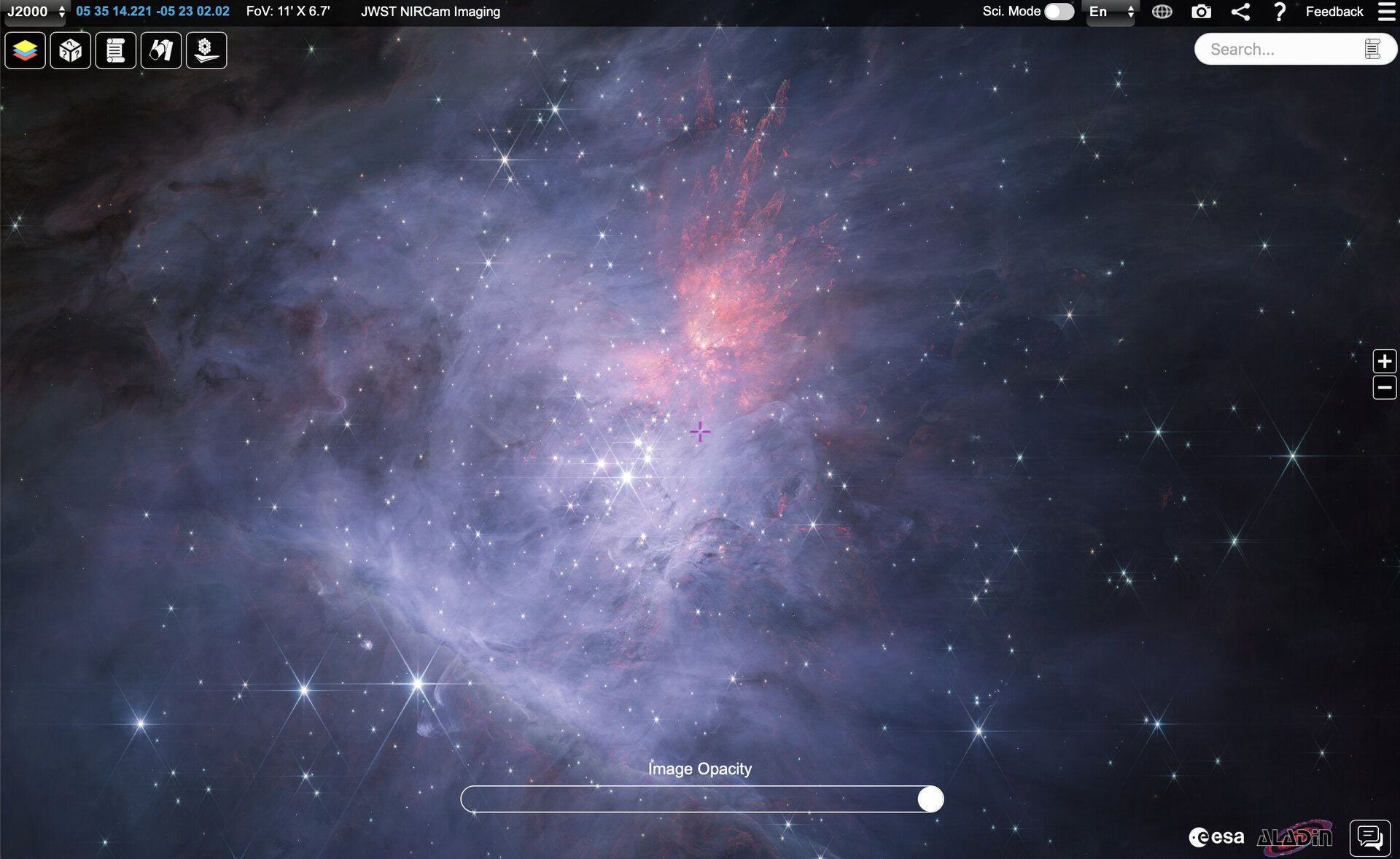
The Orion Nebula Through the Eyes of the Webb Telescope
The Orion Nebula is one of the nearest stellar nurseries to Earth—and one of the most familiar sights in the night sky. Located about 1,300 light-years away in the constellation Orion, this vast cloud of gas and dust is a place where new stars are taking shape. NASA’s James Webb Space Telescope has given astronomers an unusually detailed view of this busy region, revealing young stars, glowing gas, and planet-forming disks that are difficult to study with visible-light telescopes.
A Nearby Stellar Nursery
Also known as Messier 42, or M42, the Orion Nebula can be seen without a telescope under dark skies as a hazy patch in Orion’s sword. It is part of a larger complex of gas and dust where stars are born. Powerful radiation from hot, massive stars illuminates the nebula and shapes the surrounding material.
That radiation creates a challenging environment for young stars. It heats nearby gas, pushes material outward, and can gradually erode the dusty disks around newly formed stars. Those disks are important: they are the raw material from which planets may eventually develop.
Why Webb Makes a Difference
Webb observes infrared light, which can pass through much of the dust that obscures young stars in visible-light images. Its instruments can also detect the infrared glow of warm dust and gas. Together, these capabilities let astronomers examine structures inside the nebula that would otherwise be hidden or hard to distinguish.
Webb’s NIRCam instrument captures near-infrared light, while MIRI observes at mid-infrared wavelengths. Looking at the same region in different parts of the infrared spectrum helps researchers separate stars from dusty disks and trace changes in the nebula’s gas.
What Webb Has Revealed
Webb’s observations show the Orion Nebula in remarkable detail, including clusters of young stars, filaments of gas, and dusty disks surrounding some newborn stars. These disks, known as protoplanetary disks or “proplyds,” are potential sites of planet formation. Studying them can help scientists understand how planets begin—and how a nearby massive star might affect that process.
The images also reveal intricate structures sculpted by stellar radiation. Some areas glow as energetic light from massive stars heats the surrounding gas. Elsewhere, denser material creates dark lanes and wisps against the bright background. The result is not a static cloud but a changing environment, shaped by the ongoing birth of stars and their effects on the material around them.
A Closer Look at Star Formation
The Orion Nebula gives astronomers an opportunity to study star formation relatively close to home. Webb’s observations help researchers investigate how young stars gather material, how their disks evolve, and how radiation from massive stars influences neighboring systems.
These questions matter far beyond Orion. Stars and planetary systems form in many kinds of environments across the galaxy. By examining a nearby example in detail, astronomers can build a clearer picture of processes that may also have shaped our own solar system.
A New View of a Familiar Sky
The Webb Telescope has not changed the Orion Nebula itself, but it has transformed how clearly we can observe it. By looking through dust and detecting infrared light from young stars and their surroundings, Webb is helping scientists explore the hidden stages of stellar and planetary development.
For skywatchers, Orion remains a recognizable constellation. For astronomers, its nebula is a remarkable laboratory—one that Webb continues to examine, revealing new details about how stars and the building blocks of planets come into being.
8 Tips for Exploring the Orion Nebula Through the Webb Telescope
- Look for the Orion Nebula in the sword of Orion.
- Webb observes the nebula in infrared light.
- Infrared views reveal details hidden by dust.
- The nebula is a stellar nursery where stars form.
- Zoom in to spot young stars and glowing gas.
- Webb images show disks of material around some young stars.
- Compare Webb’s view with visible-light images to see different details.
- Remember that Webb’s colors represent infrared wavelengths translated into visible colors.
Look for the Orion Nebula in the sword of Orion.
To find the Orion Nebula, look for Orion’s three-star belt, then follow the short line of stars hanging below it—the hunter’s sword. On a clear, dark night, the nebula may appear as a faint, fuzzy patch near the middle of the sword. Binoculars can make it easier to spot, while a telescope reveals more detail. The James Webb Space Telescope’s striking images show features far beyond what the unaided eye can see.
Webb observes the nebula in infrared light.
The James Webb Space Telescope observes the Orion Nebula in infrared light, which can pass through much of the dust that blocks visible light. This lets Webb reveal young stars, glowing gas, and dusty disks that might otherwise remain hidden, giving astronomers a clearer look at how stars and potential planetary systems form.
Infrared views reveal details hidden by dust.
Webb’s infrared observations let astronomers peer through much of the dust that hides parts of the Orion Nebula in visible light. These views reveal young stars, glowing gas, and planet-forming disks that would otherwise be difficult to see, giving researchers a clearer picture of how stars and planetary systems develop.
The nebula is a stellar nursery where stars form.
The Orion Nebula is a stellar nursery—a vast cloud of gas and dust where new stars are born. As gravity pulls dense pockets of material together, they heat up and develop into young stars. Observations from the James Webb Space Telescope help astronomers peer through the nebula’s dust to study these developing stars and the environments where planets may eventually form.
Zoom in to spot young stars and glowing gas.
Zoom in on Webb’s images of the Orion Nebula to explore its intricate details: look for bright, newly formed stars and the colorful, glowing gas around them. You may also spot wispy clouds and dark patches of dust, where stars are taking shape. Each closer look reveals more of this stellar nursery’s activity.
Webb images show disks of material around some young stars.
Webb images reveal disks of gas and dust surrounding some young stars in the Orion Nebula. These protoplanetary disks contain the raw materials from which planets may form, giving astronomers a closer look at how planetary systems begin. By observing the disks in infrared light, Webb can see details that are often hidden by the nebula’s thick clouds of dust.
Compare Webb’s view with visible-light images to see different details.
Compare Webb’s infrared view of the Orion Nebula with visible-light images to discover how differently each telescope reveals this stellar nursery. Visible light highlights glowing gas and familiar structures, while Webb’s infrared observations can peer through dust to show young stars and planet-forming disks hidden within. Together, the views offer a richer picture of how stars—and potentially planets—form.
Remember that Webb’s colors represent infrared wavelengths translated into visible colors.
When viewing images of the Orion Nebula from the James Webb Space Telescope, remember that the colors are not exactly what human eyes would see. Webb detects infrared light, which is invisible to us, and scientists assign visible colors to different infrared wavelengths so we can interpret the data. The vivid hues help highlight features such as warm dust, glowing gas, and young stars—but they are a carefully translated view of the nebula, not a standard-color photograph.