
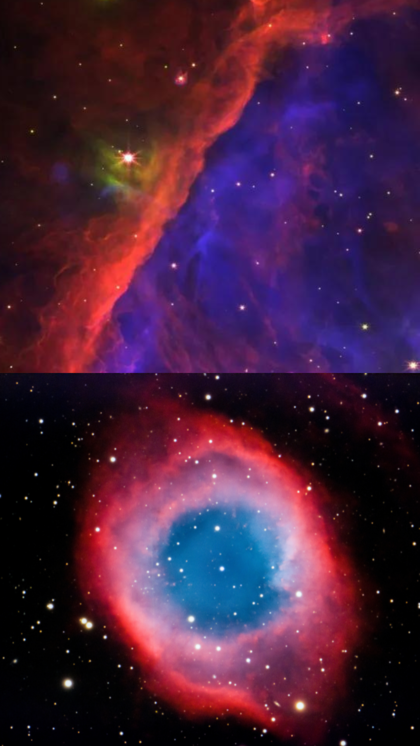
The Orion Nebula Through the Eyes of JWST
The Orion Nebula is one of the closest and best-known stellar nurseries in our region of the Milky Way. With the James Webb Space Telescope (JWST), astronomers can examine this nearby region of active star formation in striking detail, seeing young stars, dusty disks, and structures that were difficult to study before.
A Stellar Nursery Close to Home
Located about 1,300 light-years from Earth in the constellation Orion, the Orion Nebula—also known as Messier 42, or M42—is a vast cloud of gas and dust. Within it, gravity draws material together to form new stars. The nebula’s brightest central region is illuminated by the Trapezium Cluster, a group of young, massive stars whose intense radiation shapes the surrounding cloud.
Although the nebula is visible to the naked eye under dark skies, much of its activity is hidden by dust. JWST observes primarily in infrared light, which can pass through dust more effectively than visible light. This lets researchers peer into parts of the nebula where stars and planetary systems are taking shape.
What JWST Reveals
JWST’s detailed infrared observations show a complex landscape of glowing gas, dark dust lanes, and young stars at different stages of development. Its images help astronomers investigate how newborn stars interact with their surroundings. Powerful radiation and stellar winds from the Trapezium stars can heat and erode nearby clouds, while dense pockets of gas may continue collapsing to form stars.
The telescope also helps researchers study protoplanetary disks: flattened rings of gas and dust that surround some young stars. These disks are the raw material from which planets can eventually form. In the Orion Nebula, however, the strongest radiation from massive stars can strip material from nearby disks. Observing these exposed systems gives scientists clues about how a star’s environment may influence the formation of planets.
A Surprising Discovery: JuMBOs
One of the most unexpected findings reported from JWST observations of the Orion Nebula was a group of free-floating objects with masses similar to Jupiter’s. Some appeared in pairs, leading researchers to call them Jupiter-Mass Binary Objects, or JuMBOs.
The discovery raised questions about how such pairs could form and remain together without orbiting a star. Their origins are still uncertain. They may have formed in ways not yet fully understood, or they could have been ejected from their original systems. JuMBOs are not confirmed planets in the usual sense, and the discovery has prompted further study rather than a settled explanation.
Why the Orion Nebula Matters
The Orion Nebula offers astronomers a close-up laboratory for studying processes that also took place when the Sun and planets formed. By examining young stars, disks, and the effects of radiation, researchers can test ideas about how planetary systems begin—and why they develop in different ways.
JWST does more than produce beautiful images. Its observations provide scientific data that help reveal the physical conditions inside a star-forming cloud. As astronomers continue to analyze the telescope’s findings, the Orion Nebula is likely to offer new insights into the origins of stars, planets, and unusual objects such as JuMBOs.
A New View of an Old Favorite
People have observed the Orion Nebula for centuries, but JWST has opened a fresh window onto its hidden structures. The telescope’s infrared vision brings the nebula’s turbulent, crowded environment into sharper focus—and shows that even a familiar patch of sky can still hold surprising discoveries.
Orion Nebula and the James Webb Space Telescope: 5 Frequently Asked Questions
- What nebula did the James Webb Telescope discover?
- Is the Orion Nebula visible now?
- Why is the Orion Nebula so special?
- What is the scariest nebula?
- What is the Orion Nebula by Webb?
What nebula did the James Webb Telescope discover?
The James Webb Space Telescope did not discover the Orion Nebula; it has been known and observed for centuries. JWST has captured detailed infrared images of this nearby star-forming region, revealing young stars, dusty disks, and other features hidden by dust. The telescope has also studied many other known nebulae, including the Carina Nebula and the Southern Ring Nebula.
Is the Orion Nebula visible now?
As of late October, the Orion Nebula is becoming visible in the Northern Hemisphere, typically rising in the east during the late evening and appearing higher in the sky after midnight; it’s best viewed on clear, dark winter nights. You may spot it as a faint fuzzy patch below Orion’s Belt, especially with binoculars or a telescope, though visibility depends on your location, local time, weather, and light pollution. JWST’s detailed images are not visible in the sky—they’re available through published NASA and ESA imagery.
Why is the Orion Nebula so special?
The Orion Nebula is special because it is one of the closest, brightest regions where stars are actively forming, making it an ideal natural laboratory for studying how stars and planetary systems develop. JWST’s infrared vision can peer through much of the nebula’s dust to reveal young stars, planet-forming disks, and unusual objects that are difficult to observe in visible light. Its proximity and variety of activity help astronomers explore processes that may also have shaped our own solar system.
What is the scariest nebula?
There’s no officially “scariest” nebula—it depends on what you find eerie. A popular contender is the Skull Nebula, NGC 246, whose ghostly, skull-like appearance earned it its nickname. The Orion Nebula can also look dramatic in JWST images, with glowing gas and dark dust clouds, but these nebulae are distant cosmic regions, not threats to Earth.
What is the Orion Nebula by Webb?
The Orion Nebula, as seen by NASA’s James Webb Space Telescope (JWST), is a nearby star-forming region about 1,300 light-years from Earth. Webb’s infrared observations reveal young stars, glowing gas, dust, and planet-forming disks that are partly hidden in visible-light images, giving astronomers a detailed look at how stars and planetary systems develop.