
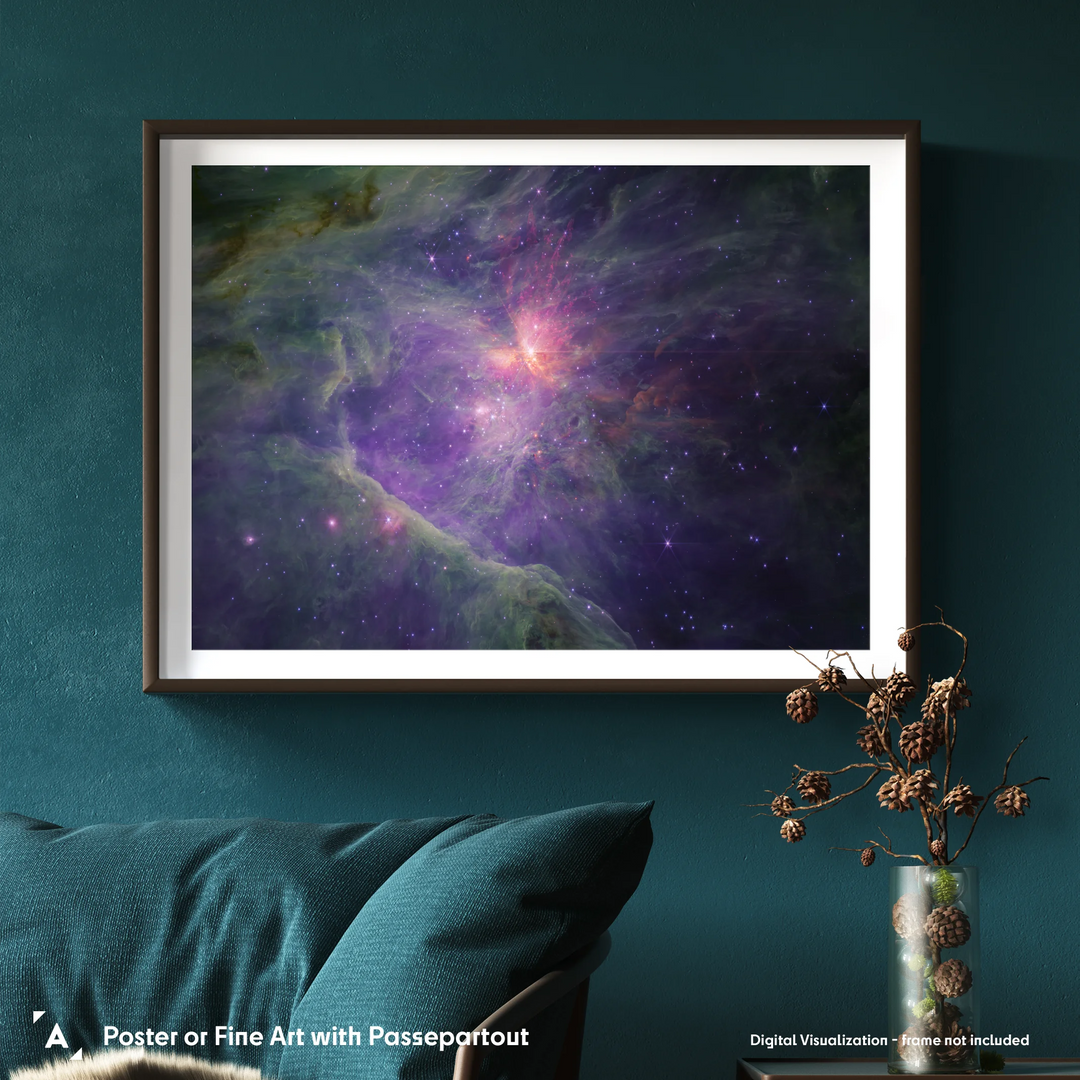
JWST’s View of the Orion Nebula
The Orion Nebula is a vast stellar nursery about 1,300 light-years from Earth. Visible in the constellation Orion, it is a region where clouds of gas and dust are giving birth to new stars. The James Webb Space Telescope (JWST) has brought this familiar celestial landmark into remarkable detail, revealing young stars, planet-forming disks, and structures hidden from many earlier observations.
A Closer Look at a Stellar Nursery
JWST observes infrared light, which can pass through some of the dust that obscures visible light. Using its Near-Infrared Camera (NIRCam), the telescope captured a detailed view of the nebula’s crowded central region. The images show bright, young stars surrounded by glowing gas, as well as dark lanes of dust and delicate features shaped by stellar winds and radiation.
One prominent feature of the Orion Nebula is the Trapezium Cluster, a group of massive, hot stars near its center. Their intense radiation illuminates the surrounding gas and influences how nearby stars and planetary systems develop. JWST’s sharp infrared vision helps astronomers study this activity while also revealing fainter objects in the cluster.
Disks Where Planets May Form
Many young stars are surrounded by disks of gas and dust. Over time, material in these disks can gather into planets, moons, and other bodies. Some disks in Orion are known as protoplanetary disks, or “proplyds.” JWST helps researchers examine their shapes and composition, and study how radiation from nearby massive stars affects the material within them.
These observations offer a useful comparison with our own Solar System’s beginnings. Orion contains a large population of young stars at different stages of development, giving astronomers a chance to investigate how common planet-forming environments may be—and how they change over time.
The Puzzling Jupiter-Mass Objects
JWST observations of Orion also drew attention for identifying objects with masses comparable to planets. Some appear to form pairs, leading researchers to describe them as Jupiter-mass binary objects, or JuMBOs. They do not appear to orbit a star in the way planets in our Solar System do.
The discovery raised new questions about how such objects form and remain paired. They may have formed like stars and later been ejected from their systems, or they may have developed through another process. Their origin is still uncertain, and the observations do not establish that they are planets formed in the same way as those around the Sun.
Why JWST’s Orion Observations Matter
Orion is close enough to study in detail but rich enough in young stars and planet-forming material to serve as a natural laboratory. JWST’s observations help scientists investigate how stars emerge from clouds, how nearby stars shape their surroundings, and what kinds of objects can form in a crowded stellar nursery.
The telescope’s images are striking, but they are also scientific data. Researchers combine them with measurements from other observatories and follow-up studies to understand what the objects are and how they formed. As that work continues, JWST’s view of Orion is helping turn a beautiful patch of sky into a deeper story about the origins of stars and planetary systems.
7 Tips for Exploring the Orion Nebula in JWST Images
- Explore JWST’s Orion Nebula images to see star-forming regions.
- Look for young stars surrounded by disks of gas and dust.
- Compare infrared views with visible-light images.
- Notice how infrared light reveals dust-hidden details.
- Study the Orion Bar, a bright edge of the nebula.
- Remember that Orion is about 1,300 light-years away.
- Use NASA’s image captions to learn what each feature shows.
Explore JWST’s Orion Nebula images to see star-forming regions.
Explore JWST’s images of the Orion Nebula to get a closer look at star-forming regions in action. Infrared observations reveal glowing clouds of gas and dust, newly forming stars, and disks of material that may eventually give rise to planets. These detailed views offer a fascinating glimpse into how stars and planetary systems begin.
Look for young stars surrounded by disks of gas and dust.
Look for young stars surrounded by disks of gas and dust—these are potential planet-forming systems. In JWST’s infrared views of the Orion Nebula, the disks stand out against glowing clouds and dense fields of stars. Studying their shapes and surroundings helps astronomers learn how planets may begin to form and how radiation from nearby massive stars can affect their development.
Compare infrared views with visible-light images.
Compare JWST’s infrared views of the Orion Nebula with visible-light images to see how different wavelengths reveal different details. Visible light highlights glowing gas and bright stars, while infrared light can pass through some of the nebula’s dust to reveal young stars, planet-forming disks, and structures hidden from view. Looking at both types of images gives a fuller picture of this stellar nursery and helps explain how dust and gas shape the region.
Notice how infrared light reveals dust-hidden details.
Notice how JWST’s infrared observations reveal details in the Orion Nebula that visible light can’t easily show. Infrared light passes through some of the thick dust, helping astronomers spot young stars, planet-forming disks, and intricate structures hidden within this stellar nursery.
Study the Orion Bar, a bright edge of the nebula.
Study the Orion Bar, the bright, narrow edge of the Orion Nebula where intense radiation from nearby young stars meets a dense cloud of gas and dust. JWST’s infrared observations can reveal how this radiation heats and reshapes the cloud, while helping astronomers trace the molecules and structures within it. Looking closely at the Orion Bar offers a valuable view of how stars influence the environments where new stars—and potentially planets—form.
Remember that Orion is about 1,300 light-years away.
Orion is about 1,300 light-years from Earth, which means its light takes roughly 1,300 years to reach us. When the James Webb Space Telescope observes the Orion Nebula, it captures light that began its journey long before modern telescopes existed, giving astronomers a glimpse of the region as it appeared centuries ago.
Use NASA’s image captions to learn what each feature shows.
Use NASA’s image captions to learn what the features in JWST’s Orion images represent. Captions can help identify young stars, glowing clouds of gas, dusty protoplanetary disks, and other structures, while explaining how astronomers interpret them. Reading the captions alongside the images makes it easier to distinguish visible details and understand what they reveal about star and planet formation.