
JWST’s View of the Carina Nebula: A Stellar Landscape in the Making
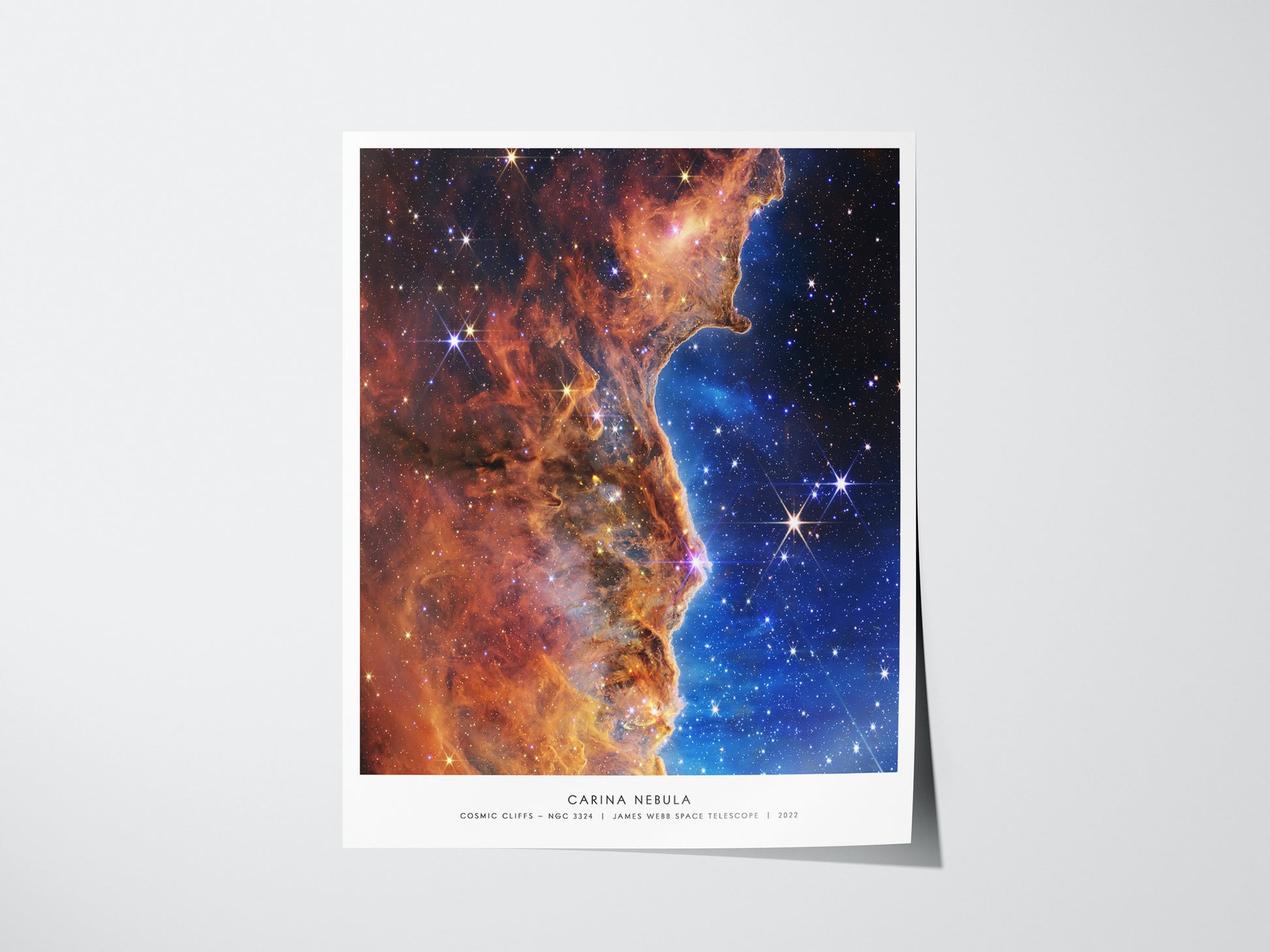
When NASA’s James Webb Space Telescope (JWST) revealed its first full-color images in July 2022, one view immediately stood out: the “Cosmic Cliffs” in the Carina Nebula. The dramatic scene resembles a mountain range beneath a starry sky. In reality, it shows the edge of a vast region where stars are being born.
Where Are the Cosmic Cliffs?
The Carina Nebula is a large cloud of gas and dust in the southern constellation Carina, about 7,600 light-years from Earth. The Cosmic Cliffs are part of a star-forming area called NGC 3324. Though the image looks like a rugged landscape, the “cliffs” are enormous clouds of gas and dust, sculpted by radiation and winds from nearby stars.
How Webb Revealed the Scene
Webb captured the image using its Near-Infrared Camera, or NIRCam. Infrared light can pass through some of the dust that blocks visible light, allowing Webb to reveal stars and details hidden from many earlier observations. The image shows a range of objects, from hot, young stars to delicate structures in the surrounding nebula.
Some of the bright points are stars in the foreground or background, while others belong to NGC 3324. Astronomers can also see signs of young stars still forming. In some cases, these stars send out jets of material that interact with the surrounding gas.
A Nebula Shaped by Stars
The Carina Nebula is both a stellar nursery and a changing environment. Powerful ultraviolet radiation and stellar winds from massive, hot stars heat and push against nearby clouds. This process can erode the gas, carving cavities and ridges over time.
At the same time, dense pockets of gas and dust can collapse under gravity and form new stars. The interaction is complex: radiation can disperse the material that stars form from, but it may also compress nearby clouds and help trigger further star formation.
Why the Image Matters
Webb’s view gives astronomers a detailed look at how young stars affect their surroundings. By studying the shapes, temperatures, and motion of gas and dust, researchers can investigate how stellar radiation changes a nebula and how stars emerge from these vast clouds.
The Cosmic Cliffs image is also a reminder that the universe is not static. The landscape is changing as stars form, shine, and reshape the material around them. What looks like a tranquil, distant mountain range is part of an energetic process unfolding across enormous distances and timescales.
With its infrared instruments, JWST continues to offer new ways to study star-forming regions like Carina. Each observation helps astronomers build a clearer picture of how stars—and the planetary systems that may surround them—begin.
Exploring the Carina Nebula: 8 Common Questions About JWST’s Stunning Images
- What is the Carina Nebula, and where is it located?
- What are the “Cosmic Cliffs” in JWST’s Carina Nebula image?
- How far away is the Carina Nebula from Earth?
- Which James Webb Space Telescope instrument captured the Cosmic Cliffs image?
- What do the colors in JWST’s Carina Nebula image represent?
- How does JWST see through the dust in the Carina Nebula?
- What do the JWST images reveal about star formation in the Carina Nebula?
- When did NASA release JWST’s first image of the Carina Nebula?
What is the Carina Nebula, and where is it located?
The Carina Nebula, also known as NGC 3372, is a vast cloud of gas and dust where new stars are forming, as well as home to many young, massive stars. It lies about 7,500 light-years from Earth in the constellation Carina, which is visible mainly from the Southern Hemisphere.
What are the “Cosmic Cliffs” in JWST’s Carina Nebula image?
The “Cosmic Cliffs” are a dramatic edge of gas and dust within the Carina Nebula’s star-forming region NGC 3324, captured by NASA’s James Webb Space Telescope. They look like towering mountains, but the apparent cliffs are vast clouds sculpted by intense radiation and stellar winds from nearby young, massive stars. Webb’s infrared vision reveals stars and fine details that are difficult to see through the dust, giving astronomers a closer look at how stars form and shape their surroundings.
How far away is the Carina Nebula from Earth?
The Carina Nebula is about 7,600 light-years from Earth, in the southern constellation Carina. That means the light captured by the James Webb Space Telescope began its journey roughly 7,600 years ago.
Which James Webb Space Telescope instrument captured the Cosmic Cliffs image?
The James Webb Space Telescope’s Near-Infrared Camera (NIRCam) captured the iconic Cosmic Cliffs image in the Carina Nebula. By observing infrared light, NIRCam can reveal stars and structures obscured by cosmic dust in visible-light images.
What do the colors in JWST’s Carina Nebula image represent?
The colors in JWST’s Carina Nebula image are assigned to different wavelengths of infrared light captured by the telescope’s filters; they are not a literal view of how the nebula would look to the human eye. In general, shorter infrared wavelengths are shown in bluer tones and longer wavelengths in redder tones. These color choices help distinguish stars, warm dust, and clouds of gas, revealing structures that are difficult or impossible to see in visible light.
How does JWST see through the dust in the Carina Nebula?
JWST can see many features hidden by dust because its instruments observe infrared light, which passes through cosmic dust more readily than visible light. Its Near-Infrared Camera (NIRCam) detects stars and structures obscured in visible-light images, while Webb’s Mid-Infrared Instrument (MIRI) can reveal cooler dust and warm regions within the Carina Nebula. Dust still blocks some light, so Webb doesn’t see through every cloud, but its infrared observations provide a much clearer view of the nebula’s star-forming regions.
What do the JWST images reveal about star formation in the Carina Nebula?
JWST’s infrared images of the Carina Nebula reveal young stars forming inside dense clouds of gas and dust, along with jets and outflows from some newborn stars. They also show how radiation and powerful winds from massive stars carve and reshape the surrounding nebula. These processes can disperse star-forming material or compress nearby clouds, helping astronomers study how stellar activity both influences and may trigger new star formation.
When did NASA release JWST’s first image of the Carina Nebula?
NASA released JWST’s first image of the Carina Nebula on July 12, 2022, as part of the telescope’s first full-color science images. The view, known as the “Cosmic Cliffs,” shows a star-forming region called NGC 3324.