
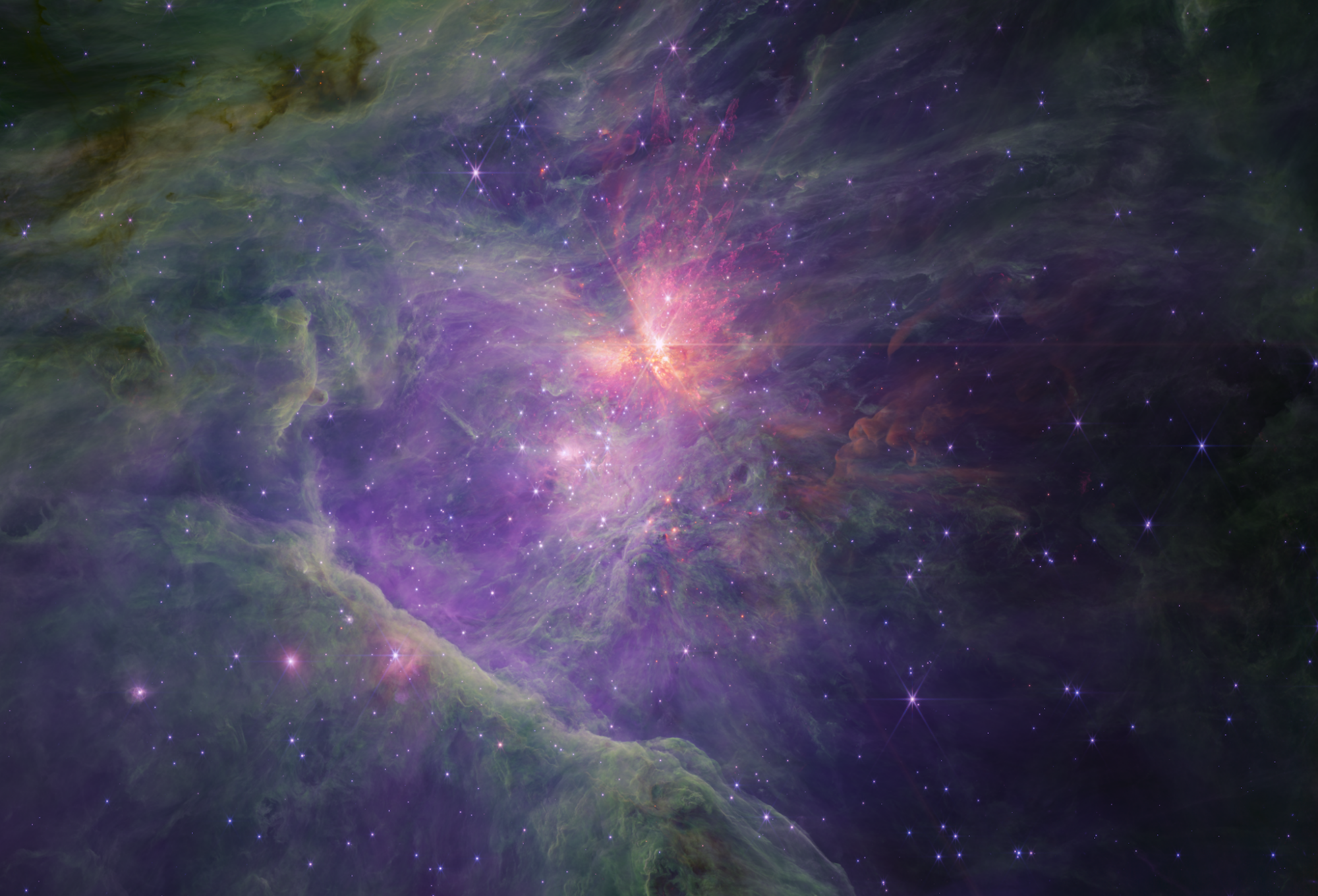
The James Webb Space Telescope’s View of Orion
The Orion Nebula is one of the closest and most active stellar nurseries to Earth. Located about 1,350 light-years away in the constellation Orion, this vast cloud of gas and dust is a place where stars are forming. The James Webb Space Telescope (JWST) has given astronomers an exceptionally detailed look inside it, revealing young stars, planet-forming disks, and structures hidden from many earlier observations.
Why Webb Observes Orion in Infrared
Visible light cannot easily pass through the dense dust in star-forming regions. Webb observes primarily in infrared light, which can travel through much of that dust and reveal objects concealed within it. Its instruments also help researchers study the temperatures and chemical composition of gas and dust, offering clues about how stars and planetary systems develop.
Webb’s Orion images show a complex landscape shaped by intense radiation and stellar winds. Bright, massive young stars illuminate nearby gas, while darker regions mark denser clouds and dusty material. The result is more than a striking portrait: it is a detailed view of the conditions in which stars are born.
Inside the Orion Nebula
At the center of the nebula is the Trapezium Cluster, a group of young, massive stars. Their strong ultraviolet radiation heats and reshapes the surrounding cloud. One especially important region is the Orion Bar, a boundary where radiation from the stars meets cooler molecular gas. Webb’s observations help scientists examine how this energetic environment affects the chemistry and structure of the cloud.
The telescope has also revealed many young stars surrounded by disks of gas and dust. These protoplanetary disks are potential sites of planet formation. By studying them, researchers can investigate how quickly disks change and how nearby massive stars influence the material from which planets may form.
Unusual Planet-Mass Objects
One surprising result from Webb’s Orion observations was the identification of dozens of paired objects with masses comparable to Jupiter’s. Researchers have called these pairs Jupiter-mass binary objects, or JuMBOs. They appear to move through the nebula without being bound to a star, and some are gravitationally paired with one another.
Their origin is still uncertain. They may have formed in ways that differ from ordinary planets or stars, or they may have been ejected from other systems. The discovery raises new questions about how low-mass objects form and how stable pairs can exist in a crowded stellar nursery. It does not, by itself, establish that these objects are planets in the usual sense.
Why the Observations Matter
Orion is a valuable natural laboratory because it is close enough for detailed study while containing a wide range of star-forming environments. Webb’s observations allow astronomers to connect what they see in the nebula—dust, gas, disks, and young stars—with the physical processes that shape emerging planetary systems.
As researchers continue analyzing Webb’s data, Orion will remain a key place to test ideas about star and planet formation. The telescope’s images are beautiful, but their deeper significance lies in the new details they provide about how cosmic neighborhoods like our own begin.
James Webb Space Telescope and the Orion Nebula: 5 Frequently Asked Questions
- What has the James Webb Space Telescope discovered in the Orion Nebula?
- What are the Jupiter-mass binary objects Webb found in Orion?
- How far away is the Orion Nebula?
- Why does the James Webb Space Telescope observe Orion in infrared light?
- What do Webb’s images of Orion reveal about how stars and planets form?
What has the James Webb Space Telescope discovered in the Orion Nebula?
The James Webb Space Telescope has revealed new details in the Orion Nebula, including young stars, planet-forming disks, and the effects of intense stellar radiation on nearby gas and dust. It also spotted unusual Jupiter-mass objects, including some that appear in pairs and are not clearly orbiting stars. These findings are helping astronomers investigate how stars and planetary systems form, though the origin and nature of the paired objects remain uncertain.
What are the Jupiter-mass binary objects Webb found in Orion?
Jupiter-mass binary objects, or JuMBOs, are pairs of free-floating objects found in the Orion Nebula by the James Webb Space Telescope. Each has a mass comparable to Jupiter’s, but the pairs do not appear to orbit a star. Their discovery surprised astronomers because it is unclear how such low-mass objects formed or how they remained gravitationally paired. Researchers are studying them to learn more about how stars and planetary systems take shape.
How far away is the Orion Nebula?
The Orion Nebula is about 1,350 light-years from Earth, though estimates can vary slightly depending on the measurement method. That means its light takes roughly 1,350 years to reach us, so telescopes like the James Webb Space Telescope show the nebula as it appeared in the distant past.
Why does the James Webb Space Telescope observe Orion in infrared light?
The James Webb Space Telescope observes Orion in infrared light because infrared wavelengths can pass through much of the thick gas and dust that blocks visible light. This lets Webb peer into the nebula’s star-forming regions and reveal young stars, planet-forming disks, and details of the surrounding clouds that would otherwise be hidden. Infrared observations also help astronomers study the temperature and chemical makeup of the material in Orion.
What do Webb’s images of Orion reveal about how stars and planets form?
Webb’s infrared images of the Orion Nebula peer through dust to reveal young stars, planet-forming disks, and the clouds of gas and dust around them. They show how radiation and winds from massive stars can heat, shape, and sometimes erode nearby material, while cooler regions provide the raw ingredients for new stars and planets. By observing these structures in detail, astronomers can better understand how stellar environments influence the formation and development of planetary systems.