
How the James Webb Space Telescope Reveals Nebulae
Nebulae are vast clouds of gas and dust where stars are born, where dying stars shed material, or where the remains of stellar explosions spread through space. The James Webb Space Telescope (JWST) is giving astronomers an extraordinary new view of these cosmic landscapes. By observing infrared light, Webb can reveal details that are difficult or impossible to see in visible-light images.
Why Webb Observes in Infrared
Many nebulae contain thick clouds of dust. Visible light can be blocked or scattered by this dust, hiding young stars and structures within. Infrared light passes through much of the dust more readily, allowing Webb to look deeper into these regions.
Webb’s instruments also detect heat from relatively cool objects and material. This helps scientists study newborn stars, disks of gas and dust that may form planets, and the complex chemistry taking place inside nebulae. The telescope’s sharp vision can distinguish fine features, such as glowing filaments, shock waves, and knots of gas.
Famous Nebulae in Webb’s View
The Carina Nebula
One of Webb’s early landmark images showed a region of the Carina Nebula known as the Cosmic Cliffs. The dramatic, mountainous appearance is created by the edge of a large cloud of gas and dust. Powerful radiation and winds from nearby stars shape the cloud, while newly forming stars emerge within it.
The Southern Ring Nebula
Webb also observed the Southern Ring Nebula, a cloud of gas released by a dying star. Its images helped reveal the structure of the expanding material and showed that the nebula’s shape is more complex than it might first appear. The observations also provided evidence that a second star is involved in shaping the surrounding gas.
The Tarantula Nebula
The Tarantula Nebula is a huge star-forming region in a neighboring galaxy called the Large Magellanic Cloud. Webb’s infrared observations show bright young stars and detailed structures in the surrounding gas. Because the region forms stars at a high rate, it offers astronomers a useful place to study processes that may have been common in the early universe.
The Pillars of Creation
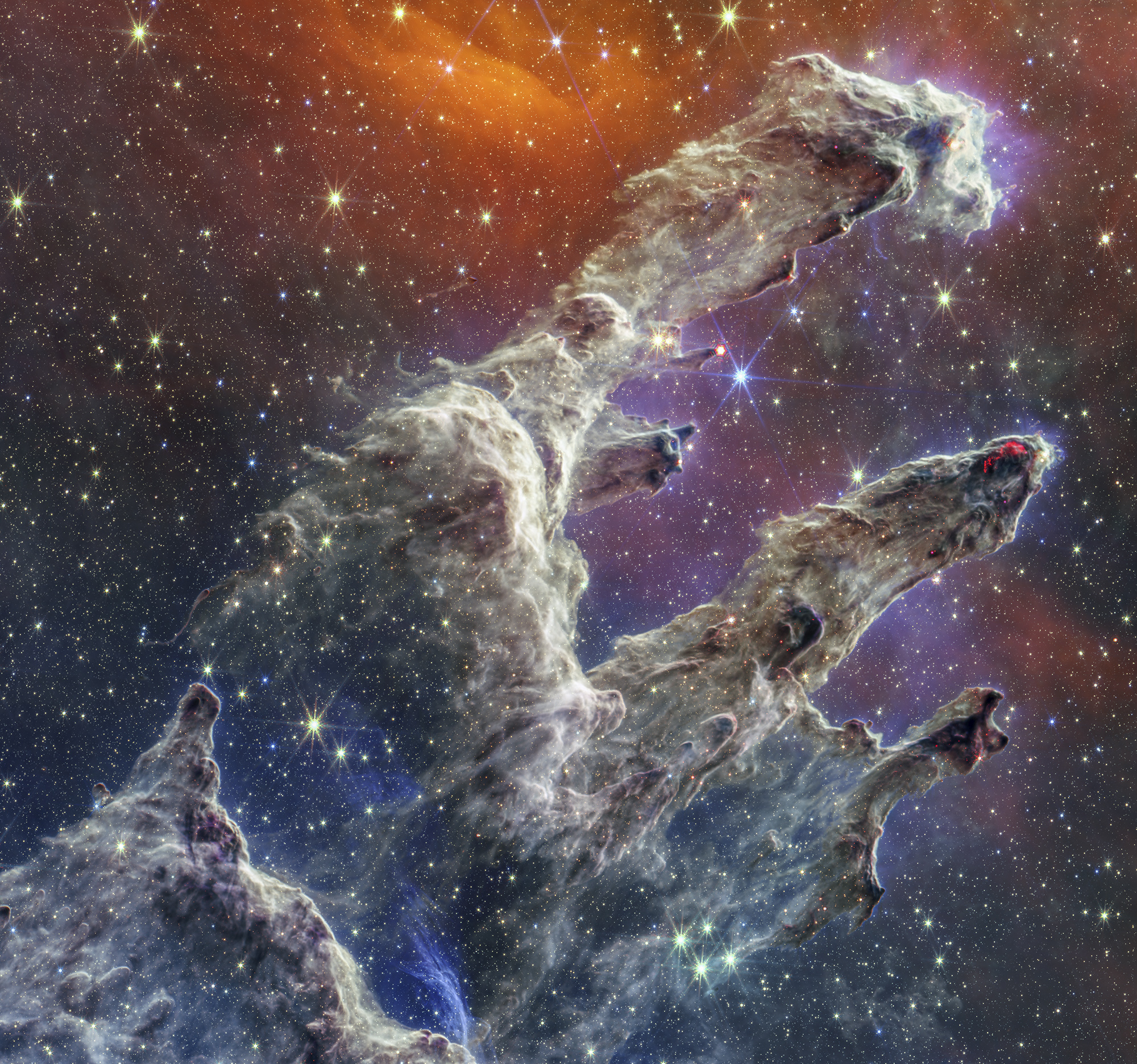
The Pillars of Creation are towering columns of gas and dust in the Eagle Nebula. Webb’s infrared images reveal stars hidden within the pillars and show how radiation from massive stars affects the surrounding material. These observations help scientists investigate how stars form and how young stars can alter the environments where other stars are developing.
What Nebula Images Can Teach Us
Webb’s nebula observations are more than striking pictures. They provide data about the temperatures, compositions, and motion of material in space. By studying how gas and dust behave around stars, astronomers can learn how stars form, how planetary systems begin, and how dying stars return elements to their surroundings.
The colors in Webb images are often assigned to represent different wavelengths of infrared light. Since infrared light is not visible to human eyes, scientists translate the observations into colors that make features easier to compare and interpret. The images are based on real measurements, even though their colors are carefully chosen for visualization.
A New View of the Cosmos
The James Webb Space Telescope is transforming the study of nebulae by revealing structures concealed behind dust and capturing details across enormous distances. Each observation offers clues about the life cycle of stars—from their beginnings inside dense clouds to the material they release when they die. Together, these views show nebulae not as static clouds, but as active, changing environments that help shape the universe.
9 Tips for Exploring Nebulae with the James Webb Telescope
- Look for glowing gas and dust in Webb’s infrared images.
- Notice how infrared light reveals stars hidden by dust.
- Compare different wavelengths to see changing details.
- Remember that nebula colors are assigned to infrared data.
- Spot newborn stars inside bright, dusty regions.
- Look for jets and outflows from young stars.
- Check the image caption for the nebula’s name and distance.
- Use Webb’s official image gallery for high-resolution views.
- Explore nebula images alongside visible-light telescope images.
Look for glowing gas and dust in Webb’s infrared images.
Look for glowing gas and dust in the James Webb Space Telescope’s infrared images. Infrared light can pass through many dusty regions that block visible light, revealing hidden stars, bright clouds, and delicate nebula structures. The colors in these images represent different wavelengths of infrared light, helping highlight features that would otherwise be difficult to see.
Notice how infrared light reveals stars hidden by dust.
Notice how the James Webb Space Telescope’s infrared images reveal stars that are hidden behind thick clouds of cosmic dust. Unlike much visible light, infrared light can pass through dust more easily, letting Webb peer into nebulae and show young stars and other details that would otherwise remain obscured.
Compare different wavelengths to see changing details.
Compare images of the same nebula taken at different wavelengths to uncover details that a single view may miss. Webb’s near-infrared observations can reveal stars and structures hidden behind dust, while mid-infrared light highlights cooler dust and glowing molecules. Looking across these wavelengths helps show how gas, dust, and stars interact—and why a nebula can appear dramatically different from one image to another.
Remember that nebula colors are assigned to infrared data.
When viewing a nebula image from the James Webb Space Telescope, remember that its colors are assigned to infrared data. Infrared light is invisible to the human eye, so scientists map different wavelengths to visible colors to highlight features such as hot gas, dust, and newborn stars. The colors help reveal real details in the data, but they don’t necessarily show what the nebula would look like to your eyes.
Spot newborn stars inside bright, dusty regions.
Look closely at the bright, dusty regions in images from the James Webb Space Telescope: some of the tiny points of light hidden among the clouds may be newborn stars. Webb observes infrared light, which can pass through much of the dust that blocks visible light, revealing young stars as they emerge from their stellar nurseries. These glimpses help astronomers study how stars begin to form.
Look for jets and outflows from young stars.
When exploring James Webb Space Telescope images of nebulae, look for narrow jets and outflows streaming from young stars. These energetic flows can appear as bright, knotted streaks or glowing arcs where material slams into surrounding gas and dust. They may point away from a young star in opposite directions, offering clues about how the star is growing and reshaping its surroundings. Infrared observations can help reveal these features even when dust hides the star that produced them.
Check the image caption for the nebula’s name and distance.
When viewing a James Webb Space Telescope nebula image, check its caption for the nebula’s name and distance from Earth. These details help you identify the region being shown and understand its place in the universe. Keep in mind that distances are often given in light-years—the distance light travels in one year—so even a beautiful, detailed image may show a nebula as it appeared long ago.
Use Webb’s official image gallery for high-resolution views.
For high-resolution views of nebulae, visit NASA and the Space Telescope Science Institute’s official James Webb Space Telescope image gallery. It features downloadable images, captions, and background information that can help you understand what you’re seeing—from glowing clouds of gas and dust to newly forming stars. Check the image details for the instrument and wavelength information, too, since many Webb images combine infrared observations and use color to make features visible.
Explore nebula images alongside visible-light telescope images.
Explore James Webb Space Telescope nebula images alongside visible-light images of the same region to see how different wavelengths reveal different details. Visible light often highlights glowing gas and the shapes of clouds, while Webb’s infrared observations can peer through dust to uncover hidden stars and structures. Comparing the views offers a richer picture of how nebulae form and change.