
James Webb Space Telescope Reveals the Carina Nebula’s Cosmic Cliffs
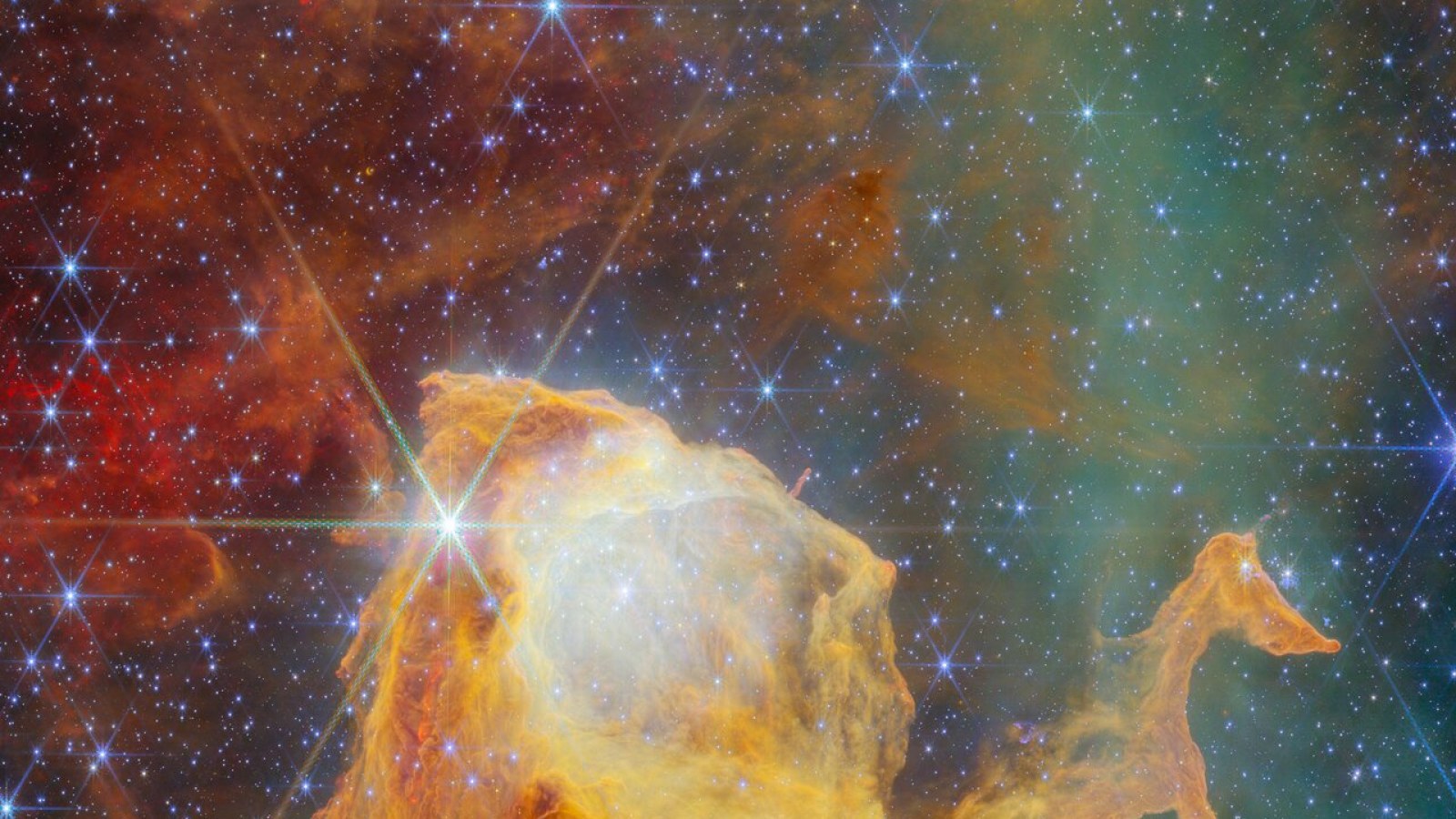
The James Webb Space Telescope has offered a striking new view of the Carina Nebula, a vast region where stars are forming. In an image released in July 2022, Webb shows a rugged, glowing landscape nicknamed the “Cosmic Cliffs.” The scene is part of NGC 3324, a star-forming region on the northern edge of the larger Carina Nebula, about 7,600 light-years from Earth.
A Landscape Shaped by Young Stars
At first glance, the image resembles a mountain range beneath a starry sky. But the apparent cliffs are enormous clouds of gas and dust. The tallest features stretch for several light-years, and the bright, hazy areas are shaped by radiation and powerful winds from nearby young, massive stars.
Those stars are not all visible in the image. Some are hidden behind thick clouds of dust, while others appear as bright points above or within the nebula. Their energy heats and erodes the surrounding material, carving cavities and sculpting the cloud’s uneven edge. At the same time, the gas and dust in the region can collapse under gravity to form new stars. The process is complex: stellar activity can disperse material, but it can also compress nearby clouds and influence where further star formation occurs.
How Webb Sees Through the Dust
The Cosmic Cliffs image was captured with Webb’s Near-Infrared Camera, or NIRCam. Unlike visible light, infrared light can pass through some of the dust that obscures star-forming regions. That allows astronomers to see structures and stars that would be difficult or impossible to observe with many visible-light telescopes.
The colors in the image are assigned to represent different infrared wavelengths, rather than appearing exactly as they would to the human eye. Bright areas trace heated gas and dust, while delicate veils and ridges reveal the nebula’s intricate structure. Webb’s sharp view also brings out many distant galaxies in the background, visible as small shapes behind the foreground clouds.
Why the Image Matters
Pictures like this are more than spectacular portraits. By studying the light from stars and surrounding material, astronomers can investigate how young stars interact with their environments. Webb’s observations help researchers examine the details of star formation, including how radiation affects the clouds from which stars are born.
The Carina Nebula is a particularly rich target because it contains both active star-forming regions and massive, energetic stars. Webb’s infrared instruments provide a way to observe these environments in greater detail and to compare features that were previously hidden by dust. The telescope does not capture every stage of star birth in a single image, but its observations give scientists valuable clues about how these stellar nurseries change over time.
A Closer Look at a Stellar Nursery
The Cosmic Cliffs image introduced many people to Webb’s ability to reveal fine structure across the universe. Its glowing ridges and shadowed cavities make the scale of the Carina Nebula easier to imagine, while its background galaxies hint at the much larger cosmos beyond it.
For astronomers, the image is also a starting point for deeper study. Each point of light, arc of gas, and patch of dust can be examined with additional observations to learn more about the stars and material within NGC 3324. Together, those details turn a beautiful picture into a window on the forces that shape stellar nurseries.
James Webb’s Carina Nebula Image: 9 Frequently Asked Questions About the Cosmic Cliffs
- What did the James Webb Space Telescope reveal in its image of the Carina Nebula?
- What are the “Cosmic Cliffs” in the Carina Nebula?
- Where is the Carina Nebula located, and how far away is it?
- Which part of the Carina Nebula did Webb photograph?
- How did Webb capture details hidden by dust in the Carina Nebula?
- Which James Webb instrument took the Cosmic Cliffs image?
- What do the colors in Webb’s Carina Nebula image represent?
- How do massive young stars shape the Carina Nebula?
- What can astronomers learn about star formation from Webb’s observations of the Carina Nebula?
What did the James Webb Space Telescope reveal in its image of the Carina Nebula?
The James Webb Space Telescope’s image of the Carina Nebula revealed dramatic “Cosmic Cliffs”—towering clouds of gas and dust in the star-forming region NGC 3324. Captured in infrared light, the view shows details hidden by dust in visible-light images, including young stars, glowing gas, and structures shaped by intense radiation and stellar winds. It gives astronomers a closer look at how massive stars interact with their surroundings and how stars form within these stellar nurseries.
What are the “Cosmic Cliffs” in the Carina Nebula?
The “Cosmic Cliffs” are a dramatic region of the Carina Nebula captured by the James Webb Space Telescope. They’re not solid mountains, but towering clouds of gas and dust in the star-forming region NGC 3324, about 7,600 light-years from Earth. Radiation and powerful winds from nearby young, massive stars sculpt the clouds, while pockets of gas and dust may collapse to form new stars. Webb’s infrared vision reveals details in this stellar nursery that are hidden behind dust in visible-light images.
Where is the Carina Nebula located, and how far away is it?
The Carina Nebula is located in the constellation Carina in the southern sky. It lies about 7,600 light-years from Earth, making it one of the Milky Way’s prominent star-forming regions. The James Webb Space Telescope’s famous “Cosmic Cliffs” image shows part of NGC 3324, a star-forming area on the nebula’s northern edge.
Which part of the Carina Nebula did Webb photograph?
Webb photographed NGC 3324, a star-forming region on the northern edge of the Carina Nebula. Its famous “Cosmic Cliffs” view shows the sculpted boundary of a vast cloud of gas and dust, shaped by radiation and stellar winds from nearby young, massive stars.
How did Webb capture details hidden by dust in the Carina Nebula?
Webb captured details hidden by dust in the Carina Nebula by observing infrared light, which can pass through much of the dust that blocks visible light. Its Near-Infrared Camera (NIRCam) recorded this light with exceptional sensitivity and sharpness, revealing young stars, glowing gas, and intricate structures within the region. The resulting images let astronomers study parts of this stellar nursery that would otherwise remain obscured.
Which James Webb instrument took the Cosmic Cliffs image?
The James Webb Space Telescope captured the Cosmic Cliffs image using its Near-Infrared Camera, or NIRCam. This instrument detects infrared light, allowing it to reveal stars and intricate details within the dusty star-forming region that are difficult to see in visible light.
What do the colors in Webb’s Carina Nebula image represent?
The colors in Webb’s Carina Nebula image are assigned to infrared wavelengths captured by the telescope’s instruments, so they don’t show how the scene would look to the human eye. Astronomers map those wavelengths to visible colors to make different features easier to distinguish, revealing details such as stars, glowing gas, and clouds of dust that would otherwise be difficult to see.
How do massive young stars shape the Carina Nebula?
Massive young stars shape the Carina Nebula with intense radiation and powerful stellar winds that heat, erode, and push away nearby gas and dust. Over time, these forces carve cavities and sculpt the nebula’s ridges and cloud edges, creating features such as the “Cosmic Cliffs” in Webb’s observations. The stars’ influence can also compress neighboring clouds, potentially encouraging new stars to form, even as it disperses material elsewhere.
What can astronomers learn about star formation from Webb’s observations of the Carina Nebula?
Webb’s observations of the Carina Nebula help astronomers study how stars form and influence their surroundings. Its infrared instruments can peer through some of the dust that hides young stars, revealing details of the gas and dust in this stellar nursery. By examining how radiation and powerful winds from massive stars shape nearby clouds, researchers can learn how these forces disperse or compress material—and how that may affect the formation of new stars.