
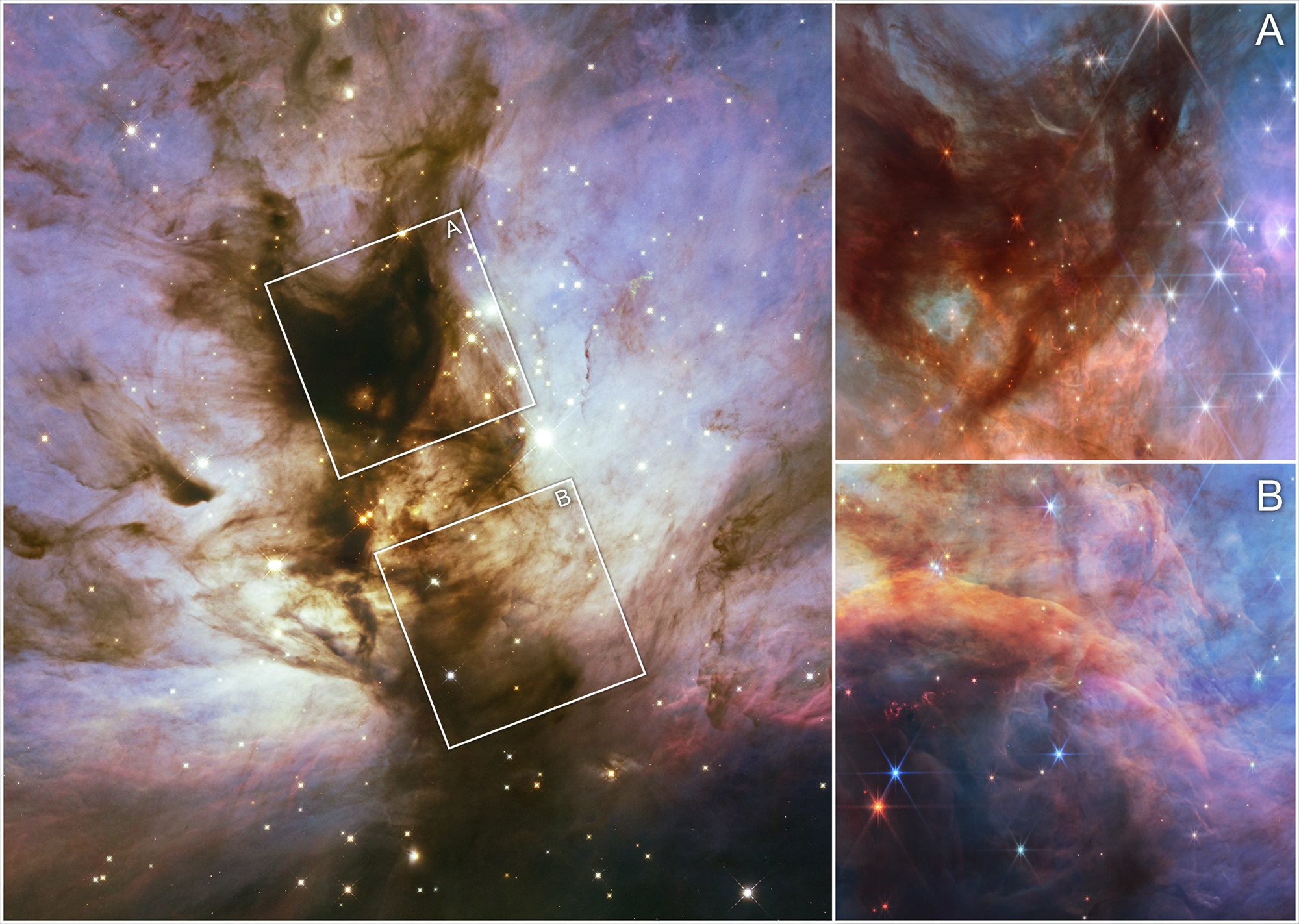
The James Webb Space Telescope and the Hidden Beauty of Nebulae
Nebulae are vast clouds of gas and dust where stars are born, evolve, and sometimes leave behind the ingredients for new generations of stars and planets. To the naked eye, many appear faint or invisible. The James Webb Space Telescope (JWST) is changing that view, revealing details hidden inside these cosmic clouds.
Why Webb Sees Nebulae Differently
Webb observes the universe mainly in infrared light. Unlike visible light, infrared can pass through some of the dust that obscures regions where stars are forming. Webb’s sensitive instruments can also detect the faint heat signatures of young stars, glowing gas, and complex molecules.
The telescope’s images are often shown in color, but the colors do not always match what a person would see with their eyes. Scientists map different infrared wavelengths to visible colors so viewers can distinguish structures and features. These images combine scientific data with careful visualization.
The Cosmic Cliffs in the Carina Nebula
One of Webb’s best-known early images shows a region of the Carina Nebula called the Cosmic Cliffs. The dramatic, mountain-like edge is actually the boundary of a cavity carved by intense radiation and winds from hot, young stars.
Above and within the cloudy landscape, Webb revealed previously hidden stars and delicate structures in the gas. Some of the bright points are young stars still surrounded by material from their formation. By studying this region, astronomers can learn how massive stars affect the clouds around them—and how that influence may shape the birth of other stars.
A Closer Look at the Southern Ring Nebula
The Southern Ring Nebula offers a different kind of story. It is a planetary nebula: an expanding shell of gas released by a dying star, rather than a region where new stars are forming. Webb’s observations helped reveal the complex structure of the gas and dust and made it easier to study the central stars responsible for shaping it.
Despite its name, a planetary nebula has little to do with planets. Early telescopes made some of these objects look like planets, and the historical name stuck.
Webb’s Views of the Tarantula Nebula
In the Tarantula Nebula, one of the most active star-forming regions in our nearby universe, Webb has captured clusters of young stars and layers of glowing gas and dust. Its infrared vision helps astronomers examine how stars form in an environment that resembles conditions in some of the universe’s early galaxies.
Webb’s observations show that nebulae are not still or simple clouds. They are dynamic environments, shaped by gravity, radiation, stellar winds, and the formation and evolution of stars.
Why These Images Matter
Webb’s nebula images are striking, but their value goes beyond appearance. They give astronomers new ways to investigate how stars are born, how stars influence their surroundings, and how the elements needed for planets and life become distributed through space.
Each nebula offers a different chapter in the life cycle of stars. By observing these clouds in infrared light, the James Webb Space Telescope is helping scientists read those chapters in greater detail—and revealing just how much of the universe was waiting behind the dust.
9 Tips for Exploring Nebula Images From the James Webb Space Telescope
- Look for glowing clouds of gas and dust in JWST nebula images.
- Use infrared views to spot stars hidden by dust.
- Compare different wavelengths to reveal different details.
- Notice how newborn stars shape nearby gas.
- Look for jets and outflows from young stars.
- Remember that nebula colors are often assigned for clarity.
- Check the image caption for the nebula’s name and distance.
- Explore zoomable images to find fine structures.
- Use official NASA and ESA galleries for labeled images.
Look for glowing clouds of gas and dust in JWST nebula images.
When viewing nebula images from the James Webb Space Telescope, look for glowing clouds of gas and dust that form wisps, pillars, and sweeping layers across the scene. These structures can mark regions where new stars are forming or where stars are shaping the surrounding material. Webb captures infrared light, so the colors in processed images often represent different wavelengths rather than what human eyes would see.
Use infrared views to spot stars hidden by dust.
Use the James Webb Space Telescope’s infrared views to look beyond the dust that hides many stars from ordinary telescopes. Infrared light can pass through much of this cosmic dust, revealing young stars forming inside nebulae and helping astronomers study how these stellar nurseries develop.
Compare different wavelengths to reveal different details.
Compare images of the same nebula at different wavelengths to uncover details that a single view may miss. Visible light can highlight glowing gas and bright stars, while infrared observations from the James Webb Space Telescope can peer through some dust to reveal hidden young stars and warm regions. Looking across wavelengths helps show how the nebula’s gas, dust, and stars fit together—and gives a fuller picture of how it is changing.
Notice how newborn stars shape nearby gas.
Notice how newborn stars shape the gas around them. Their intense radiation and powerful stellar winds can heat nearby material, carve cavities in nebulae, and sculpt the surrounding clouds into glowing ridges and delicate pillars. In some places, the pressure may also compress gas and encourage further star formation. Webb’s infrared observations help reveal these interactions, showing that a nebula is not just a star-forming cloud—it is a landscape continually changed by the stars within it.
Look for jets and outflows from young stars.
Look for narrow jets and broader outflows streaming from young stars in a nebula. These flows form as a growing star interacts with the disk of gas and dust around it, sending material into space and sometimes creating bright, shock-heated knots. In James Webb Space Telescope images, infrared observations can reveal these features through the dust, helping astronomers trace how young stars gather material and shape the clouds around them.
Remember that nebula colors are often assigned for clarity.
When viewing images of nebulae from the James Webb Space Telescope, remember that their colors are often assigned to help make different wavelengths of infrared light easier to see and compare. The colors reveal scientific details—such as variations in gas, dust, and stellar activity—but may not match what the nebula would look like to the human eye.
Check the image caption for the nebula’s name and distance.
Before exploring a James Webb Space Telescope nebula image, check its caption for the nebula’s name and distance from Earth. The name helps you identify the object and learn more about its features, while the distance gives a sense of how far away—and how far back in time—you’re looking. Keep in mind that astronomical distances are often estimates and may be described in light-years.
Explore zoomable images to find fine structures.
Explore zoomable images from the James Webb Space Telescope to discover details that may be easy to miss at a glance. As you zoom in on a nebula, look for delicate dust lanes, glowing gas, tiny points of light, and sculpted edges where young stars shape their surroundings. Taking time to examine different parts of the image can reveal how varied and intricate these cosmic clouds are.
Use official NASA and ESA galleries for labeled images.
For accurate, clearly identified images of nebulae observed by the James Webb Space Telescope, explore the official NASA and ESA image galleries. Their photos and captions often include the nebula’s name, the instruments and wavelengths used, and notes explaining the features shown—helpful context for understanding what you’re seeing and sharing it responsibly.