
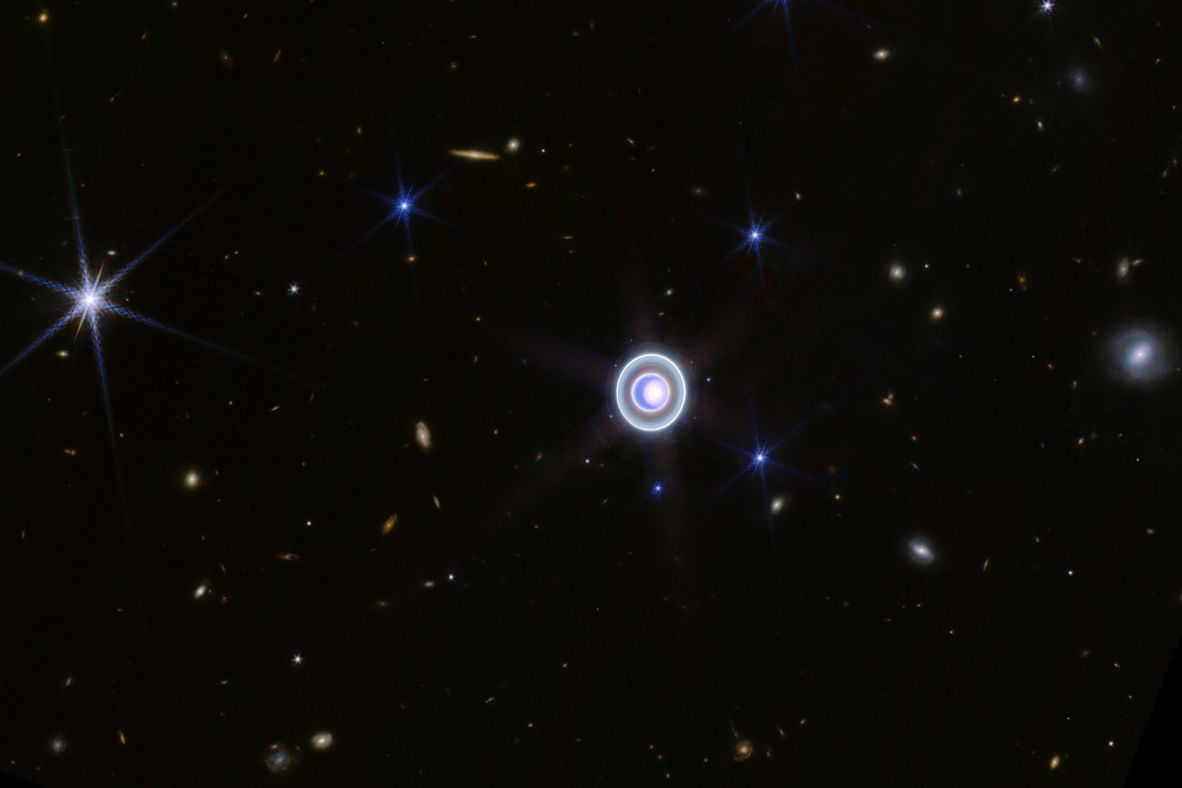
James Webb Takes a New Look at the Crab Nebula
The James Webb Space Telescope has captured a detailed infrared view of the Crab Nebula, revealing the remains of a star that exploded nearly a thousand years ago. Webb’s observations show the nebula’s tangled filaments, glowing dust, and energetic activity around its central pulsar in striking detail.
A Stellar Explosion Recorded in History
The Crab Nebula lies about 6,500 light-years from Earth in the constellation Taurus. It formed when a massive star exploded in a supernova. The event was observed by astronomers in 1054, who recorded a “guest star” bright enough to be seen in daylight for several weeks.
At the heart of the expanding debris is a pulsar: a rapidly rotating neutron star left behind by the explosion. It spins about 30 times per second and sends out powerful beams of radiation. Its intense magnetic field also accelerates charged particles, helping create the nebula’s bright inner glow.
What Webb Sees in Infrared
Webb observed the Crab Nebula with its Near-Infrared Camera (NIRCam) and Mid-Infrared Instrument (MIRI). By detecting infrared light, the telescope can reveal features that are difficult to study in visible light, including the distribution of dust and the structure of the nebula’s gas.
In Webb’s image, bright, wispy structures fill the central region. Much of the pale, glowing light comes from synchrotron radiation, produced as high-energy particles spiral around magnetic field lines. Farther out, the nebula’s tangled filaments stand out, along with emission from dust grains woven through the expanding material.
Why the Image Matters
The Crab Nebula is a nearby example of a supernova remnant—a cloud of material cast into space by a stellar explosion. Studying its shape, dust, and energetic particles helps astronomers investigate how massive stars end their lives and how their explosions enrich the space around them with elements and dust.
Webb’s infrared view complements observations made by other telescopes at different wavelengths. Together, these views help scientists build a more complete picture of the Crab Nebula, from its expanding outer filaments to the powerful pulsar at its center.
More than nine centuries after the supernova was recorded on Earth, the Crab Nebula remains a vivid reminder that stellar explosions do not simply mark an ending. They also create complex new structures that astronomers can study for generations.
James Webb Telescope Unveils New Insights into the Crab Nebula’s Mysteries
- Reveals the Crab Nebula in remarkable infrared detail.
- Shows intricate filaments from the ancient supernova.
- Helps map dust throughout the nebula.
- Highlights the energetic region around its pulsar.
- Complements images from other telescopes.
- Offers clues about how stars die and explode.
- Helps scientists study cosmic dust and elements.
- Makes a historic supernova remnant easier to explore.
Limitations of the James Webb Telescope: Understanding the Crab Nebula’s Complexities
- Webb’s infrared view does not show the nebula’s full range of light.
- A single image cannot capture how the nebula changes over time.
- The image alone cannot explain every detail of the supernova’s history.
Reveals the Crab Nebula in remarkable infrared detail.
The James Webb Space Telescope reveals the Crab Nebula in remarkable infrared detail, bringing out intricate filaments, glowing dust, and structures around its central pulsar. These observations let astronomers examine features that are difficult to see in visible light and gain a clearer understanding of how the supernova remnant is arranged and evolving.
Shows intricate filaments from the ancient supernova.
One of the James Webb Space Telescope’s key advantages in observing the Crab Nebula is its ability to reveal the intricate filaments left behind by the ancient supernova. Its detailed infrared observations show the tangled strands of gas and dust in greater clarity, helping astronomers study how the stellar debris has expanded and changed over time.
Helps map dust throughout the nebula.
One major advantage of James Webb Space Telescope observations of the Crab Nebula is their ability to help map dust throughout the nebula. By detecting infrared light, Webb can reveal dusty regions and structures that are difficult to see in visible-light images. This gives astronomers a clearer picture of where the dust is located and how it is distributed among the expanding gas and filaments left behind by the supernova.
Highlights the energetic region around its pulsar.
One major advantage of James Webb Space Telescope observations of the Crab Nebula is their ability to highlight the energetic region around its pulsar. Webb’s infrared instruments reveal glowing structures and wispy features shaped by the rapidly spinning neutron star’s powerful winds and magnetic field. This gives astronomers a clearer view of how the pulsar energizes nearby particles and influences the nebula’s complex appearance.
Complements images from other telescopes.
One major advantage of James Webb’s Crab Nebula observations is that they complement images from other telescopes. Webb detects infrared light, revealing details such as dust and warm gas that may be less apparent in visible-light images. When astronomers compare these observations with data from telescopes that study visible light, X-rays, and radio waves, they can build a more complete picture of the nebula’s structure, activity, and evolution.
Offers clues about how stars die and explode.
By revealing the Crab Nebula’s expanding filaments, glowing dust, and energetic particles, the James Webb Space Telescope offers valuable clues about how massive stars die and explode. These details help astronomers trace how a supernova scatters stellar material into space and shapes the environment around it, improving our understanding of what happens when a star reaches the end of its life.
Helps scientists study cosmic dust and elements.
Webb’s infrared observations of the Crab Nebula help scientists map cosmic dust and study the elements scattered through the remnant. By showing where dust and glowing material are located, these observations offer clues about what the exploded star produced and how supernovae return important ingredients to space, where they can contribute to future stars and planetary systems.
Makes a historic supernova remnant easier to explore.
One major advantage of James Webb Space Telescope observations of the Crab Nebula is that they make this historic supernova remnant easier to explore. By capturing infrared light, Webb reveals details in the nebula’s dust, gas, and tangled filaments that can be difficult to see in visible light. These observations help astronomers study how the remains of the 1054 supernova have changed over time and better understand the processes shaping the expanding cloud.
Webb’s infrared view does not show the nebula’s full range of light.
One limitation of Webb’s Crab Nebula image is that it shows only infrared light, not the nebula’s full range of emissions. Infrared observations reveal details such as warm dust and glowing gas, but they leave out features visible in other wavelengths, including radio, visible, ultraviolet, and X-ray light. As a result, the image offers a remarkable but incomplete view; astronomers combine it with observations from other telescopes to understand the nebula as a whole.
A single image cannot capture how the nebula changes over time.
A single James Webb image of the Crab Nebula offers a remarkable snapshot, but it cannot show how the nebula changes over time. Its gas and dust continue to expand, while energetic particles from the central pulsar shape the surrounding material. To track these changes, astronomers need repeated observations taken over months or years and compared with images from other telescopes. Without that time-based view, one image can reveal the nebula’s structure but not its evolving story.
The image alone cannot explain every detail of the supernova’s history.
Although James Webb’s image reveals remarkable detail in the Crab Nebula, a single image cannot explain every part of the supernova’s history. It captures the nebula as it appears today, but astronomers must combine observations from different telescopes, wavelengths, and time periods with scientific models to investigate how the star exploded and how its remains have changed over time.