
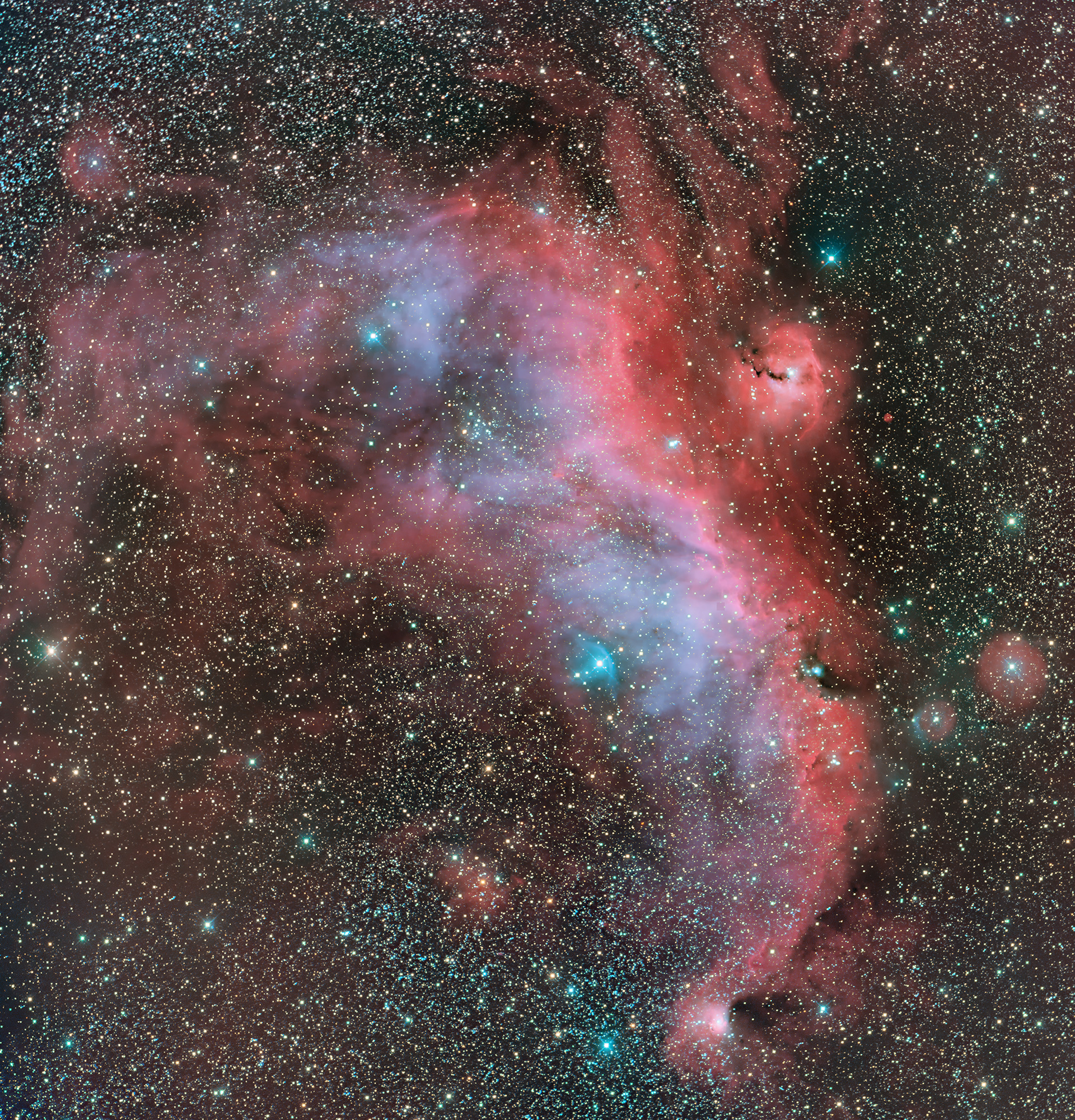
IC 2177: The Seagull Nebula
Spreading its wings across the night sky, IC 2177 is a vast cloud of glowing gas and dust commonly known as the Seagull Nebula. This striking deep-sky object is a region where stars are forming, set against the rich star fields along the border of the constellations Monoceros and Canis Major.
A Nebula with Wings
The Seagull Nebula’s popular name comes from its sweeping shape, which resembles a bird in flight. Its broad, curved wings are made of glowing gas, while denser clouds of dust create darker patches and lanes within the nebula. The region includes several related structures, including the smaller nebula NGC 2327, often identified with the Seagull’s head.
IC 2177 lies roughly 3,700 light-years from Earth, though distance estimates can vary. At that distance, the nebula spans an enormous region of space. Its apparent size in the sky also makes it a rewarding target for wide-field astrophotography.
A Stellar Nursery
IC 2177 is an emission nebula: a cloud of gas that shines after being energized by nearby stars. Hot, young stars emit intense ultraviolet light, which strips electrons from hydrogen atoms in the surrounding gas. When those electrons recombine with the atoms, the gas releases light, including the red glow often seen in photographs of the nebula.
The same energetic stars that illuminate the cloud also shape it. Their radiation and powerful stellar winds push against the surrounding gas and dust, carving cavities and sculpting the nebula’s edges. Within denser pockets of material, gravity can pull gas together to form new stars. In this way, IC 2177 shows both the creation of stars and their influence on the environments where they are born.
Seeing the Seagull
IC 2177 is located in a part of the sky best observed during the Northern Hemisphere’s winter months. Although it covers a large area, its faint glow can be difficult to see with the unaided eye. Dark skies and binoculars or a telescope may reveal some of its structure, but long-exposure photographs bring out the nebula’s sweeping outline and delicate details much more clearly.
Images of the Seagull Nebula often use filters that highlight particular wavelengths of light, making its glowing gas and intricate clouds easier to distinguish. The colors in these images may be enhanced or assigned to specific wavelengths, so they do not always match what a person would see with their eyes.
A Snapshot of Cosmic Change
IC 2177 is more than a beautiful astronomical image. It is a dynamic landscape of glowing gas, dark dust, newborn stars, and energetic stellar winds. By studying regions like the Seagull Nebula, astronomers can learn how stars form and how young stars reshape the material around them—processes that have helped transform the Milky Way throughout its history.
8 Stunning Highlights of IC 2177, the Seagull Nebula
- A striking, bird-like shape earns it the name Seagull Nebula.
- Glowing gas creates vivid colors in astrophotography.
- It is a fascinating stellar nursery.
- Young stars illuminate and sculpt its clouds.
- Its wide span suits wide-field telescope views.
- Dark dust adds dramatic detail to images.
- It lies in a rich region of the winter sky.
- It offers a beautiful glimpse of star formation.
Challenges of Observing and Photographing IC 2177
- Too faint for easy naked-eye viewing.
- Light pollution obscures its details.
- Best viewing is seasonal.
- Detailed photos require long exposures.
A striking, bird-like shape earns it the name Seagull Nebula.
One of IC 2177’s most captivating features is its striking, bird-like shape, which gives it the nickname the Seagull Nebula. Its broad, sweeping clouds resemble wings outstretched in flight, making this vast star-forming region easy to remember and especially appealing in wide-field astrophotography.
Glowing gas creates vivid colors in astrophotography.
One of IC 2177’s most striking features is the vivid color of its glowing gas, which makes it a spectacular subject for astrophotography. Energetic young stars illuminate the surrounding clouds, causing gases such as hydrogen to shine brightly. Long-exposure images can capture these rich hues and delicate details, revealing the Seagull Nebula’s sweeping shape in ways that are difficult to see with the unaided eye.
It is a fascinating stellar nursery.
IC 2177 is a fascinating stellar nursery, where clouds of gas and dust provide the raw materials for new stars. Intense radiation from young, hot stars lights up the surrounding nebula, while stellar winds shape its glowing clouds and dark lanes. These dramatic processes offer a glimpse into how stars are born and how they transform the space around them.
Young stars illuminate and sculpt its clouds.
One of IC 2177’s most fascinating features is the way its young stars both illuminate and sculpt the surrounding clouds. Their intense ultraviolet radiation causes nearby gas to glow, while powerful stellar winds push dust and gas into sweeping shapes, cavities, and ridges. These forces reveal the nebula’s dramatic structure and show how newly formed stars can transform the very clouds from which they were born.
Its wide span suits wide-field telescope views.
IC 2177’s wide span makes it an excellent target for wide-field telescope views and astrophotography. Rather than focusing on a single compact object, a wide-field setup can capture the nebula’s sweeping, birdlike outline along with the surrounding stars and clouds of gas and dust. This broader view helps reveal the Seagull Nebula’s scale and structure in one striking frame.
Dark dust adds dramatic detail to images.
Dark dust gives images of IC 2177 striking contrast and depth. Set against the nebula’s glowing gas and bright stars, its shadowy clouds form intricate lanes and shapes that make the Seagull Nebula’s structure stand out. These dramatic details also reveal where dense material gathers, offering a glimpse of the complex regions where new stars may form.
It lies in a rich region of the winter sky.
IC 2177’s location in a rich region of the winter sky makes it part of a spectacular celestial backdrop. Surrounded by bright stars and other deep-sky objects near Monoceros and Canis Major, the Seagull Nebula is especially rewarding to explore with binoculars, telescopes, or wide-field astrophotography. Its setting adds context and visual interest, making a search for the nebula an opportunity to discover more of the winter Milky Way.
It offers a beautiful glimpse of star formation.
One of IC 2177’s greatest appeals is the beautiful glimpse it offers of star formation. Its glowing clouds of gas and dust surround hot, young stars, while darker, denser pockets of material hint at places where new stars may be taking shape. Together, these features reveal a stellar nursery in action and make the Seagull Nebula a vivid reminder that the cosmos is continually creating new stars.
Too faint for easy naked-eye viewing.
One drawback of IC 2177 is that it is too faint for easy naked-eye viewing. Even though the Seagull Nebula spans a large area of the sky, its soft glow can be overwhelmed by moonlight, light pollution, or hazy conditions. To see its structure clearly, observers typically need dark skies and binoculars or a telescope; long-exposure astrophotography reveals far more detail than the unaided eye can detect.
Light pollution obscures its details.
Light pollution can make IC 2177 difficult to observe, washing out its faint glow and obscuring the delicate clouds and structures that give the Seagull Nebula its distinctive shape. From bright urban or suburban locations, even its larger features may be hard to see, especially through binoculars or a telescope. Traveling to a dark-sky area can reveal more of the nebula, while long-exposure astrophotography can capture details that are invisible to the unaided eye.
Best viewing is seasonal.
One drawback of observing IC 2177 is that it is best viewed during a limited season. The Seagull Nebula is most accessible in the night sky during the Northern Hemisphere’s winter months, so observers may need to wait much of the year for favorable viewing. Even during its viewing season, clear skies, low light pollution, and a good view of the horizon are important for spotting this faint object.
Detailed photos require long exposures.
One drawback of photographing IC 2177 is that its faint glow and delicate details usually require long exposures to capture clearly. This means taking many minutes—or even hours—of images, often across multiple sessions, while keeping the camera and telescope precisely aligned. Movement, wind, changing conditions, or light pollution can interfere, making detailed photos challenging for beginners and anyone without specialized equipment.