
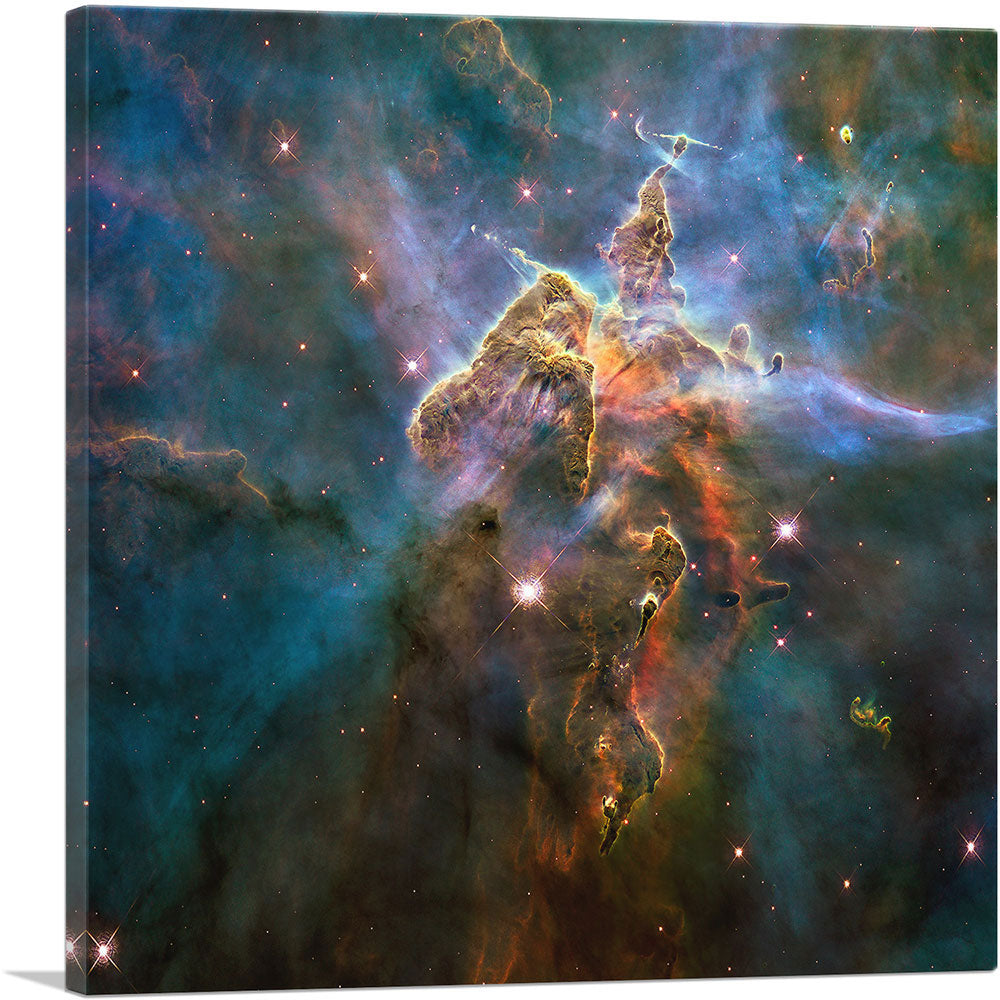
Hubble’s View of the Carina Nebula: A Stellar Nursery in the Southern Sky
The Carina Nebula is one of the Milky Way’s most dramatic regions of star formation. Located about 7,500 light-years from Earth in the constellation Carina, this vast cloud of gas and dust is home to newborn stars, towering clouds, and some of the most massive stars known. Hubble Space Telescope images have brought its turbulent landscape into striking detail, helping astronomers study how stars are born and how they reshape their surroundings.
A Nebula Shaped by Starlight
Also known as NGC 3372, the Carina Nebula stretches across hundreds of light-years. Its clouds contain the raw materials for new stars. When massive young stars form, they flood nearby space with intense ultraviolet light and powerful stellar winds. That energy heats and pushes against the surrounding gas, carving cavities, sculpting ridges, and compressing some clouds into dense knots.
The result is a landscape that appears both beautiful and unsettled. Dark pillars and dusty formations stand against glowing gas, while bright stars illuminate the nebula from within. These features are not still monuments: they change over time as radiation and winds erode the clouds around them.
Hubble’s “Mystic Mountain”
One of Hubble’s best-known views of the Carina Nebula is a region nicknamed “Mystic Mountain.” Released in 2010 to mark the telescope’s 20th anniversary, the image shows a towering column of gas and dust about three light-years tall. Young stars are forming inside the cloud, while nearby massive stars sculpt its edges with radiation and stellar winds.
In the image, jets of gas can be seen streaming from some developing stars. These outflows are part of the star-formation process: material falls toward a young star, while some is expelled into space along narrow jets. Hubble’s sharp view helped reveal these small-scale details against the much larger nebular backdrop.
A Window into Star Formation
Hubble observes the universe at visible and ultraviolet wavelengths, and it can also make observations in near-infrared light. Different wavelengths reveal different parts of the Carina Nebula. Visible light shows glowing gas and dark dust lanes; infrared observations can peer through some dust to uncover stars and structures hidden from view.
By studying the shapes of the clouds, the young stars within them, and the effects of radiation, astronomers can investigate how massive stars influence their environments. Their energy can disperse the gas that might otherwise form more stars, but it can also squeeze nearby material and encourage new stars to develop. The Carina Nebula provides a nearby, richly detailed setting for exploring this complicated process.
Why the Carina Nebula Still Captures Attention
Hubble’s images are more than spectacular portraits. They show a region in the midst of change, where stars and clouds continually affect one another. The Carina Nebula’s mix of newborn stars, dense dust, and powerful stellar activity helps researchers compare what they see in distant galaxies with processes happening much closer to home.
For viewers, the images offer a glimpse into a cosmic workshop. A pillar of dust may look like a solid mountain, but it is a vast cloud of particles being shaped by light and wind. Within those clouds, new stars are taking shape—making the Carina Nebula a vivid reminder that the universe is not only a place of distant beauty, but also one of ongoing creation.
Discover the Wonders of the Carina Nebula: 6 Tips for Exploring Hubble’s Iconic Image
- Explore Hubble’s famous Carina Nebula image, released in 2007.
- Look for towering clouds of gas and dust called the Mystic Mountain.
- The nebula is about 7,500 light-years from Earth.
- Bright, young stars shape the nebula with intense radiation and stellar winds.
- Use the image to spot regions where new stars are forming.
- Compare visible-light and infrared views to reveal different details.
Explore Hubble’s famous Carina Nebula image, released in 2007.
Explore Hubble’s famous Carina Nebula image, released in 2007, for a close-up look at a dramatic region where massive stars are forming. The image reveals towering clouds of gas and dust, glowing with light from hot young stars and sculpted by their powerful winds and radiation. As you look, notice how bright, colorful regions contrast with dark dust lanes—each offering clues to the nebula’s ongoing cycle of star birth and change.
Look for towering clouds of gas and dust called the Mystic Mountain.
Look for the towering clouds of gas and dust known as Mystic Mountain in Hubble’s famous view of the Carina Nebula. This dramatic structure rises about three light-years high, with newborn stars forming inside and powerful radiation from nearby stars sculpting its rugged edges. Hubble’s detailed image reveals jets of gas streaming from young stars, offering a glimpse of the lively process of star formation.
The nebula is about 7,500 light-years from Earth.
The Carina Nebula lies about 7,500 light-years from Earth, meaning its light takes roughly 7,500 years to reach us. When Hubble captures this stellar nursery, it shows the nebula as it appeared in the distant past, offering a glimpse into the lives of young stars and the clouds of gas and dust surrounding them.
Bright, young stars shape the nebula with intense radiation and stellar winds.
Bright, young stars are constantly reshaping the Carina Nebula. Their intense radiation heats the surrounding gas, while powerful stellar winds push clouds of dust and gas outward, carving cavities and sculpting towering pillars. This activity can erode some regions while compressing others, sometimes helping trigger the formation of new stars. Hubble’s detailed observations reveal how these stellar forces transform the nebula over time.
Use the image to spot regions where new stars are forming.
Use Hubble’s image of the Carina Nebula to look for places where new stars may be forming. Dense, dark clouds and tall pillars of gas and dust can hide young stars, while bright edges and glowing patches often mark areas being energized by nearby stars. Look closely for tiny points of light within or near these clouds, as well as narrow jets of material streaming from them—clues that stars are taking shape.
Compare visible-light and infrared views to reveal different details.
Compare visible-light and infrared views of the Carina Nebula to see how each reveals a different part of this stellar nursery. Visible light highlights glowing gas, bright stars, and dramatic dark dust lanes, while infrared light can pass through some of the dust to uncover stars and structures hidden behind it. Looking at both views together gives a fuller picture of how stars form and shape the nebula.