
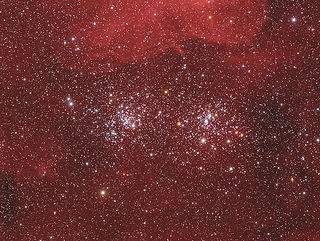
The Heart Nebula Through Hubble’s Eyes
Named for its heart-like outline, the Heart Nebula is a vast star-forming region in the constellation Cassiopeia. Cataloged as IC 1805, it lies about 7,500 light-years from Earth. Images from the Hubble Space Telescope help astronomers examine the nebula’s intricate clouds of gas and dust, where young stars are shaping their surroundings.
A Stellar Nursery in Cassiopeia
The Heart Nebula glows because energetic stars within it illuminate and energize nearby gas. Much of that gas is hydrogen, which shines in the red light often seen in images of emission nebulae. Dark lanes and knots are dense clouds of dust and gas, some of which may eventually collapse to form new stars.
Near the nebula’s center is the young star cluster Melotte 15. Its massive stars produce intense radiation and powerful stellar winds. These forces carve cavities into the surrounding material, compress some clouds, and create the dramatic ridges and pillars visible in detailed photographs.
What Hubble Reveals
Hubble’s strength is its ability to resolve fine detail. Rather than capturing the entire Heart Nebula in one sweeping view, the telescope can study smaller portions at high resolution. Its observations reveal sharply defined edges between glowing gas and dark dust, as well as compact structures shaped by radiation from nearby stars.
These close-up views help researchers investigate how massive stars affect their birthplaces. By studying the shapes and conditions of the gas, astronomers can learn how stellar winds and radiation influence the formation of later generations of stars.
Reading a Colorful Nebula Image
Many astronomical images combine observations made through different filters. Colors may represent particular wavelengths of light rather than what a human eye would see from nearby. In images of the Heart Nebula, red commonly highlights hydrogen emission, while other colors can indicate light from oxygen or sulfur. The exact color scheme depends on the image and the filters used.
It is also useful to distinguish a Hubble close-up from a wide-field portrait. The Heart Nebula is so large that broad views are often assembled from observations by ground-based telescopes or other space observatories. Hubble’s detailed images complement those panoramas by showing smaller features with exceptional clarity.
A Window Into Star Formation
The Heart Nebula is more than a striking celestial shape. It is an active region where stars are born and where young, massive stars transform the clouds around them. Hubble’s detailed observations make those interactions easier to see, turning distant clouds of gas and dust into a close study of how stars influence the environments that created them.
Heart Nebula and Hubble: 8 Frequently Asked Questions
- What is the Heart Nebula, and where is it located?
- How far away is the Heart Nebula from Earth?
- Has the Hubble Space Telescope photographed the Heart Nebula?
- What details of the Heart Nebula can Hubble reveal?
- Why does the Heart Nebula appear red in many images?
- What is the star cluster Melotte 15, and where is it in the Heart Nebula?
- How do the massive stars in the Heart Nebula shape its gas and dust?
- Where can I view Hubble images of the Heart Nebula?
What is the Heart Nebula, and where is it located?
The Heart Nebula, also known as IC 1805, is a large, heart-shaped cloud of glowing gas and dust where stars form. It is located about 7,500 light-years from Earth in the constellation Cassiopeia. The Hubble Space Telescope has captured detailed views of parts of the nebula, revealing structures shaped by radiation and stellar winds from young, massive stars.
How far away is the Heart Nebula from Earth?
The Heart Nebula, also known as IC 1805, is about 7,500 light-years from Earth in the constellation Cassiopeia. That means the light captured in Hubble images began its journey to us roughly 7,500 years ago. Distances to nebulae are estimates, so published figures may vary slightly.
Has the Hubble Space Telescope photographed the Heart Nebula?
Yes. The Hubble Space Telescope has captured detailed images of portions of the Heart Nebula (IC 1805), revealing features such as glowing gas, dark dust clouds, and structures shaped by young stars. Because the nebula is so large, Hubble’s observations show selected regions rather than the entire nebula in a single view; many wide-field images of the Heart Nebula come from other telescopes.
What details of the Heart Nebula can Hubble reveal?
Hubble can reveal fine details within the Heart Nebula, including glowing gas clouds, dark dust lanes, dense knots, and sharply defined ridges and pillars shaped by young, massive stars. Its high-resolution observations help astronomers study how stellar radiation and winds carve cavities in the nebula, compress nearby gas, and influence the formation of new stars. Hubble typically captures detailed sections rather than the entire nebula in one view.
Why does the Heart Nebula appear red in many images?
The Heart Nebula often appears red because its clouds contain ionized hydrogen, which emits red light when energized by nearby stars. In telescope images, this emission may be highlighted with red filters or assigned a red color when observations from different wavelengths are combined. The final colors can therefore be enhanced or represent specific wavelengths, rather than exactly matching what the nebula would look like to the naked eye.
What is the star cluster Melotte 15, and where is it in the Heart Nebula?
Melotte 15 is a young cluster of massive, hot stars near the center of the Heart Nebula (IC 1805) in the constellation Cassiopeia. Their intense radiation and stellar winds shape the surrounding gas and dust, helping create the nebula’s bright clouds and sculpted pillars. Hubble images often focus on parts of this central region, revealing the effects of the cluster’s stars on their stellar nursery.
How do the massive stars in the Heart Nebula shape its gas and dust?
Massive stars in the Heart Nebula reshape their surroundings with intense ultraviolet radiation and powerful stellar winds. The radiation heats and ionizes nearby gas, making it glow, while the winds sweep material away and carve cavities in the nebula. These forces sculpt bright rims, pillars, and dense knots of dust and gas. In some areas, the pressure can compress clouds and may encourage new stars to form; in others, it disperses the material.
Where can I view Hubble images of the Heart Nebula?
You can view Hubble images of the Heart Nebula through NASA’s official image archive and the European Space Agency’s Hubble website. Search their galleries for “Heart Nebula” or “IC 1805” to find available observations, image captions, and details about the instruments and filters used. Because the nebula is very large, Hubble images often show detailed sections rather than the entire nebula in one view.