
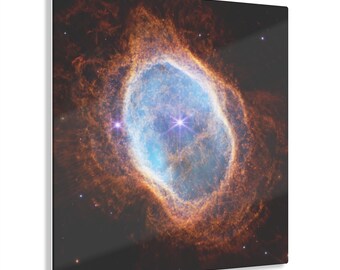
The “Eye of God” Nebula: A Cosmic View of the Helix Nebula
The striking object often called the “Eye of God” is the Helix Nebula, a vast cloud of gas and dust in the constellation Aquarius. Its circular shape and bright center can resemble a giant eye in telescope images. The nickname is informal; astronomers know the object as the Helix Nebula, or NGC 7293.
What Is the Helix Nebula?
The Helix is a planetary nebula, a stage in the life of a star—not a planet-forming cloud. It formed when a star similar in type to the Sun reached the end of its life and shed its outer layers into space. The exposed stellar core remains at the center as a hot, compact white dwarf.
Radiation from the white dwarf energizes the surrounding gas, causing it to glow. The nebula’s colors in astronomical images show different gases and conditions. They can also be enhanced or assigned to specific wavelengths to help scientists study features that human eyes cannot see directly.
Where Is It, and How Far Away?
The Helix Nebula lies in Aquarius, roughly 650 light-years from Earth, though distance estimates can vary. It is one of the closest and most familiar examples of a planetary nebula. Its apparent size in the sky is relatively large, making it a popular target for both professional astronomers and backyard observers under dark skies.
What NASA Images Reveal
NASA and its partner agencies have observed the Helix using space telescopes, including the Hubble Space Telescope and the Spitzer Space Telescope. Different instruments capture different kinds of light, from visible wavelengths to infrared. When astronomers combine observations, they can explore the nebula’s structure in greater detail than a single image can show.
Some close-up views reveal small, dense structures often called “cometary knots.” Each has a compact head and a trailing tail shaped by the surrounding radiation and gas. These knots are not comets; they are features within the nebula. Their intricate forms help scientists investigate how a dying star’s material spreads and changes over time.
A Glimpse of the Sun’s Distant Future
The Helix Nebula offers a preview of one possible future for the Sun. Billions of years from now, the Sun is expected to expand into a red giant and eventually lose much of its outer atmosphere. Its core will remain as a white dwarf, while the expelled material drifts into space. The details will not be exactly the same as the Helix, but the nebula provides a nearby example of this important phase of stellar evolution.
Why the “Eye of God” Name Sticks
The nickname comes from the nebula’s eye-like appearance in selected images, not from its scientific classification. Its dramatic shape makes it memorable, but the real story is just as compelling: the Helix is a changing shell of stellar material, illuminated by the remnant of the star that created it. NASA’s observations turn that beautiful cosmic “eye” into a way to study how stars end their lives and return material to the galaxy.
6 Reasons NASA’s “Eye of God” Nebula Is So Fascinating
- NASA images reveal the Helix Nebula’s remarkable details.
- It offers a vivid example of a star’s final stages.
- Multiple wavelengths uncover hidden structures.
- Its nearby location makes it easier to study.
- Cometary knots provide clues about stellar evolution.
- Its eye-like shape makes astronomy captivating.
NASA’s “Eye of God” Nebula: Unofficial Name, Enhanced Colors, and Viewing Challenges
- “Eye of God” is an informal nickname, not its official astronomical name.
- NASA images may use enhanced colors that differ from what the eye would see.
- The nebula is too faint to view clearly without suitable equipment and dark skies.
NASA images reveal the Helix Nebula’s remarkable details.
NASA images reveal the Helix Nebula’s remarkable details by combining observations from powerful space telescopes, including Hubble and Spitzer. Different wavelengths of light bring out features that may be invisible in ordinary views, from glowing layers of gas to tiny, comet-like knots. These detailed images help astronomers study how a dying star sheds material and enrich our understanding of stellar evolution.
It offers a vivid example of a star’s final stages.
NASA images of the Eye of God Nebula, also known as the Helix Nebula, offer a vivid example of a star’s final stages. The glowing clouds show material shed by a dying star, while the small, hot white dwarf at the center illuminates the gas around it. By studying this nearby planetary nebula, astronomers can better understand how stars like our Sun lose their outer layers and enrich space with material that may later become part of new stars and planets.
Multiple wavelengths uncover hidden structures.
NASA observations of the Helix Nebula across multiple wavelengths reveal details that a single image can miss. Visible-light images show glowing gas, while infrared observations can highlight cooler dust and other features. By comparing these views, astronomers can uncover the nebula’s layered structure and study details such as its dense, comet-shaped knots—giving a fuller picture of how a dying star’s material spreads into space.
Its nearby location makes it easier to study.
The Helix Nebula’s relatively nearby location—about 650 light-years from Earth—makes it easier for astronomers to study in detail than many more distant nebulae. NASA telescopes can capture clearer views of its structure, including the glowing gas and dense knots of material, across different wavelengths of light. These observations help scientists better understand how stars shed their outer layers and evolve at the end of their lives.
Cometary knots provide clues about stellar evolution.
NASA images of the Helix Nebula reveal cometary knots—dense pockets of gas with bright heads and trailing tails—that offer valuable clues about stellar evolution. These structures formed as the dying star shed its outer layers, and their shapes show how radiation and stellar winds interact with the expanding material. By studying the knots, astronomers can better understand how stars disperse gas into space as they reach the end of their lives.
Its eye-like shape makes astronomy captivating.
One of the most captivating features of NASA’s images of the Eye of God Nebula, also known as the Helix Nebula, is its striking eye-like shape. The bright central star and surrounding rings of glowing gas make the nebula feel familiar and mysterious, drawing people into the wonders of space. This vivid appearance can spark curiosity about stars, nebulae, and the life cycle of the universe, making astronomy more engaging for viewers of all ages.
“Eye of God” is an informal nickname, not its official astronomical name.
One drawback of calling the Helix Nebula the “Eye of God” is that the nickname can be mistaken for its official astronomical name. It’s an informal, popular label inspired by the nebula’s eye-like appearance in some images; astronomers identify it as the Helix Nebula, or NGC 7293. Using the nickname without that context may make it harder for readers to find reliable scientific information or distinguish visual description from an accepted astronomical designation.
NASA images may use enhanced colors that differ from what the eye would see.
NASA images of the Eye of God Nebula, also known as the Helix Nebula, may use enhanced or assigned colors to highlight details captured at different wavelengths of light. These colors help scientists reveal features that human eyes cannot see, but they may not match the nebula’s appearance through a telescope. As a result, the vivid images are valuable scientific visualizations rather than exact snapshots of what a person would see in space.
The nebula is too faint to view clearly without suitable equipment and dark skies.
One drawback of the Eye of God Nebula, also known as the Helix Nebula, is that it can be difficult to see clearly without the right equipment and observing conditions. Although it appears vivid in many NASA images, the nebula is faint in the night sky, so light pollution, haze, or a bright Moon can make it hard to spot. A telescope or binoculars, a clear sky, and a dark location away from city lights can improve the view, but the nebula may still look much less colorful and detailed than it does in photographs.