
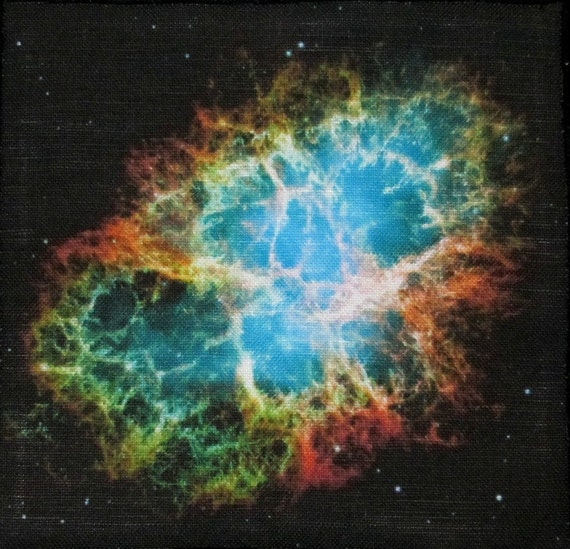
The Crab Nebula Through Hubble’s Eyes
The Crab Nebula is one of the most closely studied objects in the night sky—and one of the most striking. Located about 6,500 light-years from Earth in the constellation Taurus, this expanding cloud of gas and dust is the remnant of a star that exploded nearly a thousand years ago. Images from the Hubble Space Telescope reveal its intricate structure in remarkable detail, helping astronomers investigate what happens after a massive star reaches the end of its life.
A Supernova Recorded in 1054
The Crab Nebula formed from a supernova, an immense stellar explosion. In 1054, astronomers in China and elsewhere recorded a “guest star” that became bright enough to see in daylight for several weeks. The object remained visible in the night sky for much longer. Today, the expanding remains of that explosion are known as the Crab Nebula, or Messier 1.
At the heart of the nebula lies a pulsar: the compact remnant of the exploded star. This rapidly spinning neutron star sends out regular pulses of radiation as it rotates. Its powerful energy also drives much of the nebula’s glow.
What Hubble Reveals
Hubble’s observations show the Crab Nebula’s tangled filaments, knots, and wisps of gas. These structures are shaped by the force of the original explosion and by energy streaming outward from the central pulsar. The nebula is still expanding, so its appearance changes over time. By comparing images taken years apart, astronomers can track the movement of its features.
Different colors in Hubble images can represent different wavelengths of light or types of material. These carefully processed images help scientists distinguish structures that would otherwise overlap in a single view. The result is both a beautiful portrait and a useful map of the nebula’s complex interior.
A Pulsar Powering the Nebula
The Crab Pulsar spins about 30 times per second. As it rotates, it releases energy that accelerates charged particles and produces a glow known as synchrotron radiation. Hubble observations, alongside data from other telescopes, help researchers study how this energy moves through the nebula and interacts with its material.
The Crab is especially valuable to astronomers because it can be observed across many kinds of light, including visible, radio, infrared, X-ray, and gamma-ray wavelengths. Each view reveals different aspects of the system. Hubble contributes detailed observations in visible and ultraviolet light, while other observatories reveal energetic processes that are invisible to the human eye.
Why the Crab Nebula Matters
The Crab Nebula gives scientists an opportunity to study the aftermath of a supernova and the behavior of a neutron star. It also offers a rare chance to compare modern observations with historical accounts of the explosion. Together, these records show how a single stellar event can transform the space around it for centuries.
Hubble’s images have made the Crab Nebula familiar to people around the world, but its scientific story is still unfolding. As the remnant expands and new observations become available, the nebula continues to offer clues about stars, explosions, and the powerful objects left behind.
Exploring the Crab Nebula: 8 Fascinating Insights from Hubble’s Observations
- The Crab Nebula is the remnant of a supernova observed in 1054.
- Hubble captured detailed images of the nebula’s glowing gas.
- Look for intricate filaments formed by expanding debris.
- The nebula lies about 6,500 light-years away.
- Its central pulsar is a rapidly spinning neutron star.
- Hubble images reveal changes in the nebula over time.
- The Crab Nebula is found in the constellation Taurus.
- Hubble combines visible-light observations to show its structure.
The Crab Nebula is the remnant of a supernova observed in 1054.
The Crab Nebula is the expanding remnant of a supernova observed by astronomers in 1054. Nearly a thousand years later, the Hubble Space Telescope captures its intricate clouds of gas and dust, revealing how the star’s explosive death continues to shape the surrounding space. At the nebula’s center, a rapidly spinning neutron star—known as a pulsar—powers much of its glow.
Hubble captured detailed images of the nebula’s glowing gas.
Hubble captured detailed images of the Crab Nebula’s glowing gas, revealing delicate filaments and bright knots shaped by the aftermath of the supernova. These structures are energized by the rapidly spinning neutron star, or pulsar, at the nebula’s center. By studying the images, astronomers can examine how the stellar debris expands and changes over time.
Look for intricate filaments formed by expanding debris.
In Hubble images of the Crab Nebula, look for the intricate filaments woven throughout the glowing cloud. These strands are made of expanding material thrown off when the star exploded, shaped over time by shock waves and energy from the nebula’s central pulsar. Their tangled patterns offer a striking view of a stellar explosion’s remains.
The nebula lies about 6,500 light-years away.
The Crab Nebula lies about 6,500 light-years from Earth, meaning its light takes roughly 6,500 years to reach us. Hubble’s images therefore show the nebula as it appeared thousands of years ago, offering a detailed glimpse of the expanding remains of a stellar explosion.
Its central pulsar is a rapidly spinning neutron star.
At the heart of the Crab Nebula is a pulsar—a rapidly spinning neutron star left behind after the supernova that created the nebula. It rotates about 30 times per second, sending out beams of radiation that sweep through space like a cosmic lighthouse. The pulsar’s energy also helps illuminate and shape the surrounding clouds of gas, which Hubble captures in remarkable detail.
Hubble images reveal changes in the nebula over time.
Hubble images taken years apart show that the Crab Nebula is constantly changing as its supernova remnant expands into space. By comparing the images, astronomers can track the movement of its delicate filaments and bright knots, measuring how quickly the debris is spreading and how energy from the central pulsar shapes the surrounding material. These observations turn the nebula from a stunning snapshot into a time-lapse record of a stellar explosion’s ongoing aftermath.
The Crab Nebula is found in the constellation Taurus.
The Crab Nebula is located in the constellation Taurus, a region of the sky best known for its bright star Aldebaran and the Pleiades star cluster. Although the nebula is too faint to see with the naked eye, telescopes such as Hubble can reveal its intricate, expanding clouds of gas and dust. Its position in Taurus makes it easier for astronomers and stargazers to locate using sky charts and other celestial landmarks.
Hubble combines visible-light observations to show its structure.
Hubble combines visible-light observations to reveal the Crab Nebula’s intricate structure, including its tangled filaments, glowing knots, and expanding wisps of gas. By capturing details across the nebula, these observations help astronomers study how material from the ancient supernova interacts with energy from the rapidly spinning neutron star at its center.