
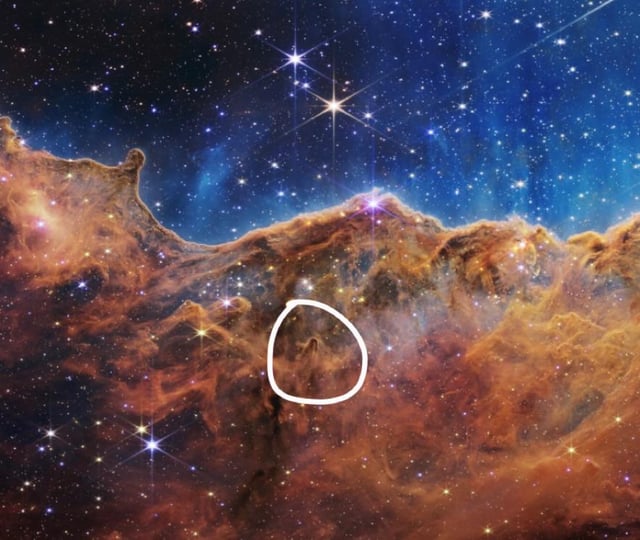
Carina Nebula Through the Eyes of the James Webb Space Telescope
The Carina Nebula is one of the Milky Way’s most spectacular regions of star formation. Located about 7,600 light-years from Earth in the southern constellation Carina, this vast cloud of gas and dust is home to young stars, towering clouds, and energetic processes that help shape the birth of new solar systems.
In July 2022, NASA, the European Space Agency, and the Canadian Space Agency released one of the first full-color images from the James Webb Space Telescope (JWST): a striking view of a portion of the nebula known as NGC 3324. The image quickly became famous for its dramatic landscape of ridges and peaks, nicknamed the “Cosmic Cliffs.”
A Landscape Made of Gas and Dust
The Cosmic Cliffs may resemble mountains beneath a starry sky, but they are actually the edge of a large cavity within a cloud of gas and dust. Powerful radiation and stellar winds from nearby massive, young stars have gradually carved out this cavity. The tallest visible peaks span several light-years.
At the boundary between the cavity and the denser cloud, ultraviolet radiation heats and erodes the gas. This boundary is known as an ionization front. Some parts of the cloud glow brightly, while thicker areas of dust block the light and appear as dark shapes. Webb’s image captures these textures in remarkable detail.
How Webb Reveals Hidden Details
Webb observes infrared light, which can pass through some of the dust that obscures visible-light views. Its Near-Infrared Camera, or NIRCam, revealed previously hidden stars and fine structures within the nebula. Webb’s Mid-Infrared Instrument, or MIRI, can show additional details in the cooler dust and gas.
The telescope’s infrared observations help astronomers study young stars at different stages of development. In some areas, jets and outflows from newly forming stars can be seen pushing through surrounding material. These features offer clues about how stars take shape and influence their environments.
Why the Carina Nebula Matters
Studying the Carina Nebula gives astronomers a close look at star formation on a grand scale. Massive stars can dramatically affect the clouds around them: their radiation and winds may disperse gas, but the compression of nearby material may also contribute to the formation of new stars. Webb’s observations help researchers investigate how these competing effects unfold.
The Cosmic Cliffs image is both a breathtaking portrait and a scientific view into a dynamic stellar nursery. By revealing details that were difficult to see before, the James Webb Space Telescope is helping astronomers better understand how stars—and the worlds that may form around them—begin their lives.
Carina Nebula and the James Webb Telescope: FAQs About Cosmic Discoveries and Alien Life
- Why is the Carina Nebula so significant?
- Did the James Webb telescope find aliens?
- Are we in the Carina Nebula?
- What planet has 99.7% chance of life?
Why is the Carina Nebula so significant?
The Carina Nebula is significant because it is a vast, active stellar nursery where astronomers can study how stars form and affect their surroundings. Its massive young stars shape nearby clouds with intense radiation and stellar winds, creating striking structures such as the “Cosmic Cliffs.” Observations from the James Webb Space Telescope reveal details hidden by cosmic dust, helping scientists investigate the life cycle of stars and the conditions in which planetary systems may develop.
Did the James Webb telescope find aliens?
No. The James Webb Space Telescope has not found evidence of aliens in the Carina Nebula or elsewhere. Its observations of the nebula reveal stars forming, gas, dust, and other astronomical features—not signs of life. Webb can study the atmospheres of some planets beyond our solar system for chemical clues that might be relevant to habitability, but no discovery has confirmed extraterrestrial life.
Are we in the Carina Nebula?
No, Earth is not in the Carina Nebula. Our solar system is located in the Milky Way, roughly 7,600 light-years from the Carina Nebula, a large star-forming region in the constellation Carina. The James Webb Space Telescope’s famous “Cosmic Cliffs” image shows a portion of that nebula—not a view of our own cosmic neighborhood.
What planet has 99.7% chance of life?
No planet is known to have a 99.7% chance of supporting life. The figure is sometimes linked to early reports about possible signs of a molecule in the atmosphere of K2-18 b, but statistical evidence for a molecule is not evidence that life exists. The James Webb Space Telescope’s Carina Nebula images show a region where stars are forming; they do not establish the presence of life on any planet.