
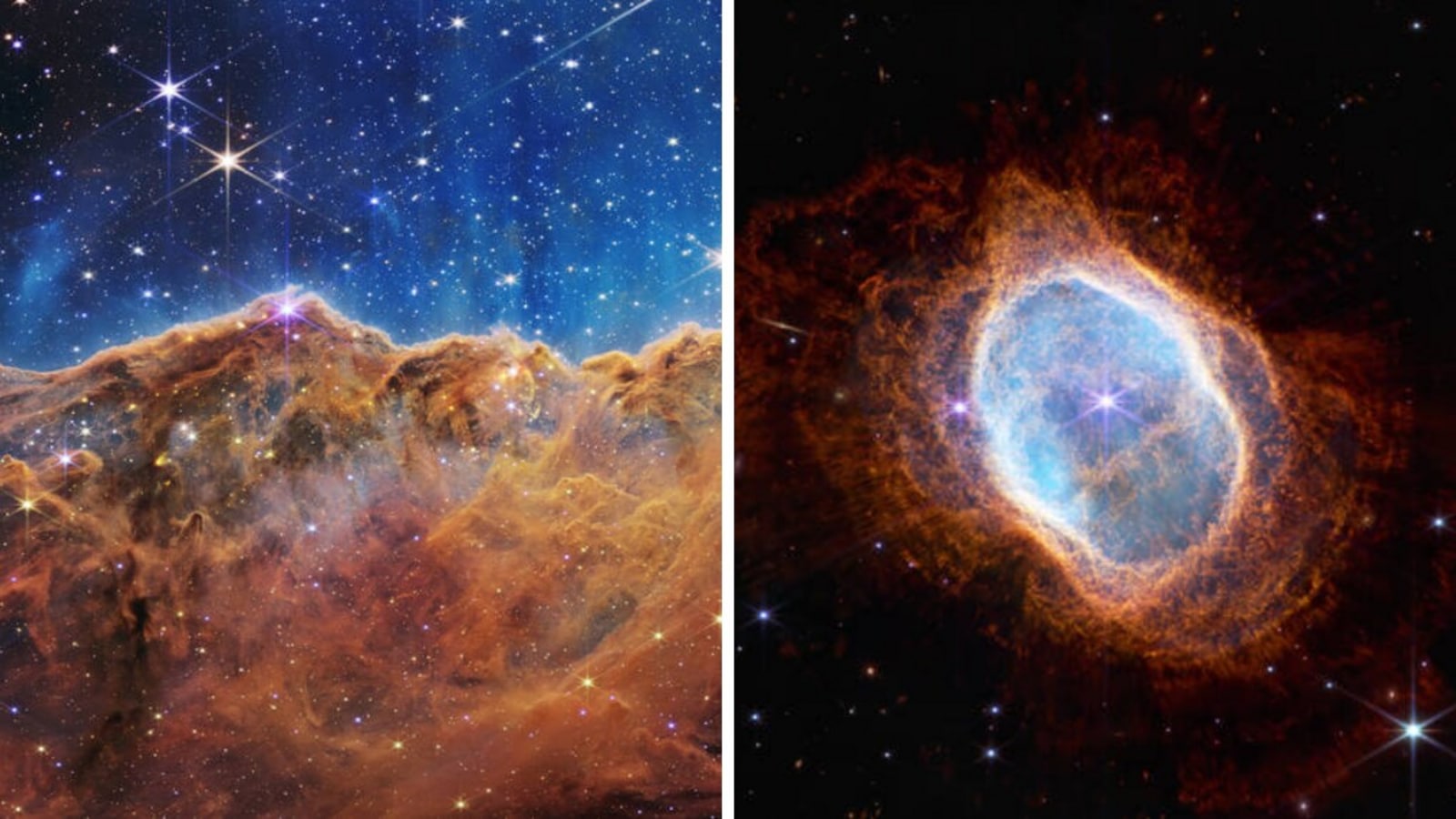
The Carina Nebula Through the Eyes of JWST
In July 2022, NASA, ESA, and the Canadian Space Agency released one of the first full-color images from the James Webb Space Telescope (JWST): a dramatic view of a star-forming region in the Carina Nebula. Known as the “Cosmic Cliffs,” the scene revealed a landscape of glowing gas, dark dust, and newly forming stars in striking detail.
A Stellar Nursery in the Milky Way
The Carina Nebula, also called NGC 3372, is a vast cloud of gas and dust in the southern constellation Carina. It lies about 7,600 light-years from Earth and is home to active regions where stars are born. The Cosmic Cliffs image focuses on a portion of the nebula called NGC 3324, near its northwestern edge.
Although the image can resemble a mountain range, the “cliffs” are enormous walls of gas and dust. The tallest features span several light-years. Their shape is carved by radiation and powerful winds from hot, massive stars nearby—some of which sit beyond the top of the image.
How Webb Reveals Hidden Details
JWST observes primarily in infrared light, which allows it to detect features that visible-light telescopes may miss. Infrared wavelengths can pass through some of the dust surrounding young stars, revealing structures within the nebula as well as stars and galaxies far behind it.
In Webb’s view, hot gas glows along the boundary of the cavity, while denser dust appears as dark, sculpted shapes. Specks of light scattered across the scene include stars at different stages of life. Some young stars are still gathering material from the clouds around them, and a few appear to be driving jets of gas into space.
A Changing Cosmic Landscape
The same forces that shape the Cosmic Cliffs also influence the nebula’s future. Radiation and stellar winds can compress nearby clouds, potentially helping new stars form. But they can also heat and disperse gas, eventually removing the material needed to make more stars. Star formation is therefore a complex process, shaped by both creation and disruption.
Why the Image Matters
The JWST image is more than a spectacular portrait. It gives astronomers a closer look at how young stars interact with their surroundings and how stellar nurseries evolve. By observing in infrared light with exceptional sensitivity and resolution, Webb helps researchers study details that were difficult to see before.
The Cosmic Cliffs offer a glimpse of a dynamic region where stars are taking shape and transforming the clouds around them. In this view of the Carina Nebula, a distant stellar nursery becomes a vivid reminder that the universe is continually changing.
9 Tips for Exploring the Carina Nebula with JWST: Unveiling the Cosmic Cliffs
- Explore JWST’s “Cosmic Cliffs” in the Carina Nebula.
- Look for the bright star-forming region NGC 3324.
- Remember
- Use infrared views to see through some cosmic dust.
- Spot newborn stars emerging from dusty regions.
- Notice how massive stars sculpt nearby gas and dust.
- Treat image colors as scientific mappings, not natural colors.
- The “cliffs” are vast clouds, not solid surfaces.
- Compare JWST images with visible-light views to see the difference.
Explore JWST’s “Cosmic Cliffs” in the Carina Nebula.
Explore JWST’s “Cosmic Cliffs” in the Carina Nebula, where towering clouds of gas and dust glow against a star-filled backdrop. This infrared view reveals details of star formation in the NGC 3324 region, about 7,600 light-years from Earth, including young stars emerging from the cosmic clouds that surround them.
Look for the bright star-forming region NGC 3324.
Look for NGC 3324, the bright star-forming region featured in JWST’s famous “Cosmic Cliffs” image of the Carina Nebula. Located about 7,600 light-years from Earth, this stellar nursery is filled with glowing gas and dust shaped by the radiation and winds of massive nearby stars. In Webb’s infrared view, young stars and delicate structures emerge from the clouds, revealing a region where stars are actively forming.
Remember
Remember that JWST’s view of the Carina Nebula is captured in infrared light, not ordinary visible light. The colors in the image represent different wavelengths and help reveal details such as warm gas, dust, and young stars that would otherwise be difficult to see.
Use infrared views to see through some cosmic dust.
Use infrared views to see through some of the cosmic dust in the Carina Nebula. The James Webb Space Telescope detects infrared light that can pass through dust more easily than visible light, revealing details of star-forming regions, young stars, and structures hidden within the nebula.
Spot newborn stars emerging from dusty regions.
Look closely at the JWST image of the Carina Nebula for newborn stars emerging from its dusty regions. Infrared light can peer through some of the cosmic dust, revealing young stars that might be hidden in visible-light images. Some appear as bright points within the clouds, while others are marked by glowing jets of gas as they take shape.
Notice how massive stars sculpt nearby gas and dust.
Notice how massive stars sculpt the gas and dust around them in JWST’s view of the Carina Nebula. Their intense radiation and powerful stellar winds carve cavities, brighten the edges of clouds, and shape the dramatic “Cosmic Cliffs.” These forces can also compress nearby material, sometimes helping trigger the formation of new stars.
Treat image colors as scientific mappings, not natural colors.
In JWST images of the Carina Nebula, colors are scientific mappings—not necessarily the colors the human eye would see. The telescope records infrared light, which is invisible to us, and scientists assign visible colors to different infrared wavelengths to make features easier to interpret. These choices can highlight differences in gas, dust, and stars, so a bright color in the image represents data rather than a direct view of the nebula’s natural appearance.
The “cliffs” are vast clouds, not solid surfaces.
The “cliffs” in JWST’s famous Carina Nebula image aren’t solid surfaces like mountains—they’re enormous clouds of gas and dust, sculpted by intense radiation and powerful winds from nearby stars. The bright, glowing edges mark regions where energetic starlight is heating the material, while darker areas show denser dust that blocks or absorbs light. These towering structures span many light-years and are part of an active stellar nursery where new stars are forming.
Compare JWST images with visible-light views to see the difference.
Compare JWST’s infrared image of the Carina Nebula with visible-light views to see how different wavelengths reveal different details. Visible light highlights glowing gas and the nebula’s overall shape, while infrared light can pass through some dust to reveal hidden structures, young stars, and background galaxies. Looking at the images side by side offers a richer sense of how this stellar nursery is changing and what lies within its clouds.