
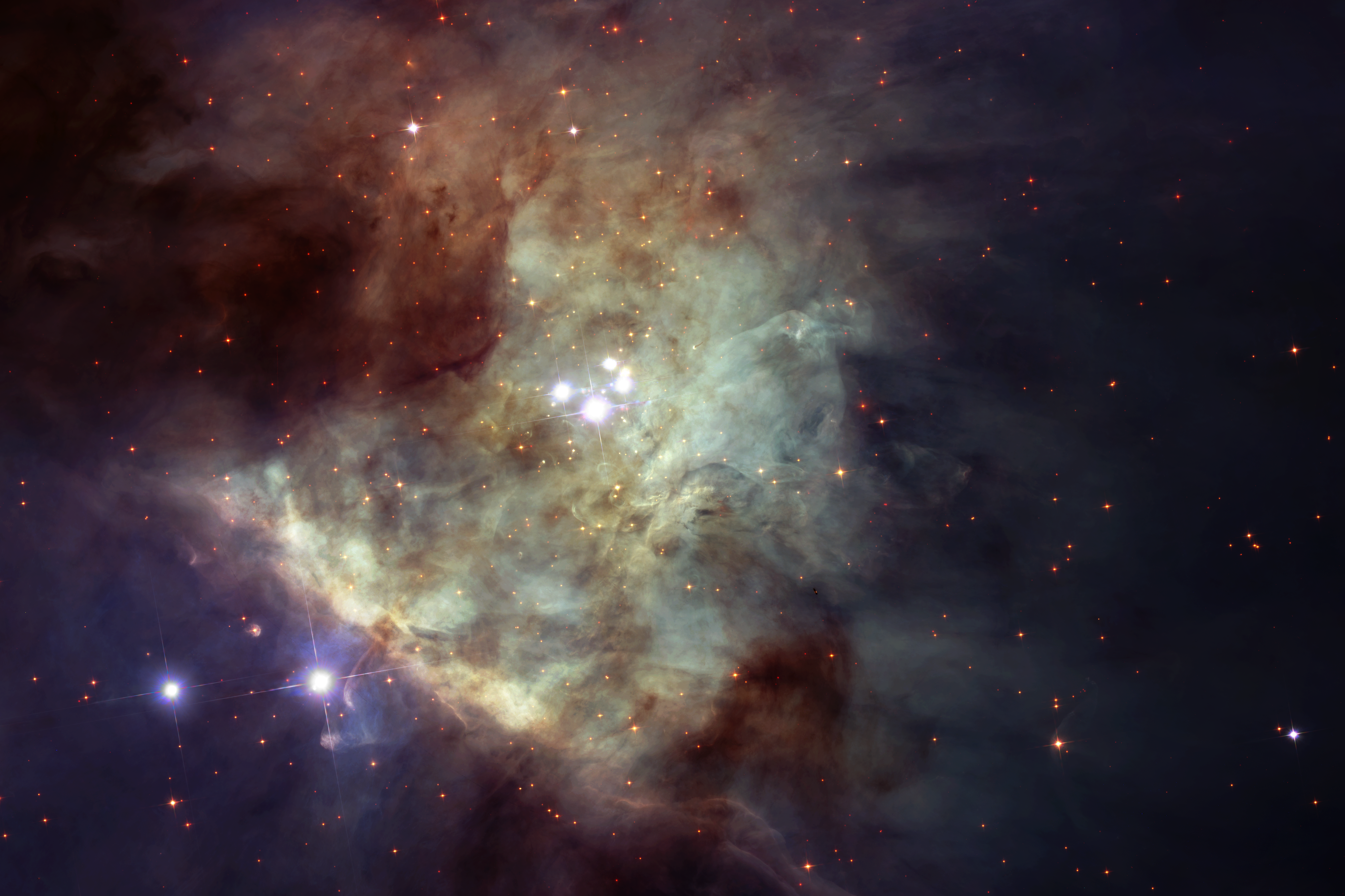
The Orion Nebula Through the Eyes of NASA’s James Webb Space Telescope
The Orion Nebula is one of the closest and most active places where stars are born. Located about 1,350 light-years from Earth in the constellation Orion, this vast cloud of gas and dust has long helped astronomers study how stars and planetary systems take shape. NASA’s James Webb Space Telescope (JWST) is giving researchers an unusually detailed view of this stellar nursery.
Why the Orion Nebula Matters
Visible to the naked eye under dark skies, the Orion Nebula is part of a much larger region of star formation. Within it, young stars are emerging from dense clouds of material. Their intense radiation and powerful winds reshape the surrounding gas, creating a complex environment where stars and potential planets develop.
Because the nebula is relatively nearby, astronomers can examine individual young stars and the disks of dust and gas around them. These disks—known as protoplanetary disks—are the raw material from which planets may eventually form.
How Webb Looks Through Cosmic Dust
Much of the Orion Nebula is obscured by dust that blocks visible light. Webb observes primarily in infrared wavelengths, which can pass through some of that dust and reveal structures hidden from ordinary optical telescopes. Its sharp view helps scientists distinguish young stars, glowing gas, jets of material, and planet-forming disks across the nebula.
Webb’s observations also show how the environment around massive, bright stars affects nearby star-forming regions. Their radiation can heat and erode neighboring disks, potentially influencing how much material remains available to build planets.
Young Stars and Planet-Forming Disks
One of the most important features in Webb’s Orion images is the abundance of young stellar objects. Some are surrounded by disks, while others are still embedded in the gas and dust from which they formed. Studying these systems gives astronomers a closer look at the early stages of stellar and planetary evolution.
Webb’s infrared instruments can reveal details in these disks and help researchers investigate how they change over time. The observations may also improve understanding of how conditions around a young star shape the kinds of planets that can form.
A Surprising Population of Free-Floating Objects
Webb observations of the Orion region have also drawn attention to pairs of Jupiter-mass objects that appear to drift through space without orbiting a star. Researchers nicknamed these objects “JuMBOs,” short for Jupiter-Mass Binary Objects. Their origin is still uncertain, and scientists are studying how such pairs could form and remain together.
These objects are not confirmed planets orbiting stars. Instead, they present a puzzle that may help researchers refine ideas about how stars and planetary-mass bodies form in crowded stellar nurseries.
What Webb’s Orion Images Tell Us
The Orion Nebula is more than a beautiful cosmic scene. It is a natural laboratory for exploring how stars are born, how young stellar systems interact, and how planets may begin to form. By combining Webb’s infrared observations with data from other telescopes, astronomers can investigate the nebula at different wavelengths and build a more complete picture of its activity.
As NASA’s James Webb Space Telescope continues to study star-forming regions, the Orion Nebula will remain an important destination. Each new observation helps reveal how our own solar system’s earliest building blocks may have formed—and how varied the process can be across the universe.
NASA’s James Webb Space Telescope and the Orion Nebula: 8 Frequently Asked Questions
- What has NASA’s James Webb Space Telescope discovered in the Orion Nebula?
- How does Webb’s infrared vision help it see through the Orion Nebula’s dust?
- How far away is the Orion Nebula from Earth?
- What do Webb’s images reveal about star formation in the Orion Nebula?
- What are protoplanetary disks, and how has Webb observed them in the Orion Nebula?
- What are the Jupiter-mass binary objects, or JuMBOs, found in the Orion Nebula?
- How does radiation from massive stars affect nearby young stars and planet-forming disks?
- Where can I see NASA’s James Webb images of the Orion Nebula?
What has NASA’s James Webb Space Telescope discovered in the Orion Nebula?
NASA’s James Webb Space Telescope has revealed remarkably detailed views of the Orion Nebula’s young stars, glowing gas, and planet-forming disks, including structures obscured by dust in visible light. Its observations have also identified unusual pairs of Jupiter-mass objects that appear to drift freely without orbiting stars, nicknamed “JuMBOs.” Their origins remain uncertain, and they are prompting astronomers to rethink how objects form in crowded stellar nurseries.
How does Webb’s infrared vision help it see through the Orion Nebula’s dust?
Webb’s infrared vision helps it detect light that can travel through some of the dust in the Orion Nebula more easily than visible light. Dust grains scatter and absorb much visible light, hiding young stars and other features, while infrared wavelengths are less affected. Webb’s sensitive instruments can therefore reveal stars, glowing gas, and planet-forming disks that would be difficult to observe in visible-light images. Dust can still block some infrared light, so Webb does not see through every part of the nebula, but its observations provide a much clearer view of many hidden regions.
How far away is the Orion Nebula from Earth?
The Orion Nebula is about 1,350 light-years from Earth, making it one of the closest major star-forming regions to our solar system. NASA’s James Webb Space Telescope can observe its young stars and planet-forming disks in remarkable detail, using infrared light to reveal features hidden behind clouds of dust.
What do Webb’s images reveal about star formation in the Orion Nebula?
Webb’s infrared images reveal young stars forming inside dense clouds of gas and dust, along with jets, glowing structures, and disks of material that may eventually form planets. Because infrared light can pass through some of the dust that obscures visible light, Webb lets astronomers study these stellar nurseries in remarkable detail. Its observations also show how radiation from massive stars can heat and erode nearby planet-forming disks, offering clues about how a star’s surroundings influence the formation of planets.
What are protoplanetary disks, and how has Webb observed them in the Orion Nebula?
Protoplanetary disks are rotating rings of gas and dust surrounding young stars—the raw material from which planets may form. In the Orion Nebula, NASA’s James Webb Space Telescope has used infrared light to peer through some of the surrounding dust and capture detailed views of these disks, including their shapes and interactions with intense radiation from nearby massive stars. These observations help astronomers study how disks change over time and how the conditions around young stars may influence the formation of planets.
What are the Jupiter-mass binary objects, or JuMBOs, found in the Orion Nebula?
Jupiter-mass binary objects, or JuMBOs, are pairs of free-floating objects about the mass of Jupiter that NASA’s James Webb Space Telescope observed in the Orion Nebula. Unlike planets in familiar solar systems, they do not appear to orbit stars, yet each pair travels together through the star-forming region. Their existence has puzzled astronomers because current models do not easily explain how such low-mass objects could form in pairs and remain gravitationally bound. Researchers are studying JuMBOs to learn more about how stars and planetary-mass objects form in crowded stellar nurseries.
How does radiation from massive stars affect nearby young stars and planet-forming disks?
In the Orion Nebula, intense ultraviolet radiation from massive stars—especially those in the Trapezium Cluster—heats nearby gas and dust and can gradually strip material from young stars’ planet-forming disks, a process called photoevaporation. This may shorten the time available for planets to form or alter the kinds of planets that can develop. The radiation also reshapes the surrounding clouds and can compress some regions, potentially encouraging new stars to form, so its effects depend on how close a young system is and how much material shields it.
Where can I see NASA’s James Webb images of the Orion Nebula?
You can view NASA’s James Webb Space Telescope images of the Orion Nebula on NASA’s website, especially its Webb Space Telescope and Image of the Day pages. NASA’s Flickr and social media accounts may also feature the images, while the European Space Agency (ESA) and Canadian Space Agency (CSA)—Webb’s partner agencies—share related images and explanations. Look for official captions and credits to learn what each image shows and how Webb’s infrared observations reveal details hidden by cosmic dust.