
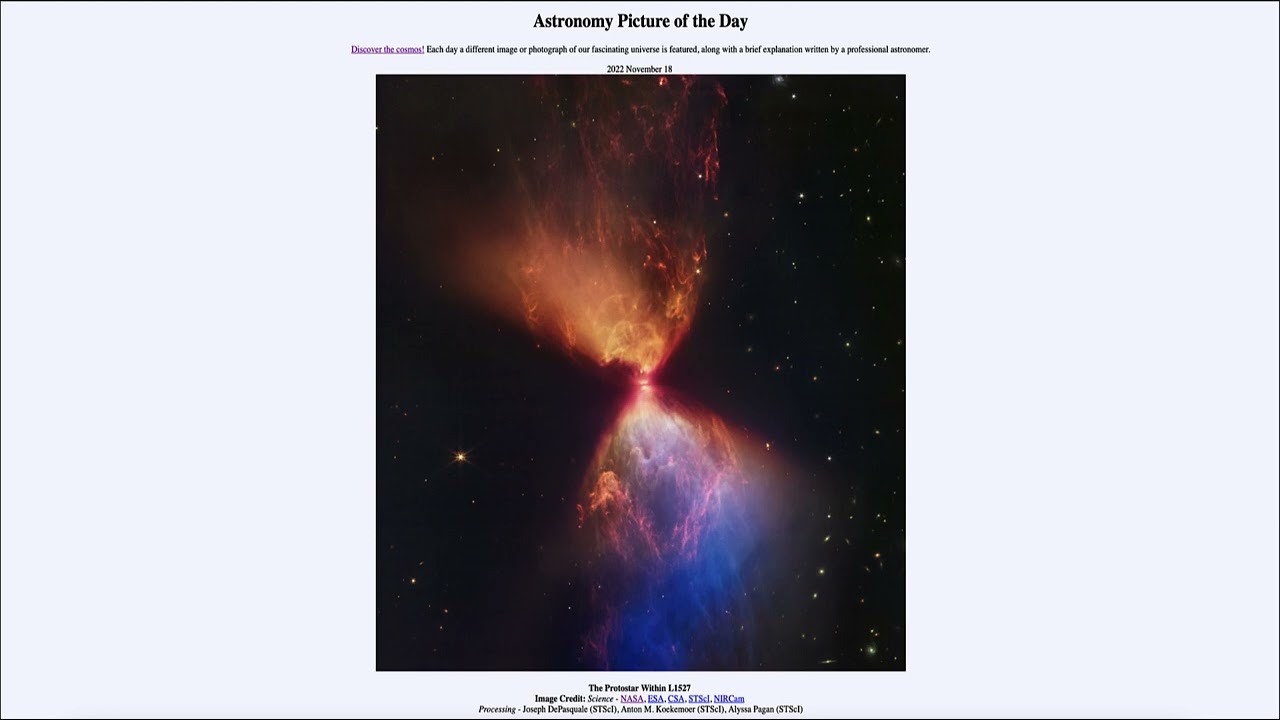
L1527: A Star Taking Shape Inside a Cosmic Hourglass
In the constellation Taurus, a young star is emerging from a dense cloud of gas and dust. The object, known as L1527, is a stellar nursery where astronomers can study the earliest stages of star formation. Images from NASA’s James Webb Space Telescope have revealed the region’s striking hourglass shape in remarkable detail.
A Young Star Hidden in Dust
L1527 lies about 460 light-years from Earth. At its center is a protostar called L1527 IRS. A protostar is a young object that is still gathering material and has not yet settled into the stable phase of a star like the Sun.
Thick clouds of dust block much of the visible light from the protostar, making it difficult to observe with ordinary optical telescopes. Infrared instruments, including Webb’s Near-Infrared Camera (NIRCam), can detect light that passes through some of this dust and reveal structures hidden within the cloud.
How the Hourglass Forms
The hourglass-shaped region around L1527 is created as material flows away from the growing protostar. The outflow clears cavities in the surrounding cloud, opening two broad lobes above and below the star. Light from the protostar illuminates the cavity walls, making them visible in infrared images.
A dark band running through the middle of the hourglass marks the dense material surrounding the protostar. Within this region, gas and dust are falling inward and forming a rotating disk. Over time, some of the disk’s material may become part of the star, while other material could contribute to the formation of planets.
A Glimpse Into Star Formation
L1527 offers astronomers a close look at a process that is usually difficult to observe. The young protostar is still gathering matter, and its surrounding disk is an early step on the path toward a mature star system. Studying the structure and composition of the region helps researchers investigate how stars grow and how the ingredients for planets begin to collect.
Webb’s observations also show how complex a stellar nursery can be. The glowing cavities, dark dust lanes, and compact central region are different parts of an active environment shaped by gravity, radiation, and outflowing material.
Why L1527 Matters
Although L1527 is not a finished star, it provides a valuable snapshot of stellar beginnings. Its dramatic appearance is more than a beautiful image: it is evidence of a young star reshaping the cloud from which it formed. By observing objects like L1527, astronomers can better understand how stars—and, eventually, planetary systems—come into being.
L1527 Nebula: 8 Tips for Exploring Webb’s Cosmic Hourglass
- L1527 is a young stellar object in the Taurus star-forming region.
- Its central protostar is hidden by a thick, edge-on disk of dust and gas.
- Look for the nebula’s distinctive hourglass shape.
- The bright lobes are cavities illuminated by the forming star.
- Outflows from the protostar help shape those cavities.
- Dust near the center appears as a dark band across the nebula.
- The James Webb Space Telescope captured a detailed infrared view of L1527.
- In telescope images, colors may represent infrared light rather than visible colors.
L1527 is a young stellar object in the Taurus star-forming region.
L1527 is a young stellar object in the Taurus star-forming region, where clouds of gas and dust are giving rise to new stars. Still in an early stage of development, it is gathering material from its surroundings and offers astronomers a valuable glimpse into how stars begin to form.
Its central protostar is hidden by a thick, edge-on disk of dust and gas.
At the heart of the L1527 nebula, a young protostar is concealed behind a thick disk of dust and gas viewed nearly edge-on from Earth. The disk blocks much of the protostar’s direct light, making the growing star difficult to see. Instead, its light escapes above and below the disk, illuminating the surrounding cloud and helping create L1527’s distinctive hourglass-shaped appearance.
Look for the nebula’s distinctive hourglass shape.
Look for L1527’s distinctive hourglass shape: two glowing lobes extend above and below a dark central band of dust. This striking structure forms as the young protostar at the center pushes material into the surrounding cloud, carving out cavities that glow when illuminated. The dark band marks dense gas and dust around the protostar, where material is gathering in a rotating disk.
The bright lobes are cavities illuminated by the forming star.
The bright lobes of the L1527 nebula are cavities carved into the surrounding cloud of gas and dust by material flowing away from its forming star. Light from the young star shines into these hollowed-out regions and illuminates their walls, creating the nebula’s distinctive glowing, hourglass-like shape.
Outflows from the protostar help shape those cavities.
Outflows from the protostar help shape the cavities in L1527’s surrounding cloud. As gas streams away from the young star in opposite directions, it pushes through nearby dust and material, gradually carving out the nebula’s distinctive hourglass-like lobes. These outflows reveal how a growing protostar can reshape its environment even as it gathers matter to become a star.
Dust near the center appears as a dark band across the nebula.
Near the center of the L1527 nebula, a thick band of dust appears as a dark stripe across the glowing hourglass-shaped region. This dense material surrounds the young protostar and helps feed its growth, while also obscuring some of the light behind it. The band is part of a rotating disk of gas and dust where planets may eventually form.
The James Webb Space Telescope captured a detailed infrared view of L1527.
The James Webb Space Telescope captured a detailed infrared view of L1527, revealing features hidden by the dense cloud of gas and dust surrounding its young protostar. The image shows the region’s distinctive hourglass-shaped cavities, carved by material flowing away from the forming star, as well as the dark band of dust and gas where a rotating disk is taking shape. These observations give astronomers a closer look at the earliest stages of star formation.
In telescope images, colors may represent infrared light rather than visible colors.
In telescope images of the L1527 nebula, the colors often represent infrared light—not colors the human eye would see. Infrared wavelengths are translated into visible shades so scientists can map features such as warm gas, dust, and the cavities carved by the young protostar. The colors help reveal the nebula’s structure, but they are a visual guide to data rather than a literal view of its appearance.