
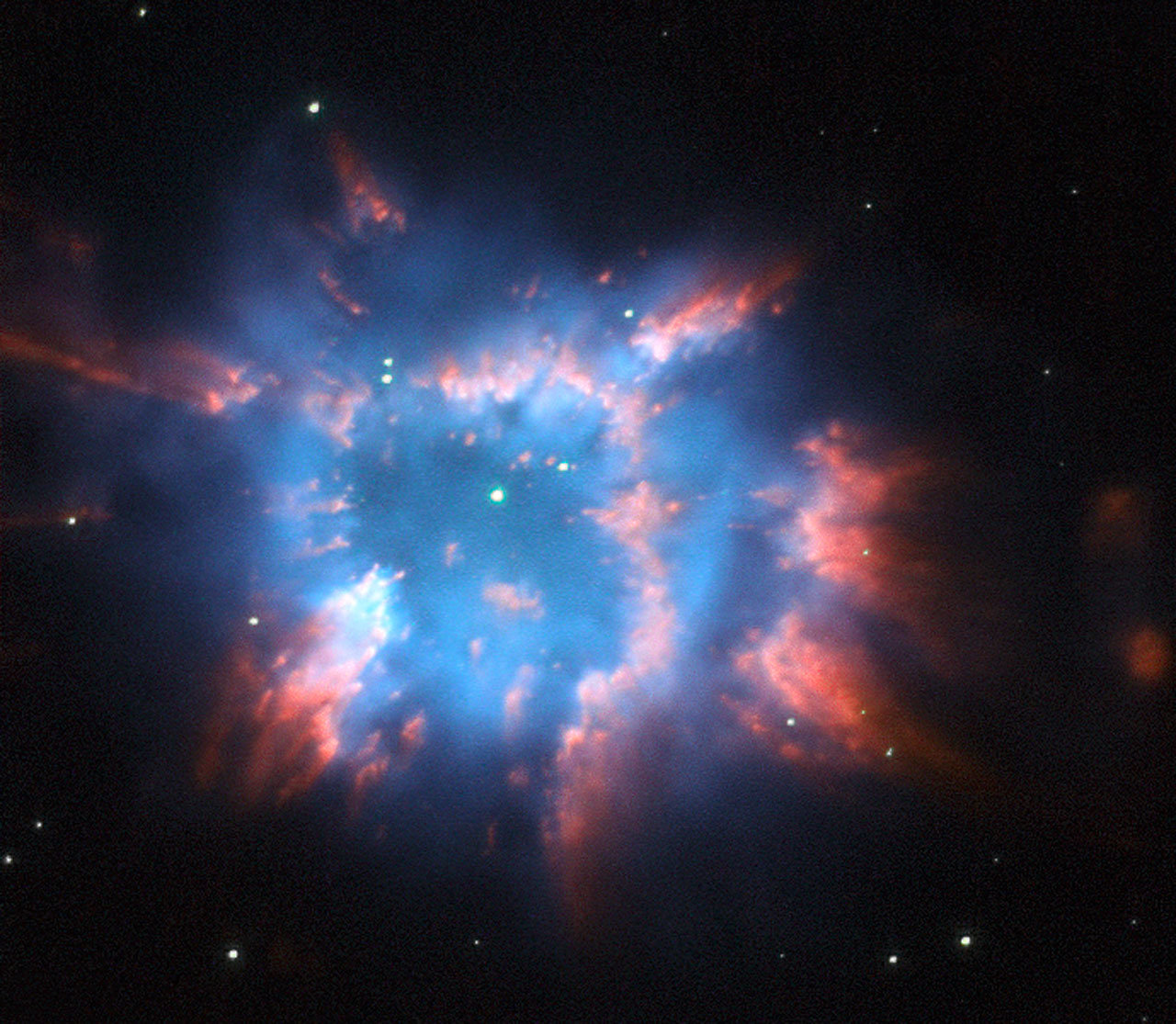
Planetary Nebulae: NASA’s View of a Star’s Final Encore
Despite the name, a planetary nebula has nothing to do with planets. The term dates back to early astronomers, who saw these glowing clouds through small telescopes and thought they looked like planets. Today, NASA’s space telescopes reveal them as something quite different: vast, intricate shells of gas shed by dying stars.
How a Planetary Nebula Forms
A planetary nebula begins with a star roughly similar in mass to the Sun. After the star has spent billions of years converting hydrogen into energy, it expands into a red giant. In its final stages, the star releases its outer layers into space. Radiation from the exposed, extremely hot core energizes the expelled gas, causing it to glow.
The glowing nebula is temporary. It expands and disperses over thousands of years, while the stellar core remains behind as a white dwarf. Planetary nebulae are therefore not the stars themselves, but the material the stars cast off.
What NASA Space Telescopes Reveal
NASA missions observe planetary nebulae in different wavelengths of light, revealing details that are difficult or impossible to see from the ground. The Hubble Space Telescope captures crisp visible-light views of their shapes and structures. The James Webb Space Telescope observes infrared light, which can reveal cooler dust and features hidden within dense clouds of gas.
One striking example is the Southern Ring Nebula, also known as NGC 3132. Webb’s observations show layers of gas and dust surrounding the central stars. The nebula’s shape is influenced by more than one star: a companion star helps shape the material as it escapes. This kind of close-up view gives astronomers clues about how stars interact during their final stages.
Other well-known examples include the Helix Nebula, whose ring-like appearance has earned it the nickname “Eye of God,” and the Cat’s Eye Nebula, famous for its layered shells and complex structure. Their different shapes show that a star’s surroundings and companion stars can affect how its final outflow unfolds.
Why Planetary Nebulae Matter
These nebulae help astronomers understand how stars evolve and how elements are returned to space. The gas released by aging stars can contain elements created during the star’s lifetime. Eventually, this material mixes with the surrounding interstellar clouds and may become part of new stars and planets.
Planetary nebulae also offer a preview of the Sun’s distant future. In about five billion years, the Sun is expected to become a red giant and later shed its outer layers. It will not explode as a supernova; instead, it is expected to leave behind a white dwarf surrounded for a time by glowing material.
A Brief but Brilliant Phase
A planetary nebula is a short-lived chapter in a star’s long life. Its changing shapes and glowing colors are more than beautiful sights: they are evidence of the processes that recycle matter across the galaxy. With observations from Hubble, Webb, and other NASA missions, astronomers can study these stellar finales in greater detail—and learn how the elements that make up future worlds return to space.
7 NASA Insights Into Planetary Nebulae and How Stars Evolve
- A planetary nebula forms when a Sun-like star sheds its outer layers.
- Despite the name, a planetary nebula has nothing to do with planets.
- Its glowing gas is lit by ultraviolet light from the hot central star.
- The central star is often a white dwarf in the making.
- NASA’s Hubble and Webb telescopes reveal nebulae in different wavelengths.
- Compare visible-light and infrared images to spot different details.
- Studying these nebulae helps scientists understand how stars evolve.
A planetary nebula forms when a Sun-like star sheds its outer layers.
A planetary nebula forms when a Sun-like star reaches the end of its life and sheds its outer layers into space. The star’s hot core illuminates this expanding cloud of gas, creating the glowing shapes astronomers observe through telescopes such as NASA’s Hubble and James Webb Space Telescopes. Despite its name, a planetary nebula has no connection to planets; it is a brief, beautiful stage in a star’s evolution.
Despite the name, a planetary nebula has nothing to do with planets.
Despite its name, a planetary nebula has nothing to do with planets. Early astronomers coined the term because these glowing clouds looked like planets when viewed through small telescopes. NASA observations now reveal their true nature: expanding shells of gas released by aging stars, illuminated by the stars’ hot cores.
Its glowing gas is lit by ultraviolet light from the hot central star.
A planetary nebula shines because its hot central star floods the surrounding gas with ultraviolet light. This radiation energizes atoms in the gas, causing them to glow in colorful patterns that telescopes such as NASA’s Hubble and James Webb can observe. The nebula’s light is a brief but brilliant sign of a star nearing the end of its life.
The central star is often a white dwarf in the making.
At the heart of many planetary nebulae is a central star in transition: the hot, exposed core of a star that has shed its outer layers. This compact remnant is on its way to becoming a white dwarf, the dense stellar ember that remains after a Sun-like star runs out of fuel. Its intense radiation lights up the surrounding gas, making the nebula glow as the star gradually cools over time.
NASA’s Hubble and Webb telescopes reveal nebulae in different wavelengths.
NASA’s Hubble and James Webb Space Telescopes reveal planetary nebulae in different wavelengths, giving astronomers complementary views of these stellar clouds. Hubble’s visible-light observations highlight glowing gas and intricate shapes, while Webb’s infrared vision can peer through dust to uncover cooler material and hidden details. Together, their images help scientists build a more complete picture of how dying stars shed and shape their outer layers.
Compare visible-light and infrared images to spot different details.
Compare visible-light and infrared images of a planetary nebula to reveal features each view shows best. Visible-light images highlight glowing gases and sharply defined shapes, while infrared images can uncover cooler dust, hidden structures, and regions obscured by dense clouds. Together, these perspectives give a more complete picture of how the nebula formed and changes over time.
Studying these nebulae helps scientists understand how stars evolve.
Studying planetary nebulae helps scientists understand how stars change as they approach the end of their lives. By observing the glowing gas that aging stars release into space, astronomers can investigate how stars shed their outer layers, form white dwarfs, and return elements to the galaxy. NASA telescopes capture these nebulae in different wavelengths, revealing details about their composition and structure and offering clues to the future evolution of stars like our Sun.