
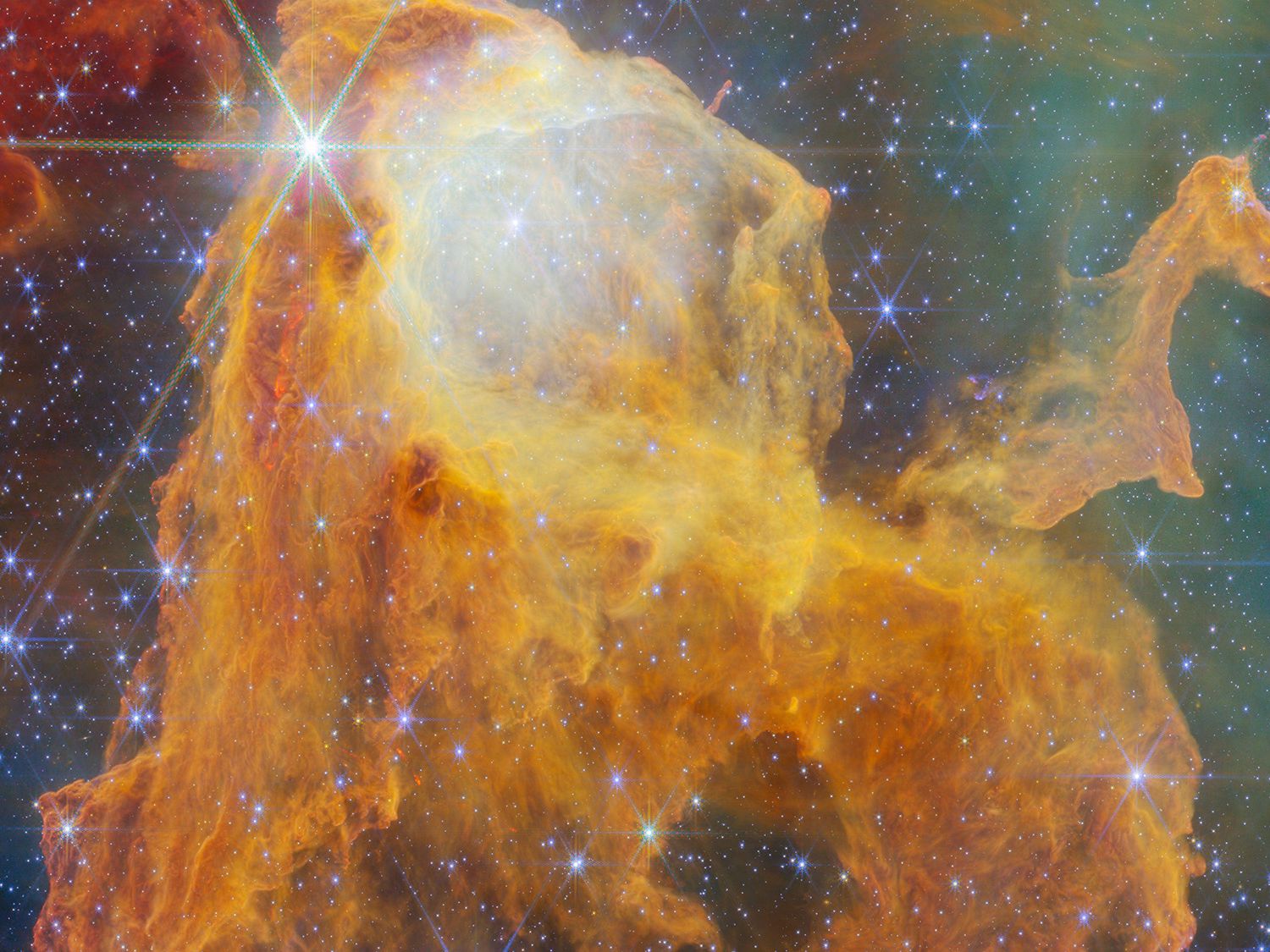
The James Webb Space Telescope Reveals the Orion Nebula in New Detail
The Orion Nebula is one of the closest and brightest regions of active star formation. Located about 1,350 light-years from Earth in the constellation Orion, it is a vast cloud of gas and dust where new stars—and the planetary systems around them—are taking shape. With its powerful infrared instruments, the James Webb Space Telescope (JWST) has offered astronomers an unusually detailed look inside this stellar nursery.
Seeing Through Cosmic Dust
Visible-light images of the nebula show glowing clouds, bright young stars, and dramatic arcs of gas. But much of the region’s activity is hidden behind dust. Infrared light can pass through some of that dust, allowing Webb to observe structures that would otherwise be difficult to see.
Webb’s Near-Infrared Camera, or NIRCam, captures fine details in the nebula’s gas and dust, while its Mid-Infrared Instrument, or MIRI, helps researchers study cooler material. Together, these observations reveal a richly layered landscape shaped by radiation and winds from young, massive stars.
A Stellar Nursery in Motion
At the heart of the Orion Nebula is the Trapezium Cluster, a group of hot, massive stars. Their intense ultraviolet radiation heats nearby gas and erodes the clouds from which other stars are forming. The result is a complex boundary between exposed, glowing gas and denser, dustier material.
One notable feature is the Orion Bar, a curved region where radiation from the massive stars meets a dense cloud. Webb’s observations help scientists examine how this radiation changes the chemistry and structure of the gas. By studying these details, researchers can better understand the conditions in which young stars and planets develop.
Disks, Jets, and the Beginnings of Planetary Systems
Many young stars are surrounded by disks of gas and dust. Over time, material in these disks may gather into planets. Webb can observe some of these disks and the small, bright features associated with young stars, including jets of material streaming into space.
These observations help astronomers compare different stages of star formation. They can investigate how quickly young stars lose their surrounding material, how radiation affects planet-forming disks, and what kinds of environments may support the formation of planets.
A Surprising Discovery
Webb observations of the Orion Nebula have also drawn attention to pairs of free-floating objects with masses similar to those of giant planets. These objects, sometimes called Jupiter-mass binary objects, appear to move through space without orbiting a star. Their existence in pairs raises questions about how they formed and whether they should be understood as very low-mass stars, planetary-mass objects, or something in between.
Scientists are still studying these objects, and their origins remain uncertain. The discovery illustrates how Webb can not only refine existing ideas but also reveal phenomena that challenge current models.
Why the Orion Nebula Matters
The Orion Nebula is a nearby laboratory for studying star formation. Because it is relatively close to Earth, astronomers can examine individual stars and structures in greater detail than they can in many more distant stellar nurseries. Webb’s infrared vision adds another layer to that research, helping reveal the interplay among stars, gas, dust, and developing planetary systems.
Each new observation contributes to a broader picture of how stars are born and how the materials that may eventually form planets are shaped. The Orion Nebula remains a familiar sight in the night sky, but the James Webb Space Telescope shows that it is also a dynamic environment full of details still waiting to be understood.
8 Tips for Exploring the Orion Nebula With the James Webb Space Telescope
- JWST observes the Orion Nebula in infrared light.
- The nebula is a nearby region where stars are forming.
- Infrared images reveal dust-hidden young stars.
- Use the telescope’s images to explore glowing gas and dust.
- Look for bright, hot stars shaping the surrounding clouds.
- JWST can detect disks of material around newborn stars.
- Compare infrared views with visible-light images for different details.
- The Orion Nebula lies about 1,300 light-years from Earth.
JWST observes the Orion Nebula in infrared light.
The James Webb Space Telescope observes the Orion Nebula in infrared light, which can pass through much of the cosmic dust that blocks visible light. This allows Webb to reveal details hidden within the nebula, including young stars, clouds of gas and dust, and the disks of material that may eventually form planets. By studying these features, astronomers can learn more about how stars and planetary systems begin.
The nebula is a nearby region where stars are forming.
The Orion Nebula is one of the closest regions of active star formation to Earth, making it a valuable place for astronomers to study how stars are born. Using its infrared instruments, the James Webb Space Telescope can peer through some of the nebula’s dust to reveal young stars and the clouds of gas and dust around them. These observations help researchers learn more about the environments where stars—and potentially planets—begin to form.
Infrared images reveal dust-hidden young stars.
The James Webb Space Telescope’s infrared images peer through layers of cosmic dust to reveal young stars hidden inside the Orion Nebula. These stars are difficult to spot in visible light because the surrounding dust blocks or scatters their light, but infrared wavelengths can pass through much of the haze. By uncovering these stellar infants and their surroundings, Webb helps astronomers study how stars form and how their intense radiation shapes the nebula.
Use the telescope’s images to explore glowing gas and dust.
Use the James Webb Space Telescope’s images to explore the Orion Nebula’s glowing gas and dust in remarkable detail. Webb’s infrared vision can reveal structures hidden within the nebula’s dusty clouds, including bright regions shaped by young stars. As you look closely, notice how the colors and patterns trace the material where stars and planetary systems are beginning to form.
Look for bright, hot stars shaping the surrounding clouds.
Look for the bright, hot stars near the center of the Orion Nebula and notice how they shape the clouds around them. Their intense radiation heats nearby gas and dust, making some regions glow while eroding and sculpting the surrounding material. These stars act like cosmic spotlights and powerful engines, revealing the nebula’s structure and influencing where new stars may form.
JWST can detect disks of material around newborn stars.
The James Webb Space Telescope can detect disks of gas and dust surrounding newborn stars, even when those disks are difficult to see in visible light. Using infrared observations, Webb can peer through some of the surrounding cosmic dust and study the disks’ structure and composition. These disks are important because they are the raw material from which planets may eventually form, offering astronomers a closer look at the early stages of planetary-system development in the Orion Nebula.
Compare infrared views with visible-light images for different details.
Compare James Webb Space Telescope infrared images of the Orion Nebula with visible-light images to see how each reveals different details. Visible light highlights glowing gas and familiar bright features, while infrared light can pass through much of the nebula’s dust, revealing hidden structures, young stars, and disks of material. Looking at both views together gives a fuller picture of this active star-forming region.
The Orion Nebula lies about 1,300 light-years from Earth.
The Orion Nebula lies about 1,300 light-years from Earth, making it one of the closest major star-forming regions to our planet. Its relative proximity gives astronomers a detailed view of how stars and planetary systems begin to form, while the James Webb Space Telescope’s infrared observations reveal structures hidden within its clouds of gas and dust.