
The Orion Nebula Through the Eyes of the James Webb Space Telescope
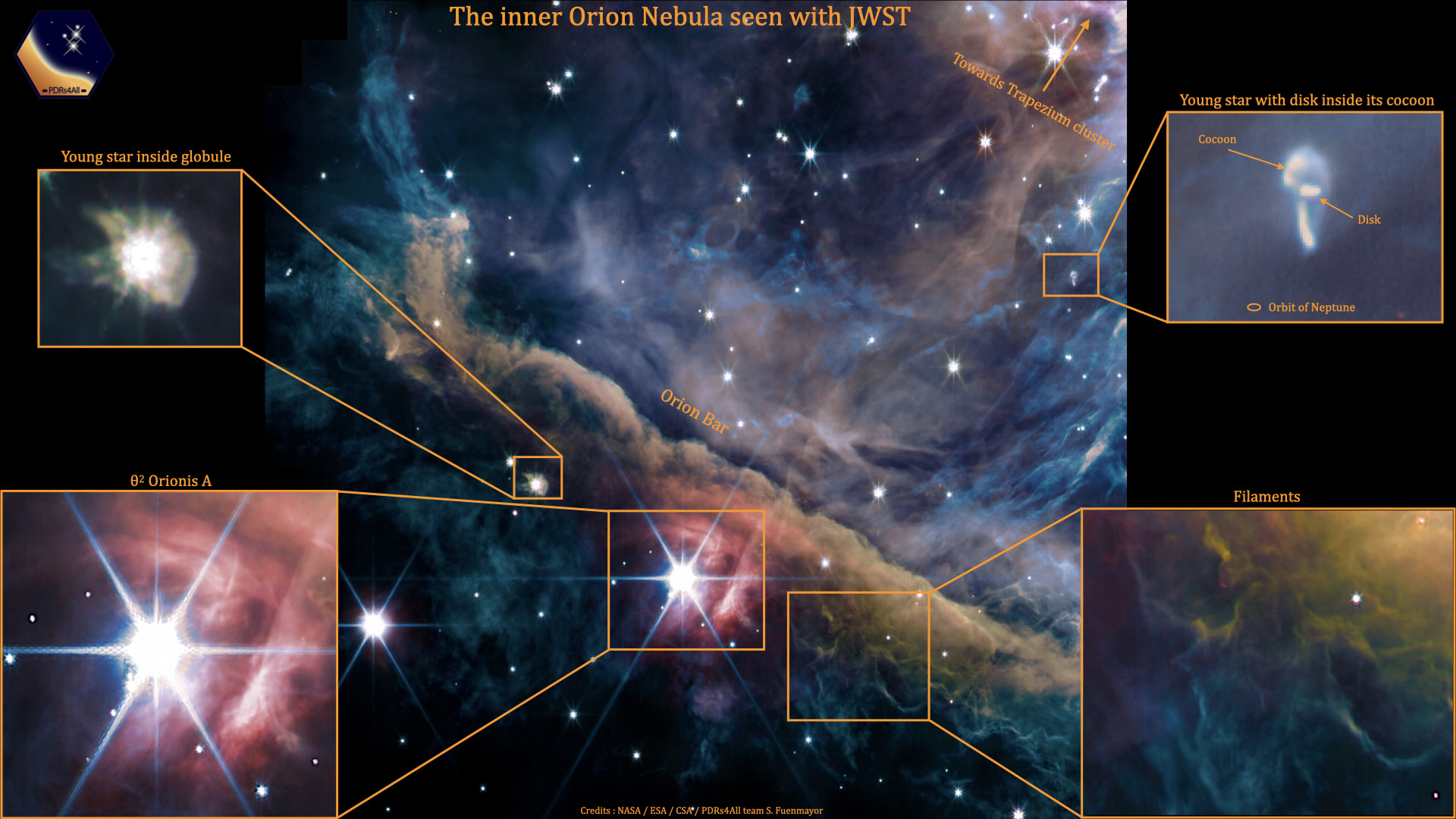
The Orion Nebula is one of the closest and most active stellar nurseries to Earth. Located about 1,300 light-years away in the constellation Orion, this vast cloud of gas and dust is a place where new stars are taking shape. The James Webb Space Telescope (JWST) has given astronomers an exceptionally detailed look inside it, revealing structures that are difficult or impossible to see in ordinary visible-light images.
What Is the Orion Nebula?
Also known as Messier 42, or M42, the Orion Nebula is a star-forming region visible to the naked eye under dark skies. Its glowing clouds surround a young cluster of stars, including the bright group known as the Trapezium. Radiation and powerful winds from these stars heat and reshape the surrounding material.
Within the nebula, dense pockets of gas and dust collapse under gravity. Over time, some of these regions form stars and planetary systems. The Orion Nebula therefore offers scientists a nearby natural laboratory for studying how stars are born.
Why Webb’s Infrared Vision Matters
Visible light is often blocked by the thick clouds of dust found in star-forming regions. Webb observes primarily in infrared light, which can pass through much of that dust. Its instruments can also detect heat from young stars and other objects embedded within the nebula.
Webb’s Near-Infrared Camera, or NIRCam, has captured detailed views of the Orion Nebula’s crowded inner regions. The telescope’s Mid-Infrared Instrument, or MIRI, adds information about cooler dust and gas. Together, these observations help researchers map the nebula’s structure and examine objects at different stages of development.
What Webb Has Revealed
Webb’s images show a complex landscape of glowing gas, dark dust lanes, young stars, and energetic outflows. They reveal how radiation from massive stars sculpts nearby clouds, carving cavities and creating sharp boundaries between illuminated and sheltered regions.
One important feature is the Orion Bar, a bright, curved region where intense radiation from nearby stars meets a dense cloud of gas. Studying this boundary helps astronomers understand how ultraviolet light changes the chemistry and structure of interstellar material.
Webb has also revealed protoplanetary disks—flattened rings of gas and dust around young stars. These disks are the raw material from which planets can form. Some lie close to bright, massive stars, where strong radiation can heat the disks and strip away their material. Comparing disks in different environments helps scientists explore how a star’s surroundings may affect planet formation.
Free-Floating Objects and New Questions
Among the surprising discoveries reported from Webb observations of Orion are pairs of objects with masses similar to those of giant planets. Researchers have called these objects Jupiter-mass binary objects, or JuMBOs. They appear to drift through space without orbiting a star, and some are found in pairs.
Their origins are still being investigated. They may challenge existing ideas about how low-mass objects form and how gravitational interactions shape young stellar systems. Webb’s observations have made these objects easier to study, but astronomers need more evidence to determine exactly what they are and how they came to be.
A Closer Look at Star Formation
The Orion Nebula is more than a beautiful astronomical target. It allows researchers to investigate how stars interact with their birth clouds, how disks survive in harsh environments, and what conditions may influence the formation of planets. Because it is relatively close and contains many young objects, Orion provides a valuable comparison point for studying more distant star-forming regions.
Webb’s views do not simply make the nebula look sharper. They reveal different kinds of light and expose details hidden behind dust. Each observation adds to the picture of a dynamic region where stars—and perhaps future planetary systems—are taking shape.
8 Tips for Exploring the Orion Nebula with the Webb Telescope
- Look for the Orion Nebula in Orion’s Sword.
- Webb sees infrared light hidden from human eyes.
- Dusty clouds reveal newborn stars in Webb images.
- The Trapezium stars illuminate the nebula’s core.
- Webb has spotted young stars with planet-forming disks.
- Compare Webb’s infrared view with visible-light images.
- Nebula colors in Webb images represent different wavelengths.
- Use a star chart to find Orion on clear winter nights.
Look for the Orion Nebula in Orion’s Sword.
To find the Orion Nebula, first look for Orion’s Belt—the three bright stars in a row—then follow the short line of fainter stars hanging below it to Orion’s Sword. On a clear, dark night, the nebula may appear as a faint, fuzzy patch near the middle of the Sword. Binoculars can make it easier to spot, while a telescope or a long-exposure photograph can reveal more detail. The James Webb Space Telescope has captured remarkable infrared views of this star-forming region, but you can still find its location in the sky with your own eyes.
Webb sees infrared light hidden from human eyes.
The James Webb Space Telescope sees the Orion Nebula in infrared light, which is invisible to human eyes but can pass through much of the dust that blocks visible light. This lets Webb reveal hidden details, including young stars, warm dust, and structures deep inside the nebula. By observing these features, astronomers can learn more about how stars and planetary systems form.
Dusty clouds reveal newborn stars in Webb images.
In Webb images of the Orion Nebula, dense clouds of cosmic dust reveal the busy beginnings of new stars. Webb’s infrared vision can peer through much of this dust, showing young stars still embedded in the clouds where they formed. These observations help astronomers study how newborn stars interact with their surroundings and how the raw ingredients for future planetary systems take shape.
The Trapezium stars illuminate the nebula’s core.
The Trapezium is a compact group of young, massive stars at the heart of the Orion Nebula. Their intense ultraviolet light illuminates the surrounding gas, making the nebula’s core glow, while their stellar winds carve and reshape nearby clouds of gas and dust. Webb’s infrared observations help reveal how this brilliant cluster interacts with the hidden structures around it.
Webb has spotted young stars with planet-forming disks.
Webb has spotted young stars in the Orion Nebula surrounded by planet-forming disks—rings of gas and dust that can gradually gather into planets. By observing these disks in infrared light, Webb can peer through some of the nebula’s obscuring dust and reveal details that are difficult to see with visible-light telescopes. Studying how the disks form and survive in Orion’s intense environment helps astronomers understand how planetary systems may begin.
Compare Webb’s infrared view with visible-light images.
Compare Webb’s infrared view of the Orion Nebula with visible-light images to see how different wavelengths reveal different details. Visible light highlights glowing gas and bright stars, while infrared light can pass through much of the dust, uncovering young stars and structures hidden within the nebula. Looking at both views side by side offers a fuller picture of this active stellar nursery.
Nebula colors in Webb images represent different wavelengths.
In James Webb Space Telescope images of the Orion Nebula, colors are assigned to different infrared wavelengths so details that human eyes cannot see become visible. These colors are not necessarily what the nebula would look like to the naked eye; instead, they help distinguish features such as warm dust, glowing gas, and young stars. The exact color choices can vary by image and processing method, but each one helps astronomers—and viewers—explore the nebula’s structure and activity.
Use a star chart to find Orion on clear winter nights.
On clear winter nights, use a star chart to locate Orion, one of the easiest constellations to recognize. Look for the three bright stars in a row that form Orion’s Belt, then trace the stars below them to Orion’s Sword. The Orion Nebula lies in the Sword and may appear as a faint, fuzzy patch to the naked eye under dark skies. Once you’ve found it, explore Webb’s infrared images to see details hidden within the nebula’s clouds of gas and dust.