
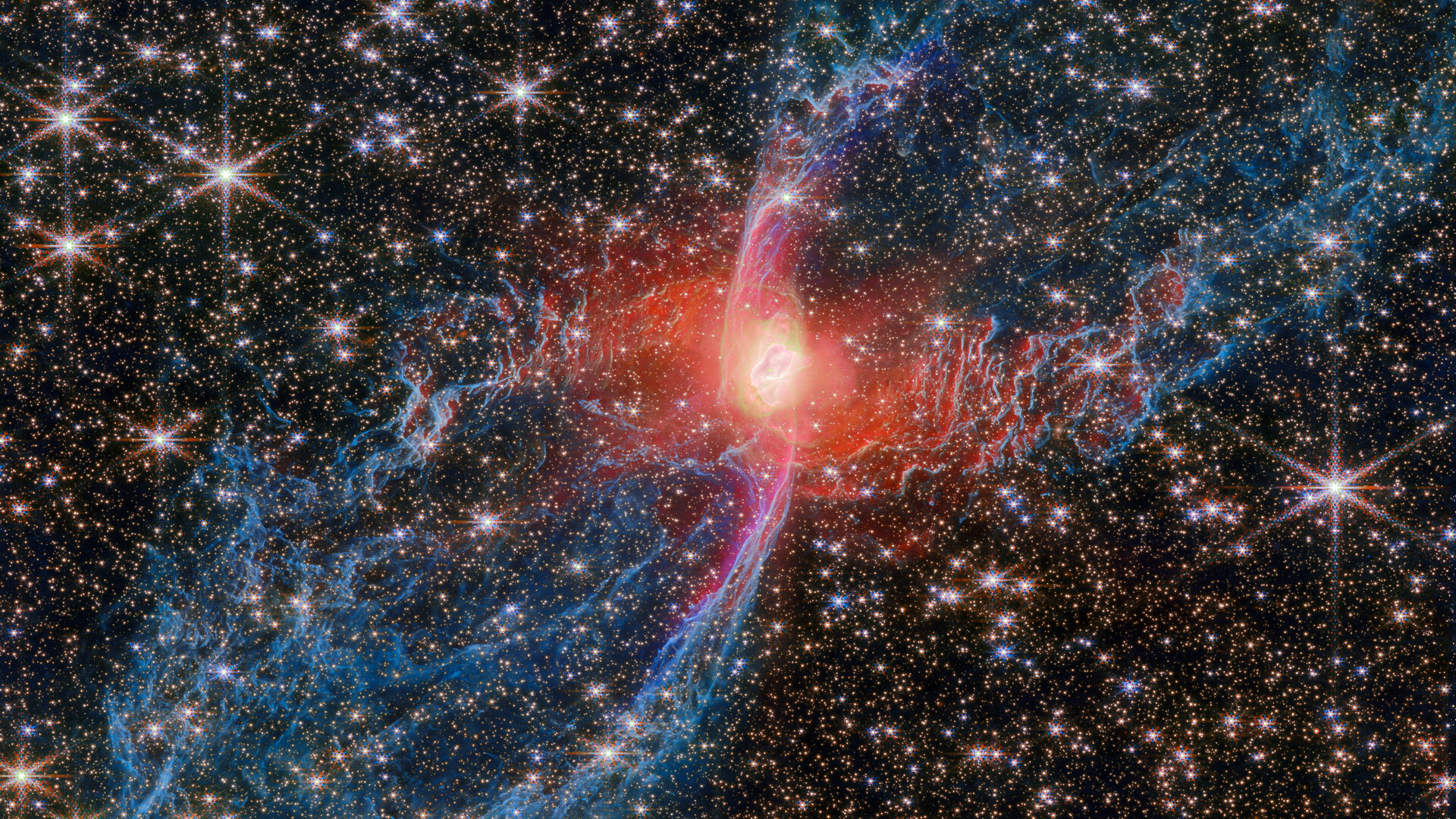
Nebulae Through the James Webb Space Telescope
The James Webb Space Telescope (JWST) is revealing nebulae in remarkable detail. Its infrared instruments can peer through some clouds of cosmic dust, highlighting young stars, heated gas, and structures that are difficult to see in visible light. These observations help astronomers study how stars form, evolve, and shape the space around them.
What Is a Nebula?
A nebula is a vast cloud of gas and dust in space. Some nebulae are regions where new stars are forming. Others are created when stars shed their outer layers or explode. Nebulae can span many light-years, and their shapes are influenced by radiation, stellar winds, gravity, and magnetic fields.
Although nebulae often appear colorful in telescope images, those colors are typically assigned to represent different wavelengths of light. The images combine scientific measurements with visual choices that make details easier to distinguish.
Why Webb Observes in Infrared
Webb was designed primarily to observe infrared light, which is invisible to human eyes. Infrared observations offer two important advantages when studying nebulae:
- They can reveal features behind dust. Some infrared wavelengths pass through dust more effectively than visible light, allowing astronomers to investigate regions hidden within a cloud.
- They can detect cool objects and warm dust. Webb can observe faint, relatively cool objects as well as heat produced when young stars illuminate nearby material.
Webb’s view does not simply make a nebula look clearer. Different wavelengths reveal different physical features, so infrared images can show a view that complements observations from visible-light telescopes such as the Hubble Space Telescope.
Notable Nebula Observations
The Carina Nebula
In the Carina Nebula, Webb captured a region of star formation known as NGC 3324. The telescope’s image, often nicknamed the “Cosmic Cliffs,” shows a dramatic boundary between a cavity carved by young, massive stars and the denser gas and dust nearby. The image gives researchers a detailed look at how stellar radiation and winds affect the material from which new stars may form.
The Southern Ring Nebula
The Southern Ring Nebula, also known as NGC 3132, is a planetary nebula—not a planet-forming cloud. It formed as a dying star expelled layers of gas and dust. Webb observations helped reveal the complex structure of the nebula and provided evidence of multiple stars shaping the surrounding material.
The Tarantula Nebula
The Tarantula Nebula, or 30 Doradus, is a vast and active star-forming region in the Large Magellanic Cloud, a nearby galaxy. Webb’s infrared observations show dense clouds, young stars, and energetic activity across this busy stellar nursery. Because the region contains many massive young stars, it offers astronomers a useful place to study how star formation proceeds under intense conditions.
What Nebula Images Can Teach Us
Webb’s observations help scientists investigate questions such as how stars begin inside dense clouds, how quickly young stars clear away their surroundings, and how material from dying stars returns to space. That recycled gas and dust can later become part of new stars, planets, and other cosmic structures.
By comparing Webb’s infrared data with observations at other wavelengths, astronomers can build a fuller picture of a nebula. Each kind of light reveals different clues about its temperature, composition, and activity.
A New View of the Universe
The James Webb Space Telescope is not a camera pointed only at beautiful cosmic scenery. Its nebula images are also scientific records, helping researchers examine processes that unfold over millions of years. With its powerful infrared instruments, Webb is offering an unprecedented look into stellar nurseries and the remains of stars—one detailed view of the universe at a time.
James Webb Space Telescope and Nebulae: 7 Frequently Asked Questions
- What planet has 99.7 chance of life?
- What has the James Webb telescope found recently?
- How did the nebula collapse?
- What is God’s eye nebula?
- Has the James Webb telescope seen anything?
- What nebula did the James Webb telescope discover?
- How big is the Horsehead Nebula?
What planet has 99.7 chance of life?
No planet has been confirmed to have a 99.7% chance of hosting life. That figure is sometimes associated with claims about K2-18 b, an exoplanet whose atmosphere the James Webb Space Telescope has studied. Researchers have reported possible chemical clues there, but the findings are uncertain and do not prove that life exists—or assign it a 99.7% probability. K2-18 b remains an intriguing target for further observation.
What has the James Webb telescope found recently?
Recent James Webb Space Telescope observations have revealed finer details inside nebulae, including young stars still forming within dusty clouds, jets of gas, and intricate structures shaped by stellar winds and radiation. Infrared images of regions such as the Carina and Tarantula nebulae help astronomers study how stars emerge and alter their surroundings. Webb’s findings add to earlier observations and offer new clues about how the gas and dust that make up stars and planets are distributed through space.
How did the nebula collapse?
A nebula collapses when gravity pulls its gas and dust inward strongly enough to overcome forces pushing outward, such as gas pressure and turbulence. The collapse may begin after a nearby supernova shock wave or other disturbance compresses part of the cloud. As the material contracts, it breaks into denser clumps that can form protostars. The James Webb Space Telescope can observe infrared light from these dusty regions, helping astronomers study the process, but it does not cause the collapse.
What is God’s eye nebula?
The “God’s Eye Nebula” is a popular nickname for the Helix Nebula (NGC 7293), a planetary nebula about 650 light-years from Earth. It formed when a dying star shed its outer layers, leaving glowing gas and dust around a hot central stellar remnant. Its eye-like appearance in some telescope images inspired the nickname, but it is not an actual eye or an official astronomical name. The James Webb Space Telescope can reveal infrared details in nebulae, complementing the visible-light views captured by other telescopes.
Has the James Webb telescope seen anything?
Yes. Since beginning science observations in 2022, the James Webb Space Telescope has captured detailed views of nebulae, galaxies, planets, and other cosmic objects. Its infrared instruments have revealed features such as newborn stars hidden in dusty clouds and intricate structures in nebulae like the Carina Nebula and the Southern Ring Nebula. These observations produce striking images while also helping astronomers study how stars and planetary systems form and evolve.
What nebula did the James Webb telescope discover?
The James Webb Space Telescope did not discover a single nebula; it has captured striking new views of nebulae already known to astronomers. Its observations have revealed previously hidden details in objects such as the Carina Nebula, the Southern Ring Nebula, and the Tarantula Nebula, helping scientists study star formation and how stars shape their surroundings.
How big is the Horsehead Nebula?
The Horsehead Nebula is about 3.5 light-years tall from its base to its highest point—roughly 33 trillion kilometers (20 trillion miles). This towering cloud of gas and dust lies in the Orion constellation, where it appears as a dark silhouette against a brighter nebula. Its size is immense by human standards, though it is only a small part of the much larger Orion molecular cloud complex.