
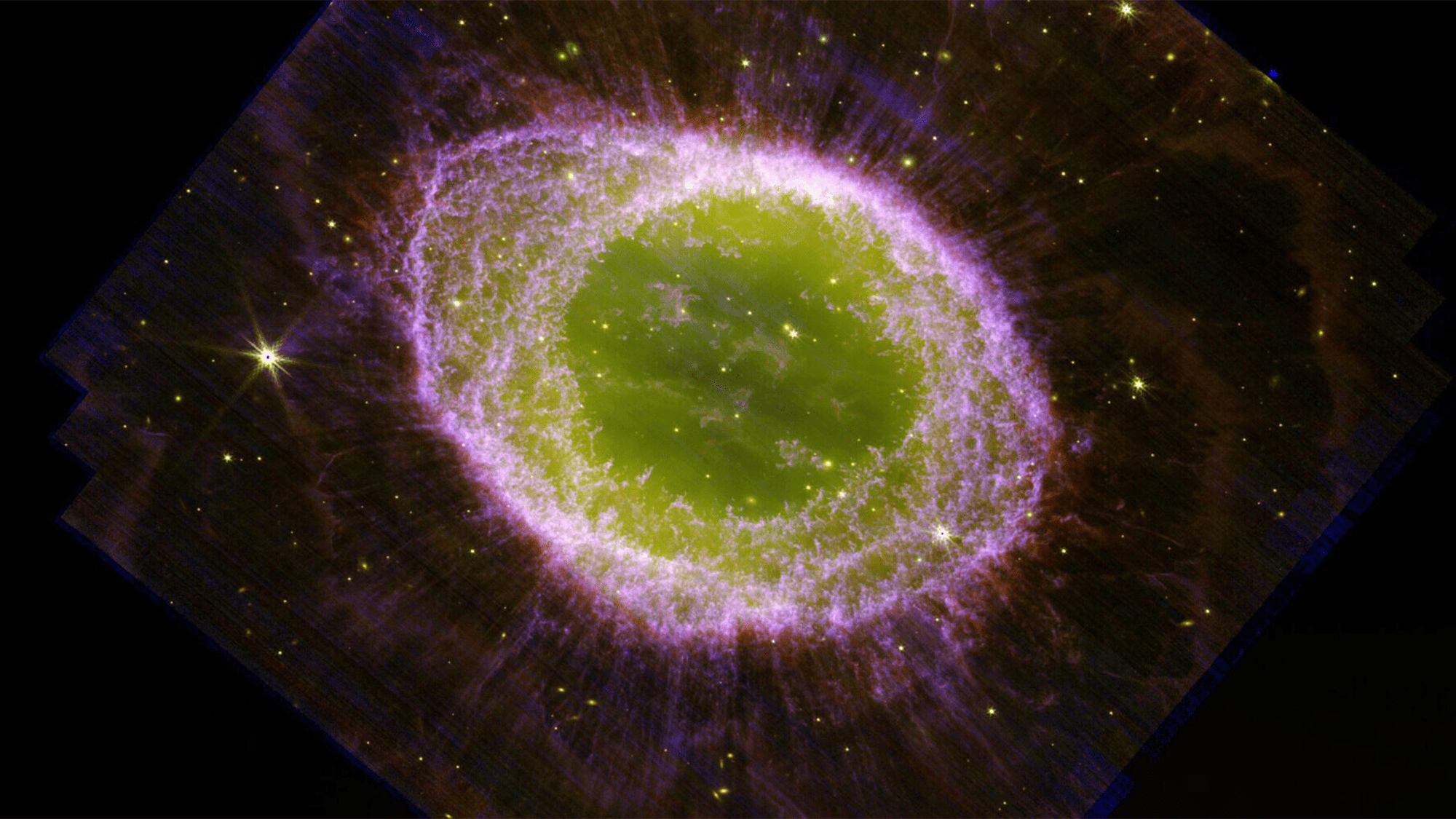
The Eye Nebula Through Hubble’s Lens
Some of the most striking objects in the night sky are also among the most complex. The Cat’s Eye Nebula, often called the Eye Nebula, is a glowing cloud of gas about 3,000 light-years from Earth in the constellation Draco. Observed in remarkable detail by the Hubble Space Telescope, it looks less like a simple cloud and more like a cosmic eye surrounded by intricate layers.
A Star’s Final Act
The Cat’s Eye Nebula, also known as NGC 6543, is a planetary nebula. Despite the name, it has nothing to do with planets. The term was coined centuries ago, when astronomers viewed these objects through telescopes and thought their round shapes resembled planets.
A planetary nebula forms when a star similar in mass to the Sun reaches the end of its life. After using up much of its nuclear fuel, the star sheds its outer layers into space. The hot, compact stellar core left behind—called a white dwarf—floods the expanding gas with ultraviolet light, causing it to glow.
What Hubble Revealed
Ground-based telescopes show the Cat’s Eye as a small, bright patch. Hubble’s sharp vision revealed a far more elaborate structure: a brilliant inner region surrounded by multiple shells, arcs, and knots of gas. The nebula also contains concentric rings that resemble ripples spreading outward.
These features suggest that the central star lost material in a series of episodes rather than in one steady flow. Astronomers are still investigating how the nebula’s complicated patterns formed. Changes in the star’s outflow, interactions with surrounding gas, magnetic fields, and the possible influence of a companion star may all play a role.
Colors That Tell a Story
Hubble images often combine observations made through different filters. The colors help distinguish gases and structures that would otherwise blend together. For example, oxygen and nitrogen emissions can be represented with different colors, allowing astronomers to trace the distribution of material across the nebula.
These colors are not necessarily what a person would see with the unaided eye. Instead, they are a visual way to present information gathered at particular wavelengths. The result is both beautiful and scientifically useful: the image helps researchers study the nebula’s shape, composition, and evolving layers.
A Brief but Important Stage
The Cat’s Eye Nebula is a temporary feature on cosmic timescales. As its gas expands and disperses, it will gradually fade into the surrounding interstellar space. The exposed stellar core will remain as a white dwarf, slowly cooling over billions of years.
By capturing the nebula’s detailed structure, Hubble has given astronomers a close look at how stars return material to space. That recycled gas can eventually become part of new stars and planetary systems. The Eye Nebula is therefore not only a spectacular end-of-life portrait of one star, but also a glimpse into the ongoing cycle of matter in the universe.
7 Fascinating Facts About the Eye Nebula in Hubble Images
- The Eye Nebula is also called NGC 6751.
- Hubble captured its layered, glowing structure.
- It lies about 6,500 light-years away.
- Look for its bright central star in Hubble images.
- Its colorful gases were shed by the dying star.
- The nebula is roughly 0.8 light-years across.
- Search NASA’s Hubble archive for high-resolution images.
The Eye Nebula is also called NGC 6751.
A helpful naming note: the Cat’s Eye Nebula shown in many Hubble images is NGC 6543, not NGC 6751. NGC 6751 is a different planetary nebula, sometimes called the Glowing Eye Nebula, and has also been photographed by Hubble.
Hubble captured its layered, glowing structure.
Hubble’s sharp observations revealed the Eye Nebula’s layered, glowing structure in remarkable detail. Instead of a simple cloud, the nebula appears as a bright central region surrounded by delicate shells, arcs, and rippling rings of gas. These patterns offer clues to how the dying star released material in successive bursts, while the gas’s colorful glow helps astronomers study its composition and shape.
It lies about 6,500 light-years away.
The Eye Nebula lies about 6,500 light-years from Earth, making it a distant but fascinating subject for the Hubble Space Telescope. Hubble’s detailed observations reveal the nebula’s glowing gas and intricate structure, offering astronomers a closer look at the material shed by a dying star.
Look for its bright central star in Hubble images.
In Hubble images of the Cat’s Eye Nebula, look toward the center for the bright star that powers the glowing cloud. Its intense radiation makes the surrounding gas shine, revealing the nebula’s layered rings and intricate patterns.
Its colorful gases were shed by the dying star.
The Eye Nebula’s vivid colors come from gases shed by its dying central star. As the star cast off its outer layers, the material expanded into space and began to glow when energized by the star’s intense ultraviolet light. Hubble’s observations reveal these glowing gases in intricate layers, offering a striking view of how a star returns material to the cosmos.
The nebula is roughly 0.8 light-years across.
The Cat’s Eye Nebula, also known as the Eye Nebula, is roughly 0.8 light-years across—vast by human standards, even though it is relatively compact compared with many nebulae. Hubble’s detailed images reveal its layered shells and intricate patterns of glowing gas, all contained within this enormous structure formed as a dying star shed its outer layers.
Search NASA’s Hubble archive for high-resolution images.
For a closer look at the Eye Nebula, search NASA’s Hubble archive for high-resolution images of NGC 6543, also known as the Cat’s Eye Nebula. The archive offers detailed views that reveal its glowing inner region, layered shells, and delicate arcs—features that can be hard to see in smaller reproductions. Check the image captions and credits for information about the filters and observations used, and follow NASA’s usage guidelines when sharing images.