
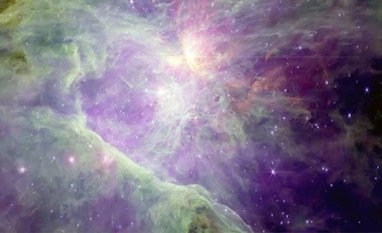
The James Webb Space Telescope Peers Into the Orion Nebula
The Orion Nebula is one of the closest and most active star-forming regions to Earth. Located about 1,300 light-years away in the constellation Orion, this vast cloud of gas and dust is a stellar nursery—and a remarkable target for the James Webb Space Telescope (JWST).
Webb’s infrared vision reveals details that are difficult or impossible to see in visible light. Its observations show young stars taking shape, disks of material surrounding newborn suns, and intricate structures sculpted by radiation and stellar winds. The result is more than a striking portrait: it offers astronomers a way to investigate how stars and planetary systems begin.
Why Look at the Orion Nebula in Infrared?
Visible light is often blocked by the thick clouds of dust found in star-forming regions. Infrared light can pass through much of that dust, allowing Webb to see deeper into the nebula. The telescope’s Near-Infrared Camera, or NIRCam, captures fine details across a wide area, while its other instruments can examine selected objects in greater detail.
In Webb images, the nebula appears as a layered landscape of glowing gas, dark dust, and bright stars. The intense radiation from massive young stars—including the stars of the Trapezium Cluster—illuminates and reshapes nearby clouds. At the same time, dense pockets of gas and dust continue to collapse, forming new stars.
Young Stars and Planet-Forming Disks
Webb has captured many young stars surrounded by disks of gas and dust. These disks, known as protoplanetary disks, are the raw material from which planets may eventually form. Some are exposed to strong ultraviolet radiation from nearby massive stars. That radiation can heat and erode the disks, creating distinctive shapes and streams of escaping gas.
Such observations help researchers investigate a key question: How do planets form in environments where powerful neighboring stars can alter or even strip away the material around a young sun? The Orion Nebula provides a natural laboratory for studying how a star’s surroundings may influence the early development of planetary systems.
A Surprising Discovery: Jupiter-Mass Binary Objects
Webb observations of the Orion Nebula also revealed a population of unusual objects called Jupiter-mass binary objects, or JuMBOs. Reported by researchers in 2023, these pairs appear to consist of two objects with masses comparable to Jupiter, drifting through space together without orbiting a star.
The discovery raised new questions about how such pairs form and remain bound. They do not fit neatly into familiar explanations for either planets or stars, and scientists are investigating different possibilities. JuMBOs are an example of how Webb can not only sharpen existing knowledge but also uncover phenomena that challenge current theories.
A Closer Look at How Stars Are Born
The Orion Nebula is a changing, energetic environment. Massive stars pour out radiation and streams of charged particles, while colder clouds collapse under gravity. Webb’s observations allow astronomers to study these processes at different scales, from broad structures in the nebula to individual young stars and their surrounding disks.
Each new observation adds to the picture of how stars emerge from clouds of gas and dust—and how their surroundings shape what comes next. By studying Orion, researchers can compare the conditions of this nearby stellar nursery with those found in other regions of the galaxy.
Webb’s Window Into the Universe
The James Webb Space Telescope has transformed the Orion Nebula from a familiar patch of light into a richly detailed scene of stellar birth and change. Its infrared images reveal hidden structures, while its scientific instruments help researchers test ideas about stars, disks, and free-floating planetary-mass objects.
Orion remains an active subject of study, and Webb’s observations are only part of the story. As astronomers analyze more data, the nebula will continue to provide clues about how stars—and perhaps worlds like our own—begin.
8 Ways the James Webb Space Telescope Reveals the Wonders of the Orion Nebula
- Reveals hidden structures through cosmic dust.
- Captures stunning infrared images of Orion.
- Helps scientists study how stars are born.
- Shows young stars and their surrounding disks.
- Offers clues about planet formation.
- Maps gas and dust in remarkable detail.
- Uncovers unusual Jupiter-mass binary objects.
- Provides a closer look at a nearby stellar nursery.
7 Limitations of Studying the Orion Nebula with the James Webb Space Telescope
- Orion’s dust still obscures some regions.
- Images can be difficult to interpret.
- Observations cover limited time periods.
- Webb time is highly competitive.
- Data analysis can take months or years.
- Bright stars can complicate measurements.
- Findings may not apply to every star-forming region.
Reveals hidden structures through cosmic dust.
One of the James Webb Space Telescope’s greatest advantages when observing the Orion Nebula is its ability to reveal structures hidden by cosmic dust. Because Webb detects infrared light, which can pass through much of the dust that blocks visible light, it can expose details such as newborn stars, developing planetary disks, and intricate clouds of gas. These observations give astronomers a clearer view of how stars and planetary systems form inside the nebula.
Captures stunning infrared images of Orion.
One of the James Webb Space Telescope’s greatest strengths is its ability to capture stunning infrared images of the Orion Nebula. Infrared light can pass through much of the dust that blocks visible light, revealing intricate clouds of gas, newborn stars, and planet-forming disks hidden within this stellar nursery. These detailed observations offer both a breathtaking view and valuable clues about how stars and planetary systems form.
Helps scientists study how stars are born.
The James Webb Space Telescope helps scientists study how stars are born by revealing details hidden inside the Orion Nebula’s clouds of gas and dust. Its infrared instruments can peer through much of this dust to observe young stars, the material gathering around them, and the forces that shape their surroundings. These observations help researchers understand how collapsing clouds form stars and how nearby stars influence the process.
Shows young stars and their surrounding disks.
One of the James Webb Space Telescope’s key contributions to studying the Orion Nebula is its ability to reveal young stars and the disks of gas and dust surrounding them. By observing infrared light that can pass through much of the nebula’s dust, Webb captures details that are difficult to see with visible-light telescopes. These disks are the building blocks of planets, so studying their shapes and environments helps astronomers learn how planetary systems begin and how nearby stars can influence their development.
Offers clues about planet formation.
The James Webb Space Telescope’s observations of the Orion Nebula offer valuable clues about planet formation. By detecting young stars and the disks of gas and dust around them, Webb helps astronomers study the raw materials from which planets may develop. Its infrared vision can peer through dusty regions and reveal how nearby massive stars affect these disks—information that can help explain why planetary systems form in different ways and how a star’s environment shapes their early development.
Maps gas and dust in remarkable detail.
One major advantage of the James Webb Space Telescope’s observations of the Orion Nebula is its ability to map gas and dust in remarkable detail. By detecting infrared light that can pass through much of the nebula’s obscuring dust, Webb reveals intricate clouds, glowing pockets of gas, and dense regions where new stars are forming. These detailed views help astronomers understand how stellar radiation and winds shape the nebula—and how its raw materials gather into young stars and planet-forming disks.
Uncovers unusual Jupiter-mass binary objects.
One remarkable advantage of the James Webb Space Telescope’s observations of the Orion Nebula is their ability to uncover unusual objects that challenge existing ideas about how planetary systems form. Webb helped reveal Jupiter-mass binary objects, or JuMBOs—pairs of planetary-mass objects that appear to drift through space together without orbiting a star. Their discovery gives astronomers a rare opportunity to study how such pairs might form and remain bound, opening new questions about the boundary between planets and stars.
Provides a closer look at a nearby stellar nursery.
The James Webb Space Telescope gives astronomers a remarkably close and detailed look at the Orion Nebula, one of the nearest stellar nurseries to Earth. Its infrared instruments can peer through much of the surrounding dust to reveal newborn stars, developing planetary disks, and the glowing clouds of gas where future stars may form. These observations help scientists study star birth in a nearby region, offering valuable clues about how stars and planetary systems develop.
Orion’s dust still obscures some regions.
Even with the James Webb Space Telescope’s powerful infrared vision, Orion’s thick clouds of dust still obscure some regions of the nebula. Infrared light can pass through much of the dust, but not all of it, so the densest areas may hide young stars and structures from view. This means Webb’s observations offer an extraordinary look into Orion, but they cannot reveal every detail of this complex stellar nursery.
Images can be difficult to interpret.
One drawback of James Webb Space Telescope images of the Orion Nebula is that they can be difficult to interpret. The images often combine infrared data, colors assigned to wavelengths invisible to the human eye, and layers of gas, dust, and starlight, so they may not look like the nebula would to a person observing it directly. Bright regions, dark patches, and intricate shapes can also be misleading without scientific context. Careful analysis is needed to distinguish actual features from image-processing choices and understand what the observations reveal.
Observations cover limited time periods.
One limitation of James Webb Space Telescope observations of the Orion Nebula is that they capture only limited periods in the region’s long, evolving story. A single image or observing campaign provides a snapshot, making it difficult to track changes in young stars, planet-forming disks, and surrounding gas over time. Repeated observations can reveal how these objects develop, but telescope time is in high demand, so astronomers may have to wait years between opportunities to study the same features.
Webb time is highly competitive.
One drawback of studying the Orion Nebula with the James Webb Space Telescope is that observing time is highly competitive. Researchers around the world submit proposals, but only a limited number can be selected, so even valuable projects may not receive time on the telescope. This can delay follow-up observations, make it harder to monitor changes in the nebula, and limit how quickly scientists can investigate new discoveries.
Data analysis can take months or years.
Although the James Webb Space Telescope has revealed remarkable details in the Orion Nebula, turning its observations into scientific discoveries can take months or even years. Researchers must carefully calibrate the data, remove noise and artifacts, compare results with computer models, and confirm that their interpretations are reliable. This lengthy process means that important findings may not be available right away, even when the telescope has already captured the observations.
Bright stars can complicate measurements.
Bright stars in the Orion Nebula can complicate observations with the James Webb Space Telescope. Their intense light may overwhelm nearby, fainter objects, making it harder for astronomers to measure details such as the brightness, temperature, or composition of young stars and planet-forming disks. Although Webb’s instruments and data-processing techniques help manage this glare, some measurements near the nebula’s brightest stars remain challenging and require careful analysis.
Findings may not apply to every star-forming region.
One limitation of studying the Orion Nebula is that its findings may not apply to every star-forming region. Orion has particular conditions, including nearby massive stars whose intense radiation can shape surrounding gas and dust. Other stellar nurseries may be denser, quieter, or otherwise different, so astronomers must compare Webb’s observations with data from many regions before drawing broad conclusions about how stars and planets form.