
The Carina Nebula Through the James Webb Space Telescope
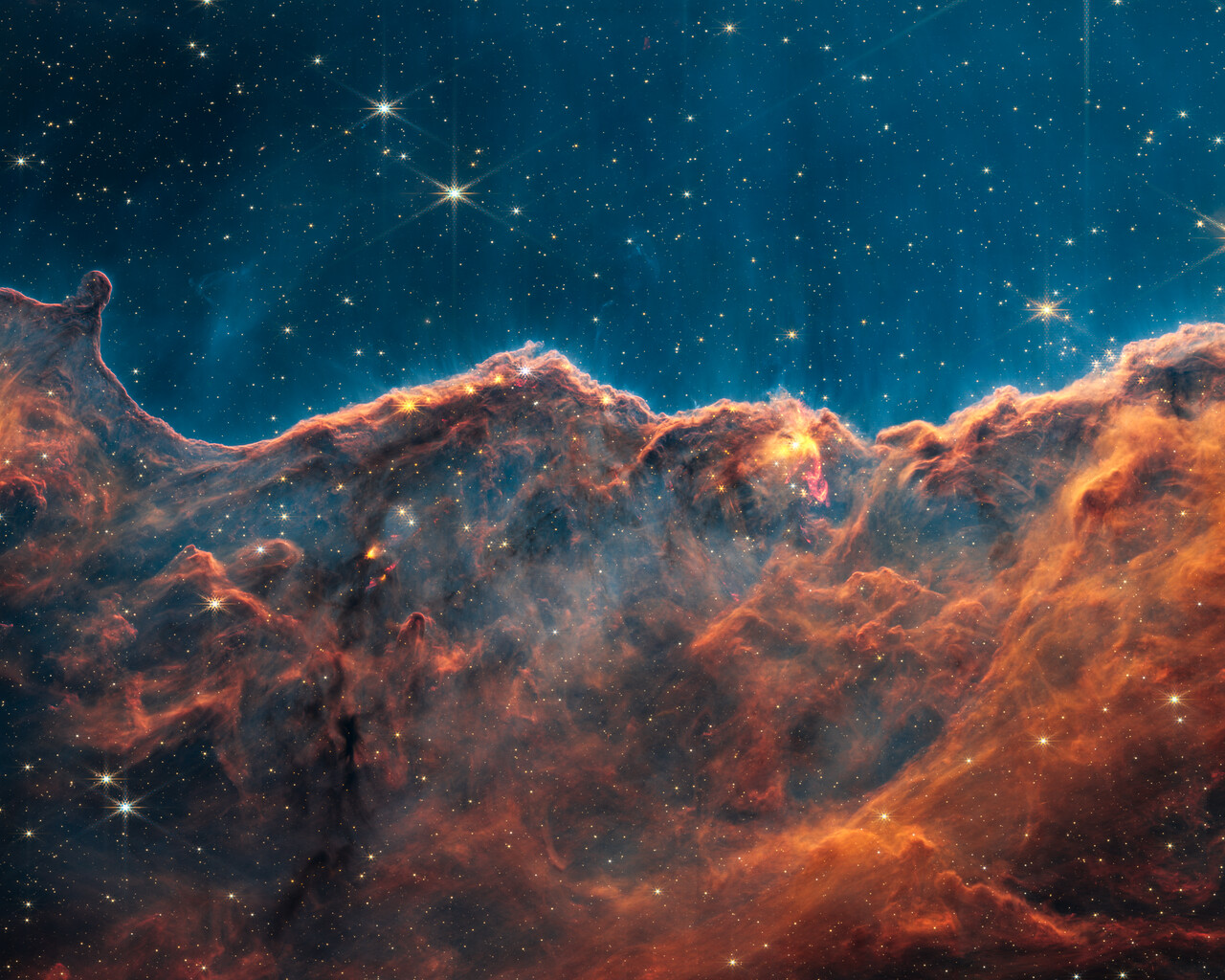
In July 2022, NASA released one of the first full-color images from the James Webb Space Telescope (JWST): a striking view of the Carina Nebula. Its dramatic ridges and glowing clouds quickly earned the nickname “Cosmic Cliffs.” Beneath the image’s otherworldly beauty is a stellar nursery, where stars are forming inside vast clouds of gas and dust.
A Stellar Nursery in the Southern Sky
The Carina Nebula is a large star-forming region in the constellation Carina, about 7,600 light-years from Earth. Webb’s “Cosmic Cliffs” view focuses on a portion of the nebula known as NGC 3324. The rugged-looking boundary in the image is not a solid landscape. It is the edge of a cavity in a cloud of gas and dust, shaped over time by the radiation and powerful outflows from massive, hot stars.
How Webb Reveals the Nebula
Webb observes the universe in infrared light. Unlike visible light, some infrared wavelengths can pass through clouds of dust, allowing the telescope to reveal structures that would otherwise be hidden. In the Carina image, Webb’s Near-Infrared Camera (NIRCam) captures details in the nebula’s dusty regions, including young stars and delicate structures in the surrounding gas.
The colors in the published image represent different infrared wavelengths translated into colors people can see. They are not necessarily the nebula’s appearance to the human eye. The bright points scattered across the scene include stars at different distances, while some young stars appear surrounded by material from which planets may eventually form.
Stars Shape Their Birthplace
Massive stars influence the clouds around them. Their ultraviolet radiation heats nearby gas, while stellar winds push material outward. These forces can carve cavities and sculpt the edges of clouds into ridges and pillars. They can also compress nearby material, potentially encouraging parts of a cloud to collapse and form new stars. The process is complex: stellar activity can both help and hinder star formation, depending on local conditions.
Webb’s view lets astronomers study these interactions in greater detail. By examining the light from stars and gas, researchers can investigate how young stars develop, how dust behaves, and how radiation changes the environment around a stellar nursery.
A New View of a Familiar Cosmic Landmark
The Carina Nebula had been observed by earlier telescopes, including the Hubble Space Telescope. Webb’s infrared vision adds a new perspective, revealing features within dusty regions that are difficult to see in visible light. Together, observations from different telescopes help astronomers build a more complete picture of how stars are born and how they transform the galaxies around them.
The “Cosmic Cliffs” image is more than a spectacular portrait. It is a glimpse into an active region of star formation—and a demonstration of how the James Webb Space Telescope can uncover intricate details hidden in the dusty clouds of the universe.
6 Tips for Exploring the Carina Nebula Through James Webb’s Eyes
- Explore JWST’s “Cosmic Cliffs” in the Carina Nebula.
- Look for newly forming stars hidden in dusty clouds.
- Notice the bright edges where starlight shapes the gas.
- Use infrared views to reveal details invisible to many telescopes.
- Remember the nebula is a stellar nursery, not a single star.
- Compare Webb images with visible-light views to see different features.
Explore JWST’s “Cosmic Cliffs” in the Carina Nebula.
Explore JWST’s “Cosmic Cliffs” in the Carina Nebula, where towering ridges of gas and dust glow beneath the light of young, massive stars. Captured in infrared by the James Webb Space Telescope, this remarkable view reveals details hidden within the nebula’s clouds and offers a glimpse of a stellar nursery, where stars are forming and shaping their surroundings.
Look for newly forming stars hidden in dusty clouds.
Look closely at the dusty clouds in Webb’s Carina Nebula image for signs of newly forming stars. Infrared light can pass through dust more effectively than visible light, helping the James Webb Space Telescope reveal young stars and stellar activity hidden inside the nebula’s dense clouds. These emerging stars are still gathering material from their surroundings, offering astronomers a glimpse of how stellar systems begin.
Notice the bright edges where starlight shapes the gas.
Notice the bright edges in Webb’s image of the Carina Nebula, where intense starlight illuminates and shapes the surrounding gas and dust. These glowing ridges trace the boundaries of a vast cavity carved by radiation and stellar winds, offering a vivid look at how massive young stars transform the clouds around them.
Use infrared views to reveal details invisible to many telescopes.
The James Webb Space Telescope uses infrared light to reveal details of the Carina Nebula that many telescopes cannot easily see. Infrared wavelengths can pass through some of the dense dust surrounding young stars, helping Webb capture hidden structures, glowing gas, and newly forming stars. These observations give astronomers a clearer look at how stars emerge and shape the nebula around them.
Remember the nebula is a stellar nursery, not a single star.
The Carina Nebula is a stellar nursery—a vast region of gas and dust where many stars are forming—not a single star. In James Webb Space Telescope images, its glowing clouds, ridges, and bright points reveal a complex environment shaped by young stars and their powerful radiation.
Compare Webb images with visible-light views to see different features.
Compare James Webb Space Telescope images of the Carina Nebula with visible-light views to discover how different wavelengths reveal different features. Webb’s infrared observations can peer through some of the nebula’s dust to show young stars and structures hidden from visible-light telescopes, while visible-light images highlight glowing gas and sharply defined clouds. Looking at both views side by side gives a fuller picture of how stars form and shape this dramatic region.