
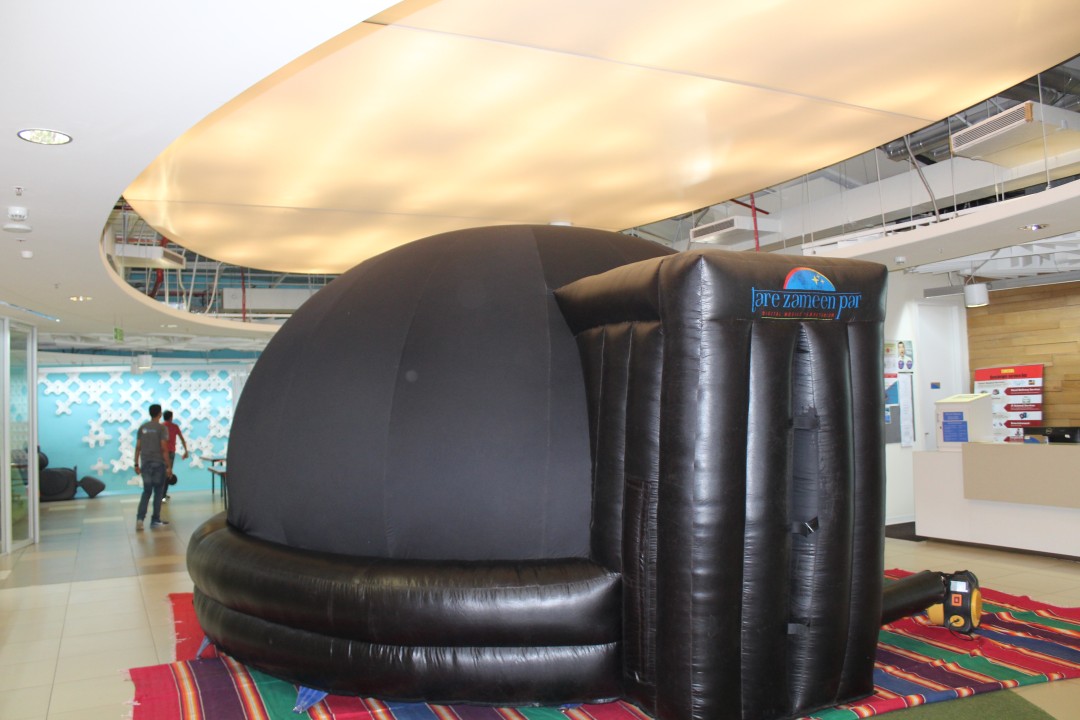
Mobile Planetarium Education: Bringing the Universe to the Classroom
A night sky can feel impossibly far away—especially from a brightly lit classroom or a city where only a few stars are visible. A mobile planetarium helps bring the universe closer. By transforming a school gym, library, or community center into an immersive theater, it gives learners a chance to explore the sky and other scientific topics without leaving their community.
What Is a Mobile Planetarium?
A mobile planetarium is a portable dome equipped with projection technology. Educators or presenters set it up in a suitable indoor space, where students sit beneath a curved screen and watch images projected around them. Programs can simulate the night sky, trace the motions of the planets, or take viewers on a journey through space.
Unlike a flat-screen presentation, a dome surrounds the audience with images. This immersive format can help students feel as if they are traveling through the solar system or looking up at the stars from different places on Earth.
Learning Through Immersion
Planetarium programs can make abstract ideas easier to picture. Students might observe how Earth’s rotation causes day and night, see the changing phases of the Moon, or follow the apparent movement of planets across the sky. A presenter can pause the show to ask questions, explain a concept, and connect the visuals to classroom learning.
The experience can also encourage curiosity. Seeing the scale of the solar system or the structure of a galaxy may prompt students to ask questions that lead to further investigation. That sense of wonder is valuable: it can turn a lesson into the starting point for deeper learning.
More Than Astronomy
Although astronomy is a natural fit, a mobile planetarium can support learning across several subjects. Depending on the program and equipment, dome presentations may explore Earth science, weather, ocean environments, biology, or the history of space exploration. Teachers can use a visit to introduce a topic, reinforce a unit, or inspire a related project.
For example, students studying Earth science might examine weather patterns from a global perspective. A class learning about ecosystems could explore how environments change across the planet. These experiences can help learners connect scientific concepts to a larger picture.
Access for More Communities
Many schools do not have access to a permanent planetarium or the time and resources for an off-site field trip. A mobile program brings the experience to the school or community venue instead. This can reduce travel barriers and make a planetarium visit possible for students who might otherwise miss out.
Mobile planetariums can also serve libraries, museums, youth programs, and community events. Bringing science experiences into familiar local spaces can help make learning more accessible and encourage families to explore science together.
Making a Visit Meaningful
The dome experience is most effective when it supports, rather than replaces, active learning. Before the visit, educators can introduce key vocabulary and invite students to share what they already know. During the presentation, questions and discussion can help keep learners engaged. Afterward, students might create a star map, build a model of the solar system, compare observations, or write questions for further research.
It is also helpful to choose a program that matches students’ ages and learning goals. Younger audiences may benefit from a story-based introduction to the sky, while older students may be ready for more detailed explanations of orbital motion, light, or the scale of the universe.
A Small Space for Big Questions
A mobile planetarium turns an ordinary room into a place for exploration. Its immersive setting can make complex ideas more vivid, invite students to ask questions, and bring science experiences to communities that may not have a permanent planetarium nearby.
For learners, the most important outcome may be the questions they carry out of the dome: What else is out there? How do we know? What would it take to find out? Mobile planetarium education offers a memorable way to begin answering them.
7 Tips for Engaging and Effective Mobile Planetarium Education
- Match each show to students’ age and learning goals.
- Check the venue’s ceiling height and available floor space.
- Use interactive questions to keep students engaged.
- Connect astronomy lessons to local sky observations.
- Test projection, sound, and seating before students arrive.
- Include accessible visuals and clear narration.
- Leave time for discussion and follow-up activities.
Match each show to students’ age and learning goals.
Choose a mobile planetarium show that fits both your students’ age and your learning goals. Younger children may respond best to engaging stories and simple explanations, while older students may be ready to explore more complex topics, such as planetary motion or the scale of the universe. Before booking, review the show’s content and vocabulary, then connect it to your curriculum so students can build on what they already know and keep exploring after the presentation.
Check the venue’s ceiling height and available floor space.
Before booking a mobile planetarium, check the venue’s ceiling height and available floor space to make sure the dome can be safely and comfortably set up. Ask the provider for the equipment’s exact dimensions and any clearance requirements, then measure the room and account for obstacles such as lights, vents, columns, and furniture. Confirming these details in advance helps prevent setup problems and ensures students have enough room to enter, sit, and move around safely.
Use interactive questions to keep students engaged.
Use interactive questions to keep students engaged throughout a mobile planetarium presentation. Invite students to predict what might happen next, identify patterns in the stars, or explain how a planet’s movement could affect what they see from Earth. Questions encourage learners to observe closely and connect the visuals to ideas they’ve explored in class. Give students time to think, share answers, and ask their own questions so the experience feels like an active exploration rather than a show they simply watch.
Connect astronomy lessons to local sky observations.
Connect astronomy lessons to local sky observations by inviting students to look at the sky from their own neighborhood before or after a mobile planetarium visit. Have them note visible stars, the Moon’s shape, or where the Sun sets, then compare their observations with the dome’s simulations. This makes big ideas—like Earth’s rotation, lunar phases, and seasonal star patterns—feel relevant and easier to understand. Encourage students to record what they see over several nights and discuss how weather, time, and light pollution affect their view.
Test projection, sound, and seating before students arrive.
Before students arrive, test the projection, sound, and seating to make sure the experience is clear, comfortable, and ready to go. Check that images are focused and visible from different parts of the dome, audio is easy to hear without being overwhelming, and seats are arranged so everyone has a good view and enough room. A quick rehearsal can help prevent technical distractions and give students more time to focus on exploring the universe.
Include accessible visuals and clear narration.
Accessible visuals and clear narration help every student take part in a mobile planetarium experience. Use high-contrast images, readable labels, and uncluttered scenes, and describe important visual details aloud so learners who are blind or have low vision can follow along. Speak at a steady pace, explain unfamiliar terms, and provide captions or transcripts when available. These thoughtful choices make the presentation easier to understand and more welcoming for students with different learning and accessibility needs.
Leave time for discussion and follow-up activities.
Leave time for discussion and follow-up activities so students can make sense of what they experienced under the dome. Invite them to share surprising discoveries, ask questions, and connect the presentation to what they are learning in class. A simple activity—such as drawing a constellation, modeling the phases of the Moon, or researching a question from the show—can reinforce key ideas and turn a memorable visit into deeper learning.