
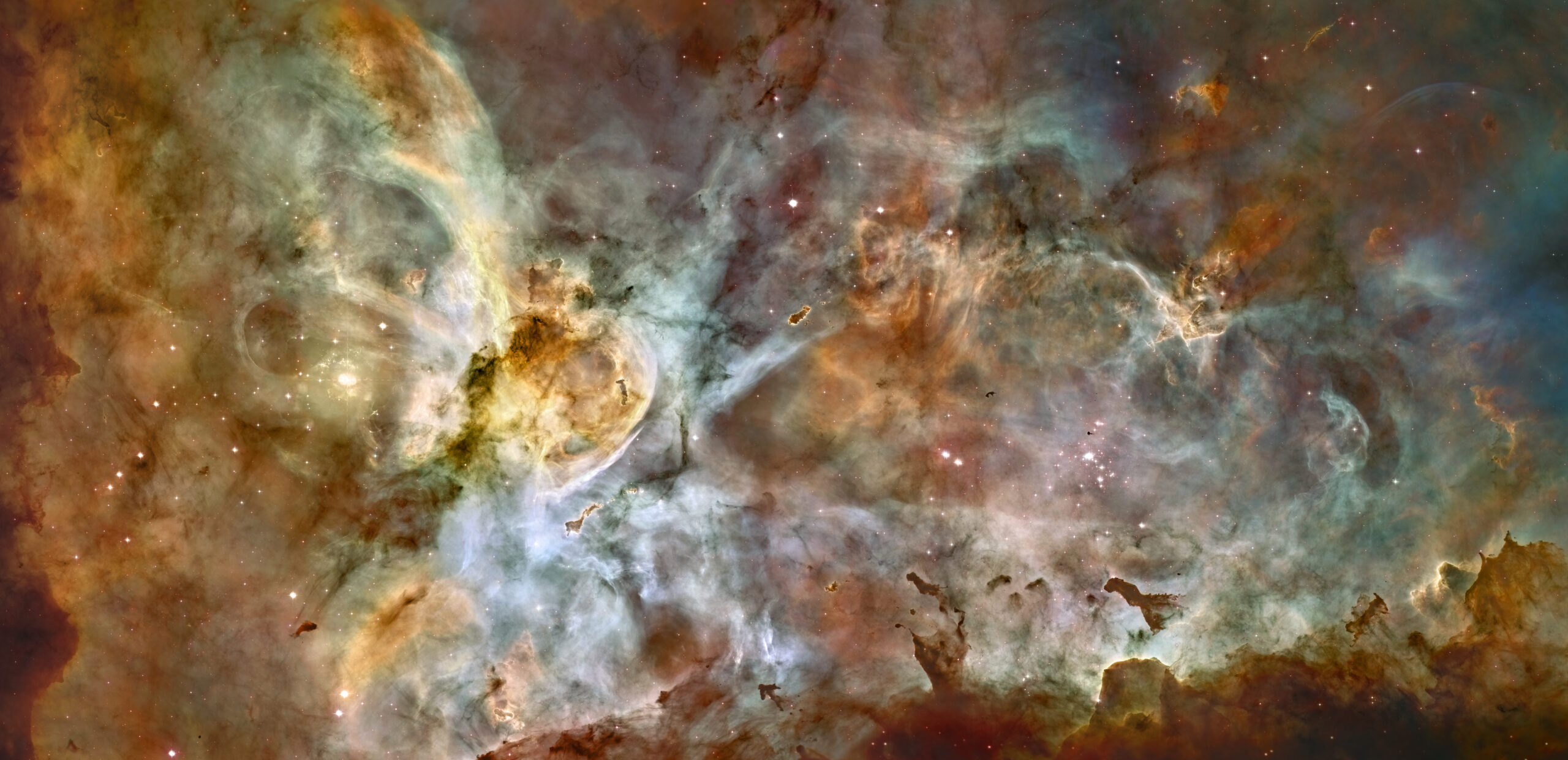
The Carina Nebula: A Stellar Nursery Revealed by NASA
The Carina Nebula is one of the largest and most active star-forming regions in the Milky Way. Located about 7,500 light-years from Earth in the southern constellation Carina, this vast cloud of gas and dust is home to young stars, intricate cosmic structures, and some of the most powerful stars known.
What Is the Carina Nebula?
Also known as NGC 3372, the Carina Nebula is an emission nebula: a cloud of gas that glows after being energized by nearby stars. Its bright regions and dark, dusty pillars form part of a stellar nursery where new stars are born. Radiation and strong stellar winds from massive young stars continually reshape the surrounding material.
The nebula is also home to Eta Carinae, a massive and unstable star system. Eta Carinae has undergone dramatic outbursts, including a major eruption in the 19th century. Its future remains an important subject of astronomical study.
NASA’s “Cosmic Cliffs”
In 2022, NASA released a striking image of the Carina Nebula captured by the James Webb Space Telescope. The scene, nicknamed the “Cosmic Cliffs,” shows a dramatic boundary between a dusty region and a cavity carved by intense radiation and stellar winds.
Webb’s infrared instruments can detect light that passes through some of the dust that blocks visible light. This lets astronomers study structures within the nebula and spot young stars that might otherwise remain hidden. The towering shapes in the image are not solid cliffs; they are clouds of gas and dust viewed across enormous distances.
How NASA Telescopes Explore the Nebula
Different NASA observatories reveal different details of the Carina Nebula. The Hubble Space Telescope has captured its glowing gas and dense clouds in visible light, while the James Webb Space Telescope observes infrared wavelengths to investigate dust and star formation. Looking at the nebula in multiple wavelengths helps scientists build a fuller picture of how stars form and affect their surroundings.
Why the Carina Nebula Matters
Studying the Carina Nebula gives astronomers a close look at the life cycle of massive stars. These stars influence nearby clouds with radiation, heat, and powerful winds. Their effects can compress gas and potentially encourage new stars to form, or disperse material and slow star formation. Observations of the nebula help researchers examine how these processes unfold.
NASA’s images of the Carina Nebula are more than spectacular views of space. They are scientific observations that help reveal how stars and planetary systems begin—and how young stars transform the galaxies around them.
NASA’s Carina Nebula: What It Is, Where It Is, and What Makes It Special
- Are we in the Carina Nebula?
- What is the Carina Nebula?
- What is special about the Carina Nebula?
- What did NASA find 8000 light years away?
Are we in the Carina Nebula?
No, we are not inside the Carina Nebula. It lies about 7,500 light-years from Earth in the direction of the constellation Carina, while our solar system is in the Milky Way’s Orion Spur. The nebula may look like a nearby cloud in NASA images, but it is a vast, distant region of gas and dust where stars are forming.
What is the Carina Nebula?
The Carina Nebula, also known as NGC 3372, is a vast cloud of gas and dust in the constellation Carina, about 7,500 light-years from Earth. It is an active star-forming region where radiation from young, massive stars illuminates and reshapes the surrounding clouds. NASA telescopes, including Hubble and the James Webb Space Telescope, have captured detailed views of the nebula, revealing its glowing gas, dusty structures, and newly forming stars.
What is special about the Carina Nebula?
The Carina Nebula is special because it is one of the Milky Way’s largest and most active star-forming regions, where massive young stars shape clouds of gas and dust with intense radiation and stellar winds. Located about 7,500 light-years away, it includes the famous “Cosmic Cliffs” photographed by NASA’s James Webb Space Telescope and the remarkable Eta Carinae star system. Its dramatic features give astronomers a nearby view of how stars are born and influence their surroundings.
What did NASA find 8000 light years away?
About 8,000 light-years from Earth, NASA’s telescopes have observed the Carina Nebula, a vast region where new stars are forming. Images from the James Webb Space Telescope reveal towering clouds of gas and dust—nicknamed the “Cosmic Cliffs”—shaped by radiation and powerful winds from hot, young stars. These observations help astronomers study how stars are born and how they reshape their surroundings.