
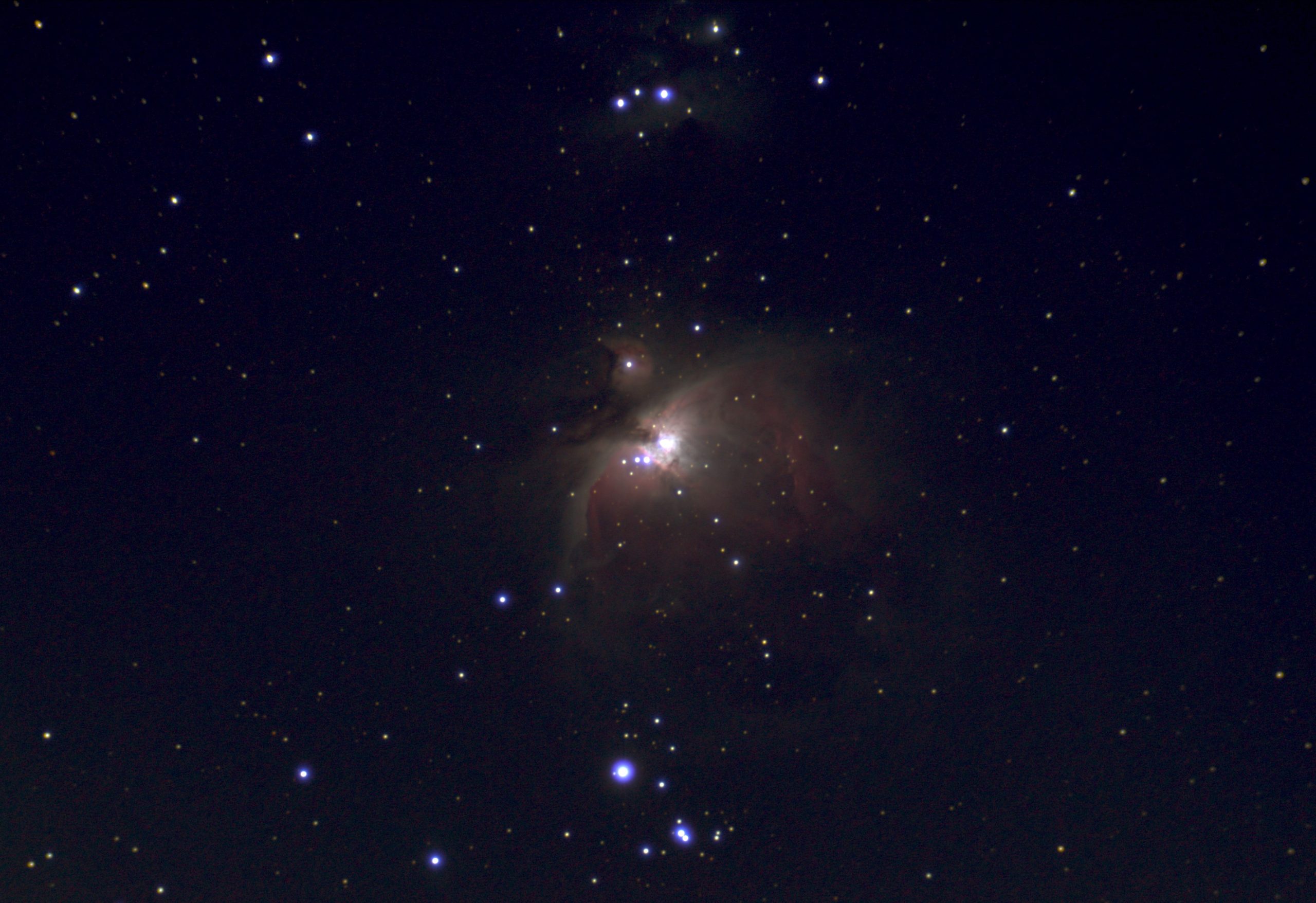
Observing the Orion Nebula Through a Telescope
The Orion Nebula is one of the most rewarding sights in the night sky. Known to astronomers as Messier 42, or M42, it is a vast cloud of gas and dust where new stars are forming. Located in the constellation Orion, it can be seen with the unaided eye under dark skies—and a telescope reveals far more of its structure.
Finding the Orion Nebula
Orion is easiest to spot in the evening sky during winter in the Northern Hemisphere. Look for the three bright stars that make up Orion’s Belt. Just below the belt is a short line of fainter stars called Orion’s Sword. The nebula lies in the middle of the sword and may look like a small, hazy patch when viewed without optical equipment.
A star chart or astronomy app can help you locate it, especially if you are new to observing. Give your eyes time to adjust to the darkness, and try to observe from a spot away from bright streetlights.
What to Expect Through a Telescope
Even a small telescope can show the nebula’s cloudy shape and bright central region. With steady skies and a larger aperture, you may notice more detail in the nebula’s uneven, winglike edges. The group of stars near its center, known as the Trapezium, is another highlight. These young stars help illuminate the surrounding gas.
Visual observations usually look less colorful than photographs. The human eye is not as sensitive to color in faint, low-light conditions, so the nebula may appear gray or faintly greenish rather than vividly pink and purple. Long-exposure astrophotography can reveal colors and details that are difficult to see through an eyepiece.
Choosing a Telescope and Eyepiece
You do not need a large or expensive telescope to enjoy M42. A beginner-friendly refractor or reflector can provide a memorable view. The telescope’s aperture—the diameter of its main lens or mirror—affects how much light it gathers, while the eyepiece determines magnification.
Begin with a low-power eyepiece. It gives you a wider field of view, making the nebula easier to find and allowing you to see more of its surroundings. Once it is centered, try a higher magnification to examine the central stars and finer features. Very high power is not always better: it can make the image dimmer and magnify atmospheric turbulence.
Tips for a Better View
- Choose a dark location. Light pollution can wash out faint detail, so a darker observing site usually provides a better view.
- Watch the Moon. Bright moonlight reduces contrast. For the clearest view, observe when the Moon is below the horizon or near its new phase.
- Let your eyes adapt. Spend about 20 minutes away from bright lights before observing. A dim red flashlight can help preserve night vision.
- Use a nebula filter if you have one. A quality narrowband or UHC filter may improve contrast by reducing some background light, though results vary with the sky and telescope.
- Be patient. Spend several minutes looking, and use averted vision—looking slightly to the side of the object—to help notice faint details.
A Stellar Nursery in Our Galaxy
The Orion Nebula is not just a beautiful target; it is an active stellar nursery. Its gas and dust are part of the process that forms stars and planetary systems. When you look through a telescope, you are seeing light that has traveled across space for roughly 1,300 years.
Whether you are using binoculars, a small backyard telescope, or a more advanced setup, M42 offers a fascinating introduction to deep-sky observing. Start with a wide, low-power view, take your time, and enjoy one of the night sky’s most accessible celestial wonders.
7 Reasons the Orion Nebula is a Must-See with Your Telescope
- Easy to find in Orion’s Sword
- Visible with small telescopes
- Shows glowing clouds of gas and dust
- Reveals the Trapezium star cluster
- A rewarding target for beginners
- Looks impressive under dark skies
- Offers a glimpse of a stellar nursery
Challenges of Observing the Orion Nebula Through a Telescope
- Light pollution can obscure faint details.
- A small telescope may show limited structure.
- The nebula often looks gray, not colorful.
- High magnification can make the view dim.
- Bright moonlight reduces contrast.
- Clouds and turbulence can spoil the view.
Easy to find in Orion’s Sword
One of the Orion Nebula’s biggest advantages for beginner stargazers is how easy it is to find. Look for Orion’s three bright Belt stars, then follow the shorter line of stars just below them to Orion’s Sword. The nebula sits near the center of the Sword and often appears as a faint, fuzzy patch to the naked eye, making it a simple and satisfying target to locate with binoculars or a telescope.
Visible with small telescopes
One of the Orion Nebula’s biggest advantages for beginner astronomers is that it’s visible through small telescopes. Even a modest backyard telescope can reveal its bright central region, soft cloudlike glow, and the stars of the Trapezium. You don’t need expensive equipment or advanced experience to find and enjoy this remarkable deep-sky object, making it an inviting first target for stargazers.
Shows glowing clouds of gas and dust
A telescope brings out the Orion Nebula’s glowing clouds of gas and dust, revealing delicate, cloudlike shapes that are difficult to see with the naked eye. Even a modest telescope can make its bright central region and hazy outer edges stand out, offering a closer look at a vast stellar nursery where new stars are forming.
Reveals the Trapezium star cluster
One of the most rewarding advantages of observing the Orion Nebula through a telescope is the chance to see the Trapezium, a compact cluster of young stars at the nebula’s bright center. Even a modest telescope can reveal its four brightest stars under steady, dark skies, while larger instruments may show additional members. These hot stars illuminate the surrounding gas, making the cluster a striking focal point and offering a closer look at the stellar nursery within the Orion Nebula.
A rewarding target for beginners
The Orion Nebula is a rewarding target for beginners because it’s relatively easy to find and bright enough to view with binoculars or a small telescope. Even a basic setup can reveal its cloudy shape and bright central stars, giving new observers an exciting first look at a deep-sky object. As you gain experience, you can return to it under darker skies or with different eyepieces to explore more of its detail.
Looks impressive under dark skies
Under dark skies, the Orion Nebula looks especially impressive through a telescope. With less light pollution to wash out the view, its glowing central region and broad, cloudlike wings stand out more clearly against the surrounding sky. Even a modest telescope can reveal a striking view, making M42 a rewarding target for both new stargazers and experienced observers.
Offers a glimpse of a stellar nursery
Observing the Orion Nebula through a telescope offers a rare glimpse into a stellar nursery, where new stars are forming from vast clouds of gas and dust. Even a modest telescope can reveal its glowing central region and the young stars that illuminate the surrounding nebula, turning a distant patch of light into a window on the ongoing process of star formation.
Light pollution can obscure faint details.
One drawback of observing the Orion Nebula through a telescope is that light pollution can obscure its faint details. Streetlights, nearby buildings, and other sources of artificial light brighten the sky, reducing contrast and making the nebula’s delicate outer clouds harder to see. From a heavily lit area, the view may appear washed out, so observing from a darker location can make a noticeable difference.
A small telescope may show limited structure.
A small telescope can offer a lovely first view of the Orion Nebula, but it may reveal only its brightest central region and a faint, hazy outline. Fine details in the nebula’s clouds and outer extensions can be difficult to see, especially under light-polluted skies or when the Moon is bright. For a clearer view, observe from a dark location, let your eyes adjust, and use a low-power eyepiece to gather more of the nebula in the field of view.
The nebula often looks gray, not colorful.
One drawback of viewing the Orion Nebula through a telescope is that it often appears gray rather than the vivid pink, purple, and blue seen in photographs. In the dim light, human eyes have limited color sensitivity, so the nebula’s gas and dust may look like a soft gray glow, especially through smaller telescopes or under light-polluted skies. Long-exposure images can capture colors and details that are difficult to see with the naked eye.
High magnification can make the view dim.
One drawback of using high magnification to view the Orion Nebula is that the image can appear dimmer. Higher magnification spreads the available light across a larger area, making faint details harder to see—especially through a small telescope or under light-polluted skies. For the best view, start with a low-power eyepiece to find the nebula and take in its broad shape, then increase magnification gradually if the sky and telescope allow.
Bright moonlight reduces contrast.
Bright moonlight can make the Orion Nebula harder to see through a telescope by washing out its faint details. The nebula may appear dimmer and less defined, especially near a full Moon or in a light-polluted area. For the clearest view, observe when the Moon is below the horizon or near its new phase.
Clouds and turbulence can spoil the view.
Clouds and atmospheric turbulence can spoil a telescope view of the Orion Nebula. Even thin clouds may dim its delicate details, while turbulent air can make the image shimmer or blur, hiding features such as the nebula’s wispy edges and central stars. Checking the forecast and observing when the sky is clear and steady can help, but these conditions are never fully under the observer’s control.