
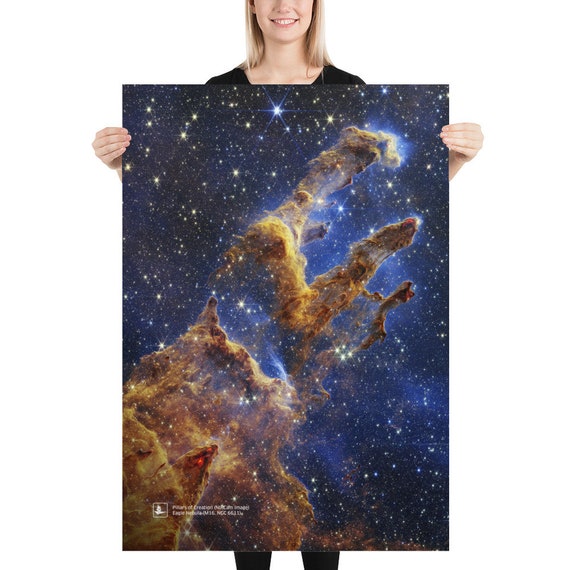
The Eagle Nebula Through the Eyes of James Webb
The Eagle Nebula is a vast cloud of gas and dust where stars are born. Located about 6,500 light-years from Earth in the constellation Serpens, it is also known as Messier 16, or M16. One of its most famous features is the Pillars of Creation: towering columns of cosmic material photographed by the Hubble Space Telescope and later observed in extraordinary detail by NASA’s James Webb Space Telescope.
A Stellar Nursery in Serpens
Inside the Eagle Nebula, young, hot stars illuminate the surrounding clouds. Their intense radiation and powerful stellar winds shape the gas and dust, carving cavities and sculpting dense columns. The nebula is an active star-forming region, where pockets of material can collapse under gravity and eventually give rise to new stars.
The Pillars of Creation are among the nebula’s most striking structures. They are made largely of cool gas and dust, and their dense interiors shield some material from the radiation of nearby stars. Bright edges and wispy streams mark places where the surrounding energy is eroding the pillars.
What James Webb Reveals
In 2022, NASA released a James Webb Space Telescope view of the Pillars of Creation taken with Webb’s Near-Infrared Camera, or NIRCam. Near-infrared light can pass through much of the dust that blocks visible light, allowing Webb to reveal stars and details hidden within the cloudy scene. The image shows numerous stars, including newly formed stars that appear as bright red points with diffraction spikes.
Webb’s observations do not make the dust disappear. Instead, they help astronomers see through parts of it and study how the structures are changing. The image also reveals layers of gas and dust with remarkable clarity, offering a closer look at the processes that shape stellar nurseries.
Webb has also observed the pillars using its Mid-Infrared Instrument, or MIRI. Mid-infrared light is especially useful for studying cooler dust. In MIRI’s view, much of the dust appears darker, while some stars shine brightly. Together, the different views provide complementary information about the region’s stars and material.
Webb and Hubble: Different Views, More Insight
Hubble’s famous images of the Pillars of Creation show the structures in visible light, highlighting glowing gas and sharply defined edges. Webb observes primarily in infrared light, revealing stars and features that are obscured in visible-light images. Neither view replaces the other: each wavelength brings out different details.
By comparing observations from Hubble and Webb, astronomers can learn more about how radiation and stellar winds affect the pillars, where young stars are forming, and how dust is distributed. These observations help researchers investigate the life cycle of stars—from the collapse of gas clouds to the energetic environments created by massive young stars.
A Window Into How Stars Form
The Eagle Nebula’s Pillars of Creation are more than a beautiful cosmic landmark. They are a natural laboratory for studying star formation. James Webb’s infrared observations give astronomers a powerful new way to examine this complex region and deepen understanding of how stars and planetary systems begin.
Exploring the Eagle Nebula: 9 Tips for Viewing the Pillars of Creation with the James Webb Telescope
- Look for the Pillars of Creation, a star-forming region in the Eagle Nebula.
- Compare Webb’s infrared view with visible-light images.
- Notice how infrared light reveals stars hidden by dust.
- Look for bright, newly formed stars near the pillars.
- Remember that the Eagle Nebula is also called Messier 16.
- Use a full-resolution image to explore fine details.
- Check the image caption for the Webb instrument used.
- Keep in mind the nebula is about 6,500 light-years away.
- Explore Webb’s official image archive for more views.
Look for the Pillars of Creation, a star-forming region in the Eagle Nebula.
Look for the Pillars of Creation, the Eagle Nebula’s towering clouds of gas and dust where new stars are forming. In James Webb Space Telescope images, infrared light reveals stars and details hidden within these dusty structures, offering a remarkable view of this stellar nursery.
Compare Webb’s infrared view with visible-light images.
Compare James Webb Space Telescope’s infrared view of the Eagle Nebula with visible-light images from telescopes like Hubble to see how each wavelength reveals different details. Visible light highlights glowing gas and the pillars’ outlines, while infrared light can pass through some of the dust to reveal stars and structures hidden within. Looking at both views side by side gives a richer picture of how the nebula’s clouds are shaped and where new stars are forming.
Notice how infrared light reveals stars hidden by dust.
Notice how James Webb’s infrared view reveals stars hidden behind the Eagle Nebula’s thick clouds of dust. Unlike visible light, infrared light can pass through much of the dust, allowing Webb to show young stars and details that earlier images couldn’t easily capture.
Look for bright, newly formed stars near the pillars.
In James Webb’s infrared view of the Eagle Nebula, look for bright, often reddish points of light near or within the Pillars of Creation. Some are newly formed stars still surrounded by dust and gas; their glow can help astronomers study how stars emerge from these stellar nurseries. Not every bright point is a newborn star, but Webb’s infrared observations reveal many young stars that are difficult to see in visible-light images.
Remember that the Eagle Nebula is also called Messier 16.
The Eagle Nebula is also known as Messier 16, or M16, so these names refer to the same star-forming region in the constellation Serpens. When exploring James Webb Space Telescope images and research, look for either name to find observations and information about this remarkable nebula and its famous Pillars of Creation.
Use a full-resolution image to explore fine details.
To appreciate the Eagle Nebula’s intricate structure, open the James Webb image at full resolution and zoom in on the Pillars of Creation. You’ll be able to explore details that are easy to miss in a smaller view, including bright young stars, delicate strands of gas and dust, and the sculpted edges of the towering pillars. Full-resolution images can take longer to load, but they offer a richer look at Webb’s observations and the cosmic activity within this stellar nursery.
Check the image caption for the Webb instrument used.
When viewing a James Webb image of the Eagle Nebula, check its caption to see which instrument captured it. Webb’s Near-Infrared Camera (NIRCam) and Mid-Infrared Instrument (MIRI) reveal different features: NIRCam highlights stars and structures visible in near-infrared light, while MIRI helps show cooler dust and other details in mid-infrared light. Knowing the instrument can help you understand what you’re seeing.
Keep in mind the nebula is about 6,500 light-years away.
Keep in mind that the Eagle Nebula is about 6,500 light-years from Earth. That means the light captured by the James Webb Space Telescope began its journey roughly 6,500 years ago, so Webb’s image shows the nebula as it appeared in the distant past—not as it looks today.
Explore Webb’s official image archive for more views.
For a closer look at the Eagle Nebula, explore NASA’s official James Webb Space Telescope image archive. You can find different views of the Pillars of Creation captured in near-infrared and mid-infrared light, along with image captions and background information. Comparing the images reveals details that stand out at different wavelengths, from young stars shining through dusty clouds to cooler material that helps shape this famous stellar nursery.