
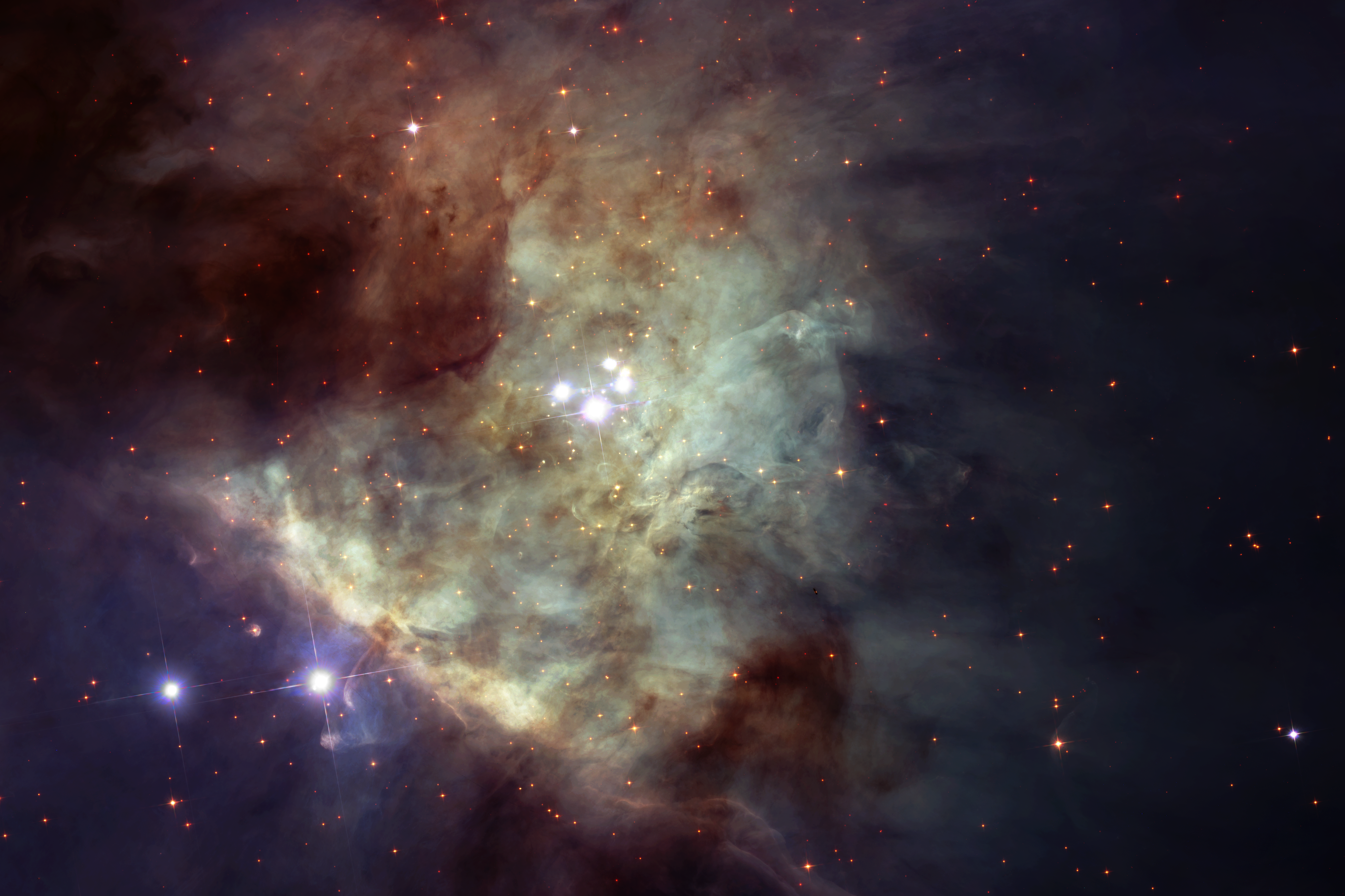
James Webb Space Telescope Reveals the Orion Nebula in New Detail
The Orion Nebula is one of the closest and most active stellar nurseries to Earth. Located about 1,300 light-years away in the constellation Orion, it is a vast cloud of gas and dust where new stars are forming. The James Webb Space Telescope (JWST) has given astronomers an unusually sharp infrared view of this region, revealing young stars, developing planetary systems, and surprising objects that are difficult to explain.
Seeing Through the Cosmic Clouds
Visible-light images of the Orion Nebula show bright gas glowing around young stars. But dense clouds of dust can hide much of what is happening inside. Webb observes infrared light, which can pass through some of that dust, allowing astronomers to study parts of the nebula that would otherwise be obscured.
Webb’s instruments have captured intricate structures in the nebula, including ridges of gas, dusty disks, and jets produced by young stars. These observations help researchers investigate how stars form and how their surroundings change as they grow.
Young Stars and the Trapezium
Near the center of the Orion Nebula is the Trapezium Cluster, a group of hot, young stars whose intense radiation illuminates the surrounding gas. That radiation also affects nearby stellar nurseries, heating and reshaping the material from which stars and planets may form.
Webb’s detailed infrared images help astronomers examine individual young stars and the environments around them. Some stars are surrounded by disks of gas and dust—the raw material that can eventually form planets. In the crowded nebula, those disks can be exposed to radiation from the massive stars nearby.
A Surprising Discovery: Jupiter-Mass Objects in Pairs
One of Webb’s most intriguing findings in Orion is a population of free-floating objects with masses comparable to Jupiter’s. Astronomers reported dozens of these objects, including pairs that appear to orbit one another. They have been nicknamed “Jupiter-mass binary objects,” or JuMBOs.
These objects are not ordinary stars: they are too low in mass to sustain the same kind of hydrogen fusion that powers the Sun. They also do not appear to be orbiting a star in the way familiar planets do. Their existence in pairs is especially puzzling, because astronomers are still working to understand how such low-mass objects could form together and remain gravitationally bound.
The discovery does not yet settle whether these objects formed like stars, began as planets and were later ejected from their systems, or arose through another process. Instead, it gives scientists a new set of clues—and questions—to investigate.
Why Webb’s Orion Observations Matter
The Orion Nebula is a natural laboratory for studying star formation because it is relatively nearby and contains many young stars at different stages of development. Webb’s observations combine the scale of a large nebula with the detail needed to examine small, faint objects within it.
By comparing Webb’s infrared data with observations from other telescopes, researchers can build a more complete picture of how stars and planetary systems take shape. The findings may also help scientists understand whether the processes seen in Orion are common across the galaxy.
A Stellar Nursery Full of Questions
Webb has not removed all the mysteries of the Orion Nebula—if anything, its observations have revealed more to explore. From planet-forming disks to free-floating objects in unexpected pairs, Orion shows that the early stages of star and planet formation are more varied than a simple story of stars surrounded by orderly planetary systems.
As astronomers continue to study the nebula, the James Webb Space Telescope will help turn its glowing clouds into a detailed record of how new worlds begin.
Exploring the Orion Nebula: 9 Insights from the James Webb Space Telescope
- Webb observed the Orion Nebula in infrared light.
- The nebula is a stellar nursery in the Orion constellation.
- Infrared views reveal stars hidden by dust.
- Webb’s NIRCam captured detailed images of the region.
- The Orion Nebula lies about 1,300 light-years away.
- Young stars in the nebula shape nearby gas and dust.
- Webb spotted free-floating planetary-mass objects there.
- The nebula’s bright core is energized by hot young stars.
- Compare Webb’s infrared images with visible-light views.
Webb observed the Orion Nebula in infrared light.
The James Webb Space Telescope observed the Orion Nebula in infrared light, allowing it to peer through some of the dust that blocks visible light. This helped astronomers see details hidden within the nebula, including young stars and the gas and dust surrounding them. By studying these infrared observations, researchers can learn more about how stars and planetary systems form.
The nebula is a stellar nursery in the Orion constellation.
The Orion Nebula is a stellar nursery in the constellation Orion, where clouds of gas and dust are gathering to form new stars. Observations from the James Webb Space Telescope reveal details hidden within these clouds, helping astronomers study how stars—and the beginnings of planetary systems—take shape.
Infrared views reveal stars hidden by dust.
The James Webb Space Telescope’s infrared view of the Orion Nebula helps astronomers see stars that thick clouds of cosmic dust hide from visible-light telescopes. Because infrared light can pass through some of this dust, Webb reveals young stars forming deep inside the nebula and gives scientists a clearer look at how stellar nurseries develop.
Webb’s NIRCam captured detailed images of the region.
Webb’s Near-Infrared Camera (NIRCam) captured remarkably detailed images of the Orion Nebula, revealing structures hidden within its clouds of gas and dust. By observing in infrared light, NIRCam can peer through some of the dust that blocks visible light, helping astronomers study young stars, glowing gas, and the environments where planetary systems may form.
The Orion Nebula lies about 1,300 light-years away.
The Orion Nebula lies about 1,300 light-years from Earth, making it one of the closest major star-forming regions to our solar system. Its relative proximity gives the James Webb Space Telescope a remarkable opportunity to study the glowing clouds of gas and dust, young stars, and developing planetary systems within it.
Young stars in the nebula shape nearby gas and dust.
Young stars in the Orion Nebula do more than shine brightly—they actively reshape the clouds around them. Their intense radiation and powerful stellar winds heat, push, and erode nearby gas and dust, carving glowing ridges and cavities into the nebula. These changes can expose young stars and planet-forming disks, while also affecting whether surrounding material can collapse to form new stars.
Webb spotted free-floating planetary-mass objects there.
The James Webb Space Telescope spotted dozens of free-floating objects in the Orion Nebula with masses similar to Jupiter’s, including some that appear to form pairs. Nicknamed Jupiter-Mass Binary Objects, or JuMBOs, they do not seem to orbit a star, and their discovery has challenged astronomers’ understanding of how planetary-mass bodies form. Researchers are still investigating whether the objects formed like stars or were once part of planetary systems before being cast adrift.
The nebula’s bright core is energized by hot young stars.
The Orion Nebula’s bright core glows because it is energized by hot, young stars in the nearby Trapezium Cluster. Their intense ultraviolet radiation heats the surrounding gas and causes it to shine, illuminating the nebula’s colorful clouds. These stars also shape their environment, influencing the gas and dust from which future stars and planetary systems may form.
Compare Webb’s infrared images with visible-light views.
Compare James Webb Space Telescope infrared images of the Orion Nebula with visible-light views to see how different wavelengths reveal different details. Visible light highlights glowing gas and bright stars, while infrared light can pass through some of the nebula’s dust to reveal young stars, dusty disks, and structures hidden from view. Looking at both kinds of images gives a fuller picture of how stars and planetary systems form in this stellar nursery.