
JWST Nebula Images: What the James Webb Space Telescope Reveals
The James Webb Space Telescope (JWST) has transformed the way we see nebulae. Its infrared instruments reveal details hidden by dust and gas in visible-light images, showing how stars are born, how they change, and how they reshape the clouds around them. The results are striking—but they are also valuable scientific maps of the processes that build and influence stars.
What Is a Nebula?
A nebula is a vast cloud of gas and dust in space. Some nebulae are stellar nurseries, where gravity draws material together to form new stars. Others are created when aging stars cast off their outer layers or when massive stars explode. Nebulae can span many light-years and contain complex structures shaped by radiation, stellar winds, and gravity.
Why JWST Observes in Infrared
Many nebulae contain thick clouds of dust that block visible light. Infrared light can pass through some of that dust, allowing JWST to observe regions that would otherwise be difficult to see. The telescope can also detect infrared light emitted by relatively cool material and young stars.
JWST’s instruments capture different wavelengths and details. Its images are often displayed in colors that represent infrared wavelengths, rather than colors exactly as the human eye would see them. These carefully processed images help scientists distinguish features such as hot gas, dust, and young stars.
Famous Nebulae Seen by JWST
The Carina Nebula
One of JWST’s best-known views shows a star-forming region in the Carina Nebula, often called the Cosmic Cliffs. The image reveals a glowing, uneven boundary where intense radiation from nearby stars erodes a cloud of gas and dust. Behind and within the cloud, astronomers can study young stars and the environments in which they form.
The Southern Ring Nebula
The Southern Ring Nebula, also known as NGC 3132, is a planetary nebula created by a dying star. Despite the name, a planetary nebula has nothing to do with planets. JWST’s observations show intricate layers of material expelled by the central star and help researchers investigate how such nebulae develop.
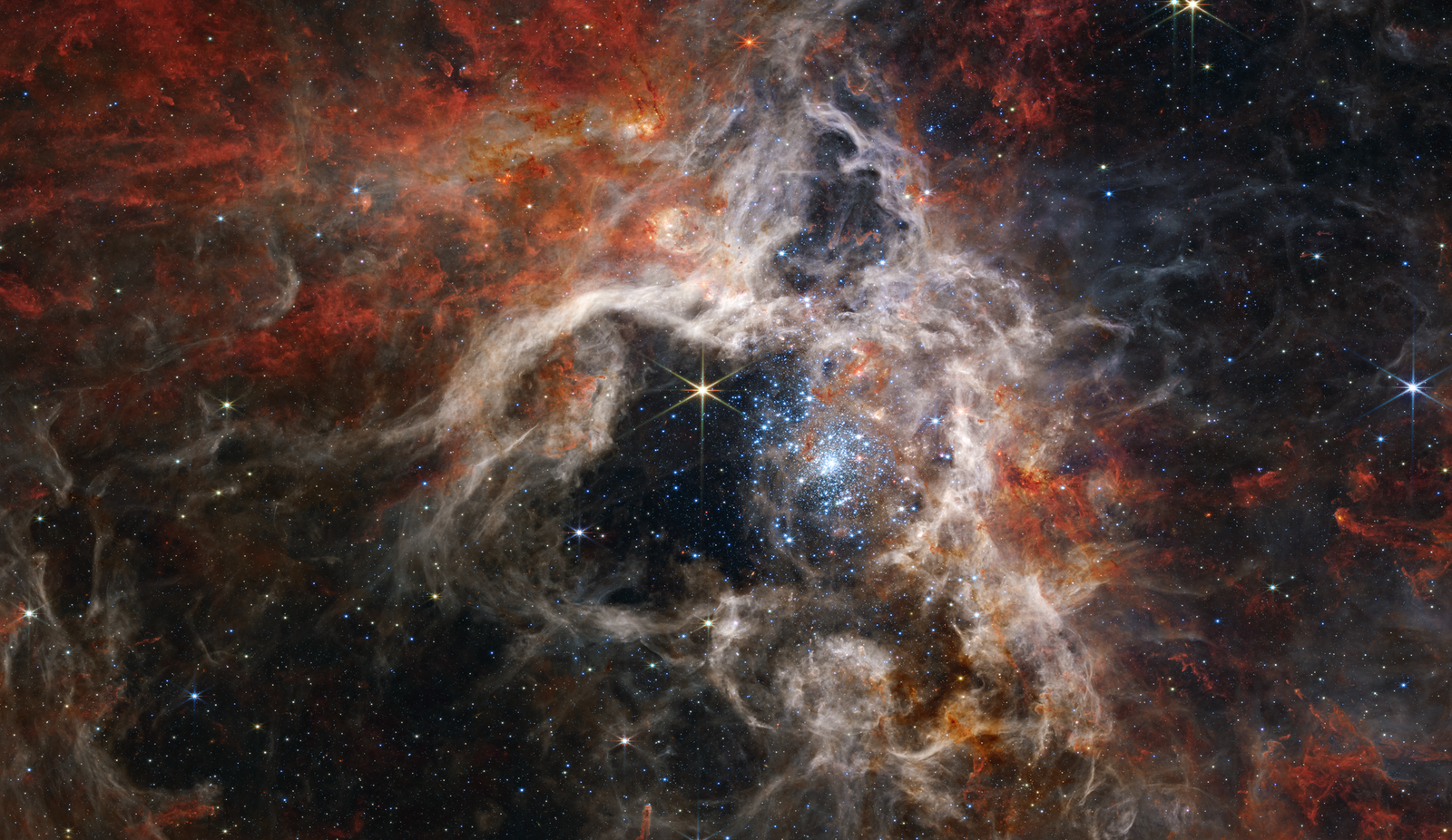
The Tarantula Nebula
The Tarantula Nebula is a vast, active star-forming region in a neighboring galaxy. JWST’s infrared observations reveal dense clouds, young stars, and cavities carved by stellar radiation. Studying this region gives astronomers a chance to examine vigorous star formation beyond our own Milky Way.
What Nebula Images Teach Us
JWST observations help researchers investigate how stars gather from clouds of gas and dust, how radiation changes those clouds, and how material from aging stars returns to space. That recycled material can later become part of new stars and planetary systems.
The images also show that nebulae are not static objects. They are changing environments, shaped by the stars within them and by nearby sources of energy. Bright ridges, dark lanes, and glowing bubbles can trace the movement and interaction of gas across enormous distances.
More Than a Beautiful Picture
A JWST nebula image is both a compelling view of the cosmos and a scientific tool. By combining infrared observations with other measurements, astronomers can study the temperature, composition, and motion of material in these clouds. Each new observation adds detail to our understanding of how stars live, die, and contribute to the next generation of cosmic structures.
Exploring Nebulae with the James Webb Space Telescope: FAQs and Discoveries
- What is a nebula, and how does the James Webb Space Telescope observe it?
- Why does JWST use infrared light to study nebulae?
- What are some of the most famous nebulae photographed by JWST?
- What did JWST discover in the Carina Nebula’s Cosmic Cliffs?
- How does JWST reveal star formation inside nebulae?
- Are JWST nebula images shown in their natural colors?
- What can JWST observations of nebulae teach us about the life cycle of stars?
- Where can I view JWST’s latest nebula images?
What is a nebula, and how does the James Webb Space Telescope observe it?
A nebula is a vast cloud of gas and dust in space, where stars may form or the remains of dying stars may spread outward. The James Webb Space Telescope observes nebulae mainly in infrared light, which can pass through some of the dust that blocks visible light. This lets JWST reveal hidden features, including young stars, warm gas, and intricate cloud structures. Its images use assigned colors to represent different infrared wavelengths, helping scientists study how nebulae form and change.
Why does JWST use infrared light to study nebulae?
JWST uses infrared light to study nebulae because it can pass through much of the dust that blocks visible light, revealing stars and structures hidden within these clouds. Infrared observations also help astronomers detect cool gas, dust, and young stars, providing clues about how stars form and how nebulae change over time.
What are some of the most famous nebulae photographed by JWST?
Some of the most famous nebulae photographed by the James Webb Space Telescope include the Carina Nebula, whose “Cosmic Cliffs” reveal active star formation; the Southern Ring Nebula, a glowing shell of gas shed by a dying star; the Tarantula Nebula, a vast stellar nursery; and the Pillars of Creation in the Eagle Nebula, where stars form within towering clouds of gas and dust. JWST’s infrared observations reveal details in these regions that are difficult to see in visible light.
What did JWST discover in the Carina Nebula’s Cosmic Cliffs?
JWST’s view of the Carina Nebula’s “Cosmic Cliffs” revealed previously obscured young stars and features of star formation within the dusty cloud. The infrared image also shows how intense radiation and stellar winds from nearby massive stars are eroding the gas, creating the cliff-like boundary and shaping the region where new stars are forming.
How does JWST reveal star formation inside nebulae?
JWST reveals star formation inside nebulae by observing infrared light, which can pass through much of the dust that hides young stars from visible-light telescopes. Its detailed images show newborn stars, jets of material, and warm gas and dust—features that help astronomers trace how stars form and reshape their surroundings. By studying these observations at different infrared wavelengths, researchers can learn about the stars’ environments and the stages of star formation.
Are JWST nebula images shown in their natural colors?
Not exactly. JWST observes nebulae mainly in infrared light, which human eyes can’t see, so its images are processed and infrared wavelengths are assigned visible colors. These colors help reveal features such as stars, gas, and dust; they’re scientifically meaningful, but they don’t show precisely what the nebula would look like to the naked eye.
What can JWST observations of nebulae teach us about the life cycle of stars?
JWST observations of nebulae help astronomers trace the stages of a star’s life, from the dusty clouds where young stars form to the glowing shells of gas shed by stars nearing the end of their lives. By observing infrared light that can pass through dust, JWST reveals newborn stars and the surrounding material, while detailed views of stellar winds and expelled gas show how aging stars return elements to space. These observations help researchers understand how stars form, change, and enrich the clouds that may eventually give rise to new stars and planetary systems.
Where can I view JWST’s latest nebula images?
You can view JWST’s latest nebula images on NASA’s official James Webb Space Telescope website, which regularly shares new discoveries, image releases, and mission updates. The European Space Agency (ESA) and Canadian Space Agency (CSA) also publish Webb images and related stories. For downloadable images and captions, visit their image galleries or explore the Space Telescope Science Institute’s Webb pages.