
JWST’s View of the Orion Nebula: A Stellar Nursery in Unprecedented Detail
The Orion Nebula is one of the closest and brightest regions where stars are forming. Located about 1,300 light-years from Earth in the constellation Orion, it has long been studied by astronomers using ground-based telescopes and space observatories. NASA’s James Webb Space Telescope (JWST) has brought the nebula into especially sharp view, revealing details hidden by cosmic dust and helping scientists investigate how stars and planetary systems begin.
Why the Orion Nebula Matters
The Orion Nebula, also known as Messier 42 or M42, is a vast cloud of gas and dust. Within it, gravity draws material together to form new stars. The nebula is relatively nearby, making it a valuable natural laboratory: astronomers can study individual young stars and their surroundings in a region where star formation is happening now.
Many of the newborn stars are grouped in the Trapezium Cluster, near the nebula’s center. These hot, massive stars produce intense ultraviolet light. That radiation illuminates the surrounding gas, creating the nebula’s glowing appearance, while also shaping the clouds around it.
How Webb Sees Through the Dust
JWST observes the universe mainly in infrared light. Unlike visible light, infrared can pass through much of the dust that obscures young stars. Webb’s instruments can therefore reveal objects and structures that are difficult or impossible to see clearly in visible-light images.
Webb’s Near-Infrared Camera (NIRCam) captures fine details in near-infrared wavelengths, while its Mid-Infrared Instrument (MIRI) detects longer wavelengths that are useful for studying cooler dust and gas. Together, these observations help astronomers examine both young stars and the material surrounding them.
Young Stars, Disks, and Planetary Beginnings
One of the most important features Webb can study is the protoplanetary disk: a rotating disk of gas and dust around a young star. Planets can form within these disks as dust particles collide and gradually build larger bodies. By observing disks in Orion, astronomers can explore how their shapes and contents change under different conditions.
The environment is not always gentle. Ultraviolet radiation from massive stars can heat and erode nearby disks, causing gas and dust to stream away into space. Webb’s detailed infrared observations help scientists examine this process and better understand how a star’s surroundings may affect the time available for planets to form.
Revealing the Orion Bar
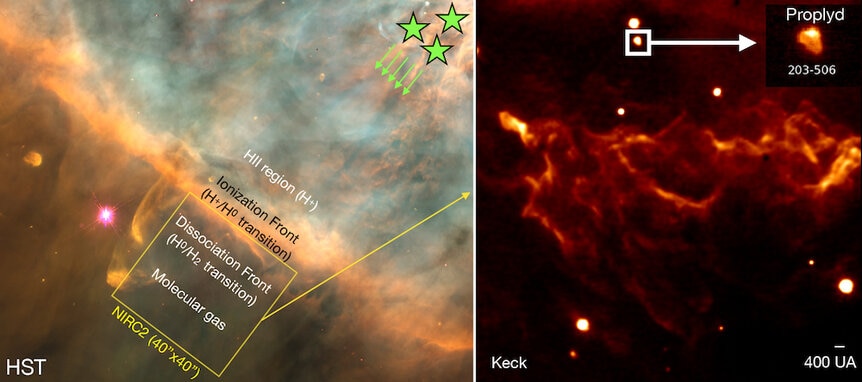
Webb has also provided a close look at the Orion Bar, a bright boundary where radiation from the Trapezium stars meets a dense cloud of molecular gas. This kind of region is known as a photodissociation region, or PDR. Radiation changes the chemistry and temperature of the gas as it penetrates the cloud, creating distinct layers of material.
By mapping these layers, researchers can investigate how interstellar molecules form and how energy moves through star-forming clouds. The observations offer a detailed look at the complex relationship between massive stars and the clouds from which they were born.
What Webb’s Observations Can—and Can’t—Tell Us
Webb images are not simply photographs in the everyday sense. The telescope collects infrared light, which scientists process and often represent with visible colors so that different wavelengths and features can be compared. The resulting images are both scientifically informative and visually striking.
These observations provide snapshots of a region in which stars are forming, but they do not show the entire process from beginning to end. Astronomers combine Webb’s data with observations from other telescopes and computer models to understand how stars and planetary systems evolve over time.
A New Perspective on a Familiar Nebula
The Orion Nebula has been a favorite target for generations of skywatchers, but JWST has added a new level of detail to its study. By looking through dust, resolving small structures, and tracing infrared signatures from gas and young stars, Webb is helping researchers investigate the conditions in which planetary systems take shape.
Each new observation adds to the picture of Orion as a dynamic stellar nursery—one where stars are born, disks are sculpted, and the ingredients for future planets are continually rearranged.
Exploring the Orion Nebula: Key Discoveries and Insights from the James Webb Space Telescope
- What has the James Webb Space Telescope revealed about the Orion Nebula?
- How far away is the Orion Nebula?
- Why is the Orion Nebula important to astronomers?
- How does JWST see through the dust in the Orion Nebula?
- What is the Orion Bar, and what has Webb discovered there?
- What are protoplanetary disks, and how does JWST study them in Orion?
- How does radiation from the Trapezium stars affect nearby young stars and disks?
- Which JWST instruments have been used to observe the Orion Nebula?
- Are JWST images of the Orion Nebula shown in true color?
What has the James Webb Space Telescope revealed about the Orion Nebula?
The James Webb Space Telescope has revealed the Orion Nebula in remarkable infrared detail, peering through dust to show young stars, planet-forming disks, and complex layers of gas that were difficult to observe before. Its observations of regions such as the Orion Bar help scientists study how intense radiation from massive stars shapes nearby clouds and affects the environments where planets may form. Together, these findings offer a clearer picture of the nebula as an active stellar nursery.
How far away is the Orion Nebula?
The Orion Nebula is about 1,300 light-years from Earth, in the constellation Orion. That means the light captured by telescopes such as the James Webb Space Telescope began its journey roughly 1,300 years ago. Because it is relatively close to our solar system, the nebula is one of the best places for astronomers to study how stars and planetary systems form.
Why is the Orion Nebula important to astronomers?
The Orion Nebula is important to astronomers because it is one of the closest and most active regions of star formation, giving researchers a nearby view of how stars and planetary systems develop. By studying its young stars, dusty disks, and surrounding gas, astronomers can investigate how planets begin to form and how intense radiation from massive stars shapes their environments. Observations from telescopes such as the James Webb Space Telescope reveal details hidden by dust, helping scientists better understand the processes that may also have shaped our own solar system.
How does JWST see through the dust in the Orion Nebula?
JWST can see through much of the dust in the Orion Nebula because it observes infrared light, which passes through dust more easily than visible light. Its sensitive instruments detect this infrared glow from young stars, warm dust, and gas hidden within the clouds. Webb’s images therefore reveal structures that visible-light telescopes may miss, though dense dust can still block some light.
What is the Orion Bar, and what has Webb discovered there?
The Orion Bar is a bright, shelf-like region in the Orion Nebula where ultraviolet radiation from hot, massive stars meets a dense molecular cloud, creating a layered zone of heated gas and dust. Webb’s infrared observations have revealed this boundary in remarkable detail, showing a complex network of filaments and small structures and tracing how the gas changes from ionized to molecular. The data also help astronomers study the chemistry of the region, including molecules in the cloud, and understand how radiation from massive stars reshapes the material from which new stars and planets may form.
What are protoplanetary disks, and how does JWST study them in Orion?
Protoplanetary disks are rotating rings of gas and dust around young stars—the raw material from which planets can form. In the Orion Nebula, JWST uses infrared light to peer through dusty clouds and observe these disks in detail. Its instruments can reveal their shapes, temperatures, and chemical signatures, as well as show how radiation from nearby massive stars heats and erodes them. These observations help astronomers understand how planetary systems begin and how a star’s environment can influence planet formation.
How does radiation from the Trapezium stars affect nearby young stars and disks?
The Trapezium stars emit intense ultraviolet radiation that heats gas and dust in the surrounding Orion Nebula. For nearby young stars, this can gradually strip material from their protoplanetary disks in a process called photoevaporation, shortening the time available for planets to form. The radiation also shapes the surrounding gas, creating bright, sculpted features around some disks. Its effects vary with distance and exposure: disks farther from the massive stars are generally less affected, while closer disks may lose material more quickly.
Which JWST instruments have been used to observe the Orion Nebula?
JWST has used several instruments to study the Orion Nebula, especially NIRCam, which captures detailed near-infrared images, and MIRI, which observes longer infrared wavelengths to reveal cooler dust and gas. NIRSpec has also been used to analyze the light from selected regions, helping astronomers identify the chemical makeup and physical conditions of the nebula. The instruments used depend on the specific observing program and scientific question.
Are JWST images of the Orion Nebula shown in true color?
JWST images of the Orion Nebula are not usually shown in “true color” as the human eye would see it. Webb detects infrared light, which is beyond the range of human vision, so scientists assign visible colors to different infrared wavelengths to make the data viewable. The colors help distinguish features such as gas, dust, and young stars, but they are a scientific representation rather than a direct-color photograph.