
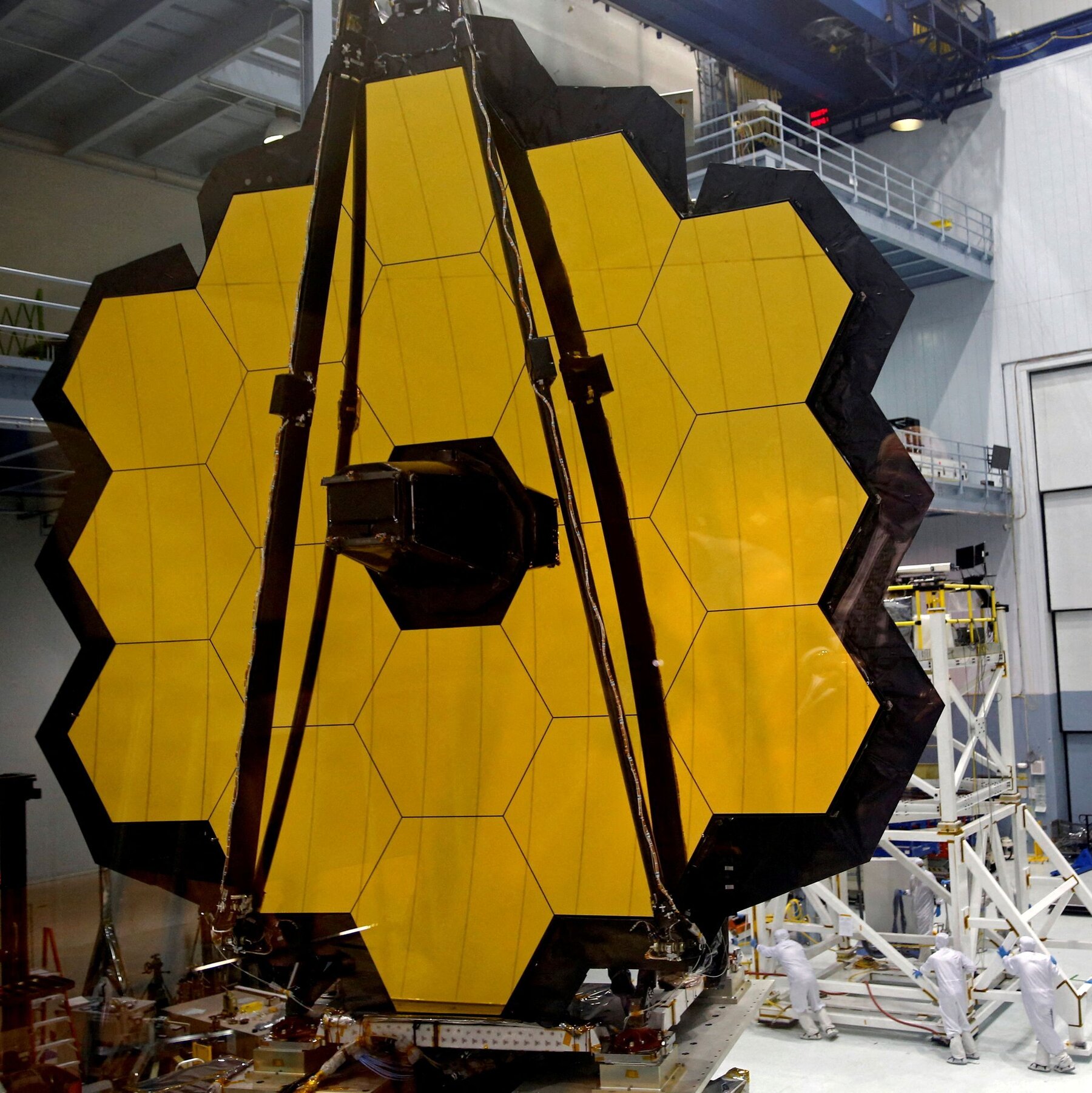
The James Webb Space Telescope: Unveiling the Mysteries of the Universe
The James Webb Space Telescope (JWST) is a revolutionary observatory that promises to transform our understanding of the cosmos. Named after James E. Webb, a former NASA administrator, this next-generation telescope is set to be the most powerful space telescope ever built.
Unprecedented Capabilities
Planned to launch in 2021, the JWST will operate in a position about 1.5 million kilometers (0.93 million miles) away from Earth, at the second Lagrange point (L2). This vantage point offers a stable environment with minimal interference from Earth’s atmosphere and heat.
Equipped with a large primary mirror measuring 6.5 meters (21 feet) in diameter, the JWST will have unprecedented sensitivity and resolution, enabling it to observe some of the earliest galaxies that formed in the universe. Its suite of scientific instruments includes infrared cameras and spectrographs that will allow scientists to peer through cosmic dust clouds and study distant objects with remarkable clarity.
Scientific Objectives
The JWST aims to address fundamental questions about our universe, such as the formation of galaxies, stars, and planetary systems. By studying exoplanets and their atmospheres, it will help scientists determine if these distant worlds could potentially support life.
Additionally, the telescope will investigate the nature of dark matter and dark energy, two mysterious components that make up most of the universe’s mass-energy content. By observing phenomena such as gravitational lensing and cosmic microwave background radiation, researchers hope to gain insights into these enigmatic forces shaping our cosmos.
Collaborative Effort
The development of the JWST has been a collaborative effort involving NASA, the European Space Agency (ESA), and the Canadian Space Agency (CSA). With contributions from scientists and engineers around the world, this ambitious project represents a testament to international cooperation in advancing our knowledge of space.
As we eagerly await the launch of this groundbreaking telescope, anticipation grows for the discoveries it will unveil and the mysteries it will unravel. The James Webb Space Telescope stands poised to revolutionize our understanding of the universe and inspire future generations to explore beyond our cosmic horizons.
Exploring the Cosmos: 7 Key Questions About the James Webb Space Telescope
- What did the James Webb telescope discover in 2025?
- Where is the James Webb Space Telescope right now?
- How far back can we see with the James Webb telescope?
- Has the James Webb telescope seen anything?
- What is the most powerful telescope in the world?
- What is so special about the James Webb telescope?
- Where is the James Webb telescope right now?
What did the James Webb telescope discover in 2025?
The question regarding what the James Webb telescope discovered in 2025 is a speculative inquiry as the James Webb Space Telescope (JWST) is scheduled to launch in 2021. As of now, any discoveries made by the JWST in 2025 are purely hypothetical. However, given the advanced capabilities of the JWST, scientists and researchers anticipate groundbreaking findings that could potentially reshape our understanding of the universe, from unraveling mysteries about early galaxy formation to studying exoplanets and probing dark matter and dark energy. The JWST’s mission is poised to unveil a wealth of new knowledge and inspire awe and wonder about the cosmos.
Where is the James Webb Space Telescope right now?
The James Webb Space Telescope is currently undergoing final preparations for its highly anticipated launch. As of now, the telescope is located on Earth, where it is being meticulously tested and readied for its journey into space. Once all pre-launch activities are completed, the James Webb Space Telescope will be transported to its designated launch site and deployed into orbit around the second Lagrange point (L2), approximately 1.5 million kilometers away from Earth. This strategic location will provide the telescope with a stable environment conducive to its mission of exploring the mysteries of the universe.
How far back can we see with the James Webb telescope?
The James Webb Space Telescope’s advanced capabilities allow us to gaze further back in time than ever before. With its powerful infrared instruments, the JWST is poised to peer back to the early universe, capturing light from galaxies that formed just a few hundred million years after the Big Bang. By studying these ancient celestial objects, scientists hope to unlock secrets about the origins of our cosmos and gain insights into the processes that shaped the universe into what we see today. The JWST’s ability to see back in time will provide a window into the distant past of our universe, offering a glimpse of its evolution over billions of years.
Has the James Webb telescope seen anything?
The James Webb Space Telescope, scheduled to launch in 2021, has not yet been deployed to its operational position at the second Lagrange point (L2) about 1.5 million kilometers away from Earth. As of now, the telescope has not captured any images or data from space. Once the JWST is successfully launched and calibrated, it will begin its groundbreaking observations, offering unprecedented views of the cosmos and providing valuable insights into the mysteries of the universe.
What is the most powerful telescope in the world?
The most powerful telescope in the world is the James Webb Space Telescope (JWST). Scheduled to launch in 2021, the JWST is set to surpass its predecessors in terms of sensitivity, resolution, and observational capabilities. With its cutting-edge technology and state-of-the-art instruments, the JWST will revolutionize our understanding of the universe by enabling unprecedented observations of distant galaxies, exoplanets, and cosmic phenomena. Positioned at the second Lagrange point (L2) away from Earth, this next-generation space telescope will provide unparalleled insights into the mysteries of the cosmos, making it a truly groundbreaking scientific instrument.
What is so special about the James Webb telescope?
The James Webb Space Telescope stands out for its groundbreaking capabilities that promise to revolutionize our exploration of the cosmos. What makes the JWST truly special is its advanced technology, including a large 6.5-meter primary mirror and infrared instruments that will enable it to observe the universe with unprecedented clarity. Positioned at the second Lagrange point (L2), away from Earth’s interference, this next-generation telescope will allow scientists to study some of the earliest galaxies, exoplanets, and cosmic phenomena in ways never before possible. Its ability to peer through cosmic dust clouds and delve into the mysteries of dark matter and dark energy sets the James Webb Space Telescope apart as a game-changer in our quest to understand the universe.
Where is the James Webb telescope right now?
The James Webb Space Telescope is currently undergoing final preparations for its highly anticipated launch. As of now, the telescope is located at the Guiana Space Centre in Kourou, French Guiana, where it is being readied for its journey into space. Once launched, the James Webb Telescope will travel to its designated position at the second Lagrange point (L2), approximately 1.5 million kilometers away from Earth. This strategic location will provide the telescope with a stable vantage point to carry out its groundbreaking observations of the cosmos.